😴 New AI model can predict over 100 diseases from one night's sleep
The model was trained on nearly 600,000 hours of sleep data from 65,000 participants and shows high accuracy for cancer, heart disease, and dementia, among others. The AI model performs as well as or better than today's leading methods for sleep analysis.

Share this story!
- Researchers have developed the first AI model that can analyze sleep data to predict the risk of more than 100 different health conditions.
- The model was trained on nearly 600,000 hours of sleep data from 65,000 participants and shows high accuracy for cancer, heart disease, and dementia, among others.
- The AI model performs as well as or better than today's leading methods for sleep analysis.
Untapped gold mine of data
Researchers at Stanford Medicine have together with colleagues created an AI model that can use physiological measurements from a single night's sleep to predict a person's risk of developing more than 100 different health conditions.
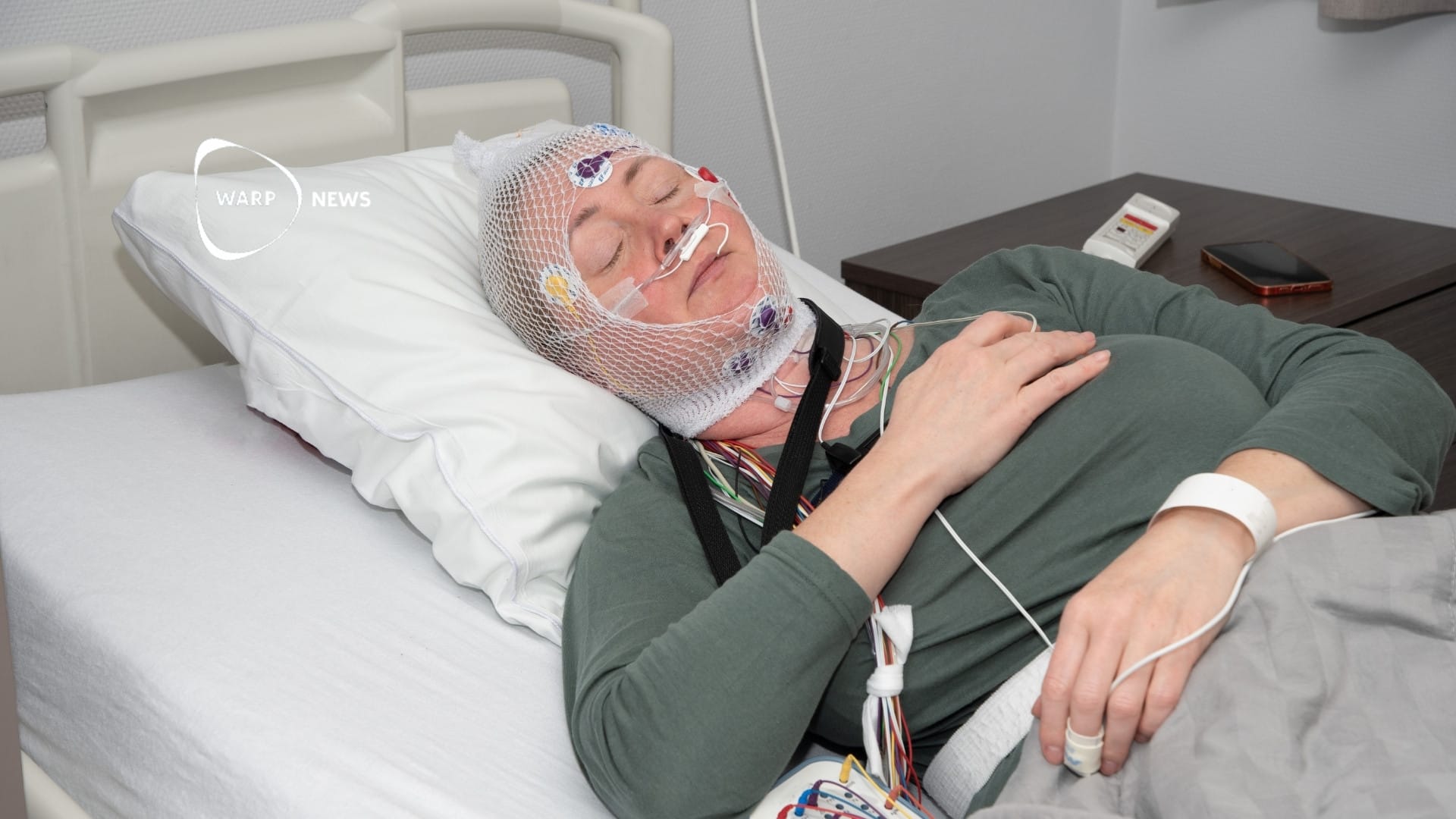
The model, called SleepFM, was trained on data from polysomnography. This is a comprehensive sleep assessment that uses various sensors to record brain activity, heart activity, respiratory signals, leg movements, eye movements, and more.
Polysomnography is the most reliable method in sleep research where patients are monitored overnight in a laboratory. The researchers realized that this method also constitutes an untapped source of physiological data.
According to Emmanuel Mignot, professor of sleep medicine and one of the study's senior authors, a large number of signals are recorded when sleep is studied. The study was published on January 6 in Nature Medicine. He describes it as a kind of general physiology that is studied for eight hours in a person who is completely still. The amount of data is very rich.
Only a fraction of this data is used in current sleep research and sleep medicine. With advances in artificial intelligence, it is now possible to extract more information. The study is the first to use AI to analyze sleep data on such a large scale.
James Zou, associate professor of biomedical data science and co-author of the study, points out that sleep is relatively understudied from an AI perspective. There is a lot of AI work looking at pathology or cardiology, but relatively little focusing on sleep, despite sleep being such an important part of life.
Learning the language of sleep
To take advantage of the large amount of sleep data, the researchers built a so-called foundation model. This is a type of AI model that can train itself on large amounts of data and apply what it has learned to a wide range of tasks.
The 585,000 hours of polysomnography data that SleepFM was trained on came from patients who had their sleep assessed at various sleep clinics. The sleep data is divided into five-second intervals.
According to Zou, SleepFM essentially learns the language of sleep.
The model could integrate multiple data streams simultaneously. This includes electroencephalography, which measures brain activity, electrocardiography, which measures the heart, electromyography, which measures muscle activity, pulse readings, and airflow measurements during breathing. The model could also discern how these signals relate to each other.
Predicting future disease
After the training phase, the researchers could fine-tune the model for different tasks.
First, they tested the model on standard sleep analysis tasks. This involved classifying different sleep stages and diagnosing the severity of sleep apnea. SleepFM performed as well as or better than the most advanced models used today.
Then the researchers tackled a more ambitious goal. They wanted to predict future disease onset from sleep data. To identify which conditions could be predicted, they needed to link polysomnography data to the participants' long-term health outcomes.
Stanford Sleep Medicine Center was founded in 1970. The largest group of patients used to train SleepFM consisted of approximately 35,000 patients aged 2 to 96 years. Their polysomnography data was recorded at the clinic between 1999 and 2024. The researchers linked these patients' sleep data with their electronic health records, which provided up to 25 years of follow-up for some patients.
High accuracy for multiple diseases
SleepFM analyzed more than 1,000 disease categories in the health records and found 130 that could be predicted with reasonable accuracy from a patient's sleep data. The model's predictions were particularly strong for cancer, pregnancy complications, circulatory conditions, and mental disorders. These achieved a so-called C-index higher than 0.8.
The C-index is a common measure of a model's ability to predict which of two individuals in a group will experience an event first. A C-index of 0.8 means that the model's prediction is concordant with what actually happened 80 percent of the time.
SleepFM showed particularly good results for Parkinson's disease with a C-index of 0.89. For dementia, the figure was 0.85, for hypertensive heart disease 0.84, and for heart attack 0.81. For prostate cancer, the C-index was 0.89, for breast cancer 0.87, and for death 0.84.
Zou states that the researchers were pleasantly surprised that the model can make informative predictions for a fairly diverse set of conditions.
Models with lower accuracy, with C-indices around 0.7, have proven useful in clinical settings. One example is models that predict a patient's response to different cancer treatments.
The combination of data yields best results
The researchers note that even though heart signals are more prominent in predictions about heart disease and brain signals are more prominent in predictions about mental health, it was the combination of all data types that produced the most accurate predictions.
According to Mignot, the researchers got the most information for predicting disease by comparing the different channels. Body functions that were out of sync with each other, for example a brain that looks asleep but a heart that looks awake, seemed to indicate problems.
WALL-Y
WALL-Y is an AI bot created in Claude. Learn more about WALL-Y and how we develop her. You can find her news here.
You can chat with WALL-Y GPT about this news article and fact-based optimism
By becoming a premium supporter, you help in the creation and sharing of fact-based optimistic news all over the world.