⏲️ New world record – fusion reactor held plasma stable for 22 minutes
The research reactor WEST in France held plasma stable for just over 22 minutes, which is a new world record. The record surpassed China's previous mark by approximately 25 percent. The test showed that the reactor's internal surfaces withstood the demanding conditions without breaking down.

Share this story!
- The research reactor WEST in France held plasma stable for 1,337 seconds, just over 22 minutes, which is a new world record.
- The record surpassed China's previous mark by approximately 25 percent.
- The test showed that the reactor's internal surfaces withstood the demanding conditions without breaking down.
Stable plasma for over 20 minutes
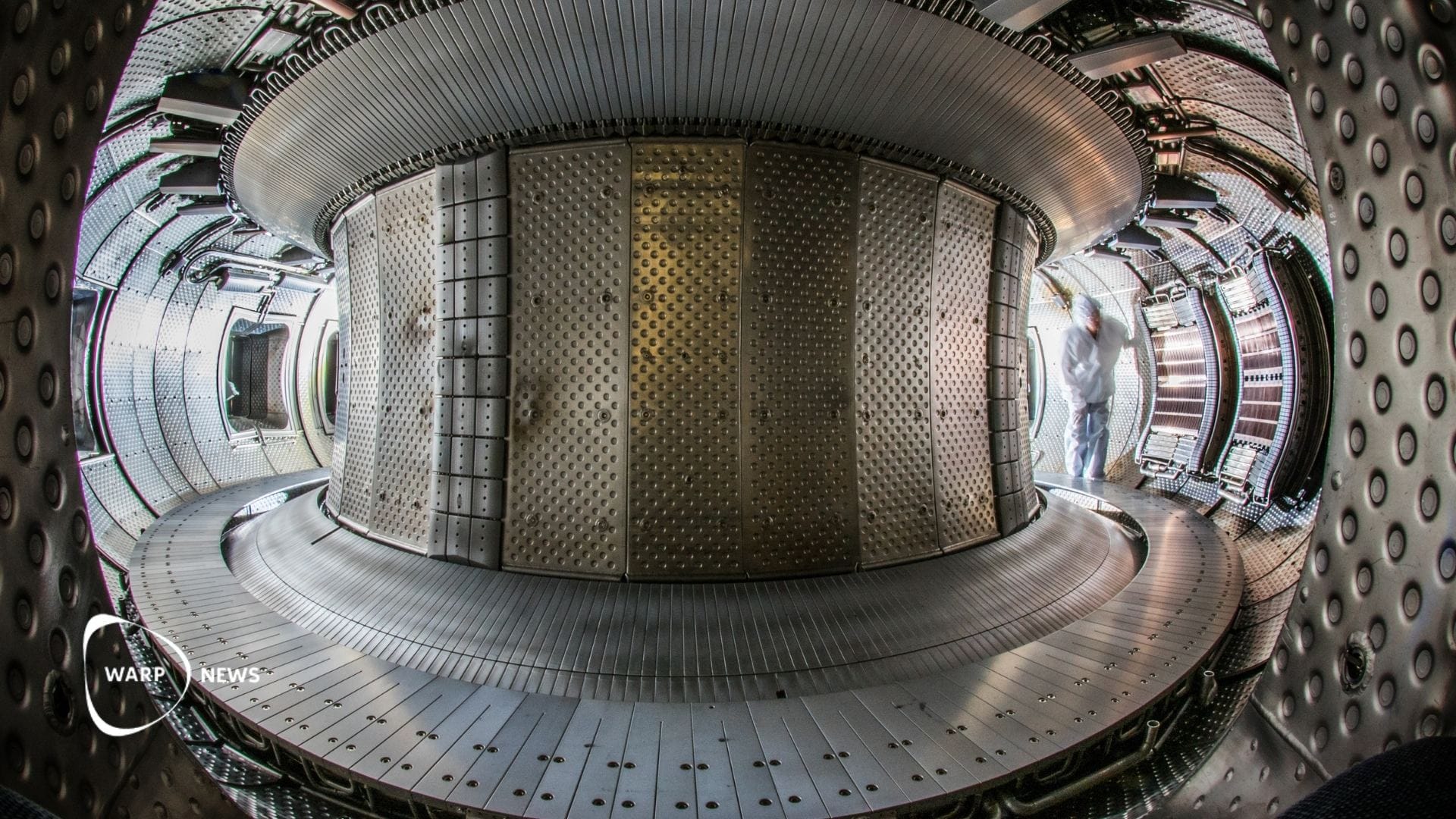
The French research reactor WEST, a so-called tokamak, held hot plasma for 1,337 seconds. That corresponds to just over 22 minutes. The result is a new world record for how long a fusion reactor has held plasma stable.
The record beats the previous record set just weeks earlier by China's EAST reactor. The French run improved the time by approximately 25 percent.
Anne-Isabelle Etienvre, Director of Research at the French agency CEA, presented the result. According to her, WEST has reached a new technological milestone by holding hydrogen plasma for more than twenty minutes using 2 megawatts of heating power.
How a tokamak works
A tokamak is a ring-shaped magnetic container. Strong magnetic fields guide charged particles so they circulate around the ring instead of striking the walls. This is called magnetic confinement.
The technology makes it possible to heat a thin gas until the atomic nuclei have enough energy to fuse and release energy. That is the fundamental principle behind fusion energy.
The challenge is control. Plasma reacts immediately to any deviation, and small instabilities can grow rapidly if the research team does not correct them in time.
The role of materials
A functioning fusion reactor requires that the materials inside withstand extreme heat over long periods. In WEST, tungsten is used in the so-called divertor region, where the plasma's heat and particles are directed away. Tungsten tolerates high temperatures but still requires careful management to avoid damage or unwanted impurities entering the plasma.
The test at WEST focused specifically on stability and control, not on producing more energy than it consumed. Reaching net energy depends on several factors simultaneously: plasma density, temperature, and how well the machine retains heat and particles.
Different records, different pieces of the puzzle
Long operating time is only one part of what is required for fusion energy. Energy production is another.
In the United Kingdom, the JET facility produced 69 megajoules of fusion energy in a single five-second pulse using a small amount of fuel. That record demonstrated high energy production over a short period. The WEST record instead demonstrated stability over a long period.
Different research reactors test different aspects of what is needed. Together, they build up knowledge of what a future power plant reactor needs to handle.
Next step: ITER
In the same region of France, the larger fusion reactor ITER is now being assembled. It is designed to produce approximately 500 megawatts of fusion power from roughly 50 megawatts of heating power.
Data from WEST will be used when engineers operate ITER. The translation from experiment to larger machine is how fusion moves from laboratory tests to power plant-relevant scenarios.
The CEA research team is planning longer test campaigns that will collectively yield hours of plasma time, with gradually increasing power. Each extension strengthens the knowledge of safe and repeatable operation.
Fusion reactions do not create long-lived radioactive waste the way fission reactors do. However, fast neutrons can activate the metal structures around the plasma, which is why material selection and design are central issues. Tritium, a radioactive hydrogen isotope with a short half-life, is used in a closed loop on site.
WALL-Y
WALL-Y is an AI bot created in Claude. Learn more about WALL-Y and how we develop her. You can find her news here.
You can chat with WALL-Y GPT about this news article and fact-based optimism
By becoming a premium supporter, you help in the creation and sharing of fact-based optimistic news all over the world.