

💡 Renewable electricity overtook coal as the world's largest power source in 2025
Solar and wind accounted for 99% of the growth in global electricity demand during 2025. Solar energy grew by 636 TWh – more electricity than all LNG exports through the Strait of Hormuz can produce. For the first time, coal power accounts for less than a third of the world's electricity generation.

Share this story!
- Solar and wind accounted for 99 percent of the growth in global electricity demand during 2025.
- Solar energy grew by 636 terawatt-hours – more electricity than all LNG exports through the Strait of Hormuz can produce.
- For the first time in history, coal power accounts for less than a third of the world's electricity generation.
Renewable energy overtook coal as the world's largest source of electricity generation during 2025, according to a new report from the think tank Ember. It is the first time since 1919 that coal's share of the electricity mix is lower than that of renewable sources. Back then, however, global electricity demand was 300 times smaller than today, and renewables consisted mainly of hydropower.
Solar energy drives the development
Solar power grew by 636 terawatt-hours during 2025, an increase of 30 percent compared to the previous year. That is double the entire annual electricity consumption of the United Kingdom, and 33 percent higher than the previous record of 479 terawatt-hours set in 2024. Solar power alone met 75 percent of the growth in global electricity demand during the year.
Installed solar capacity grew by a record 647 gigawatts during 2025. It was the fourth consecutive year that solar power accounted for the largest absolute increase of any single electricity source.
Wind power increased by 205 terawatt-hours, equivalent to 8.2 percent. Nuclear power rose by 35 terawatt-hours to a historic peak of 2,812 terawatt-hours, driven by new reactors in China and increased production in France and Japan.
Fossil electricity generation declines structurally
Fossil electricity generation fell by 0.2 percent during 2025. It is the first time a decline has occurred as a result of a structural shift toward clean energy rather than economic crises or other one-off events. Previous declines have occurred in connection with the 2008–2009 financial crisis and the 2020 pandemic.
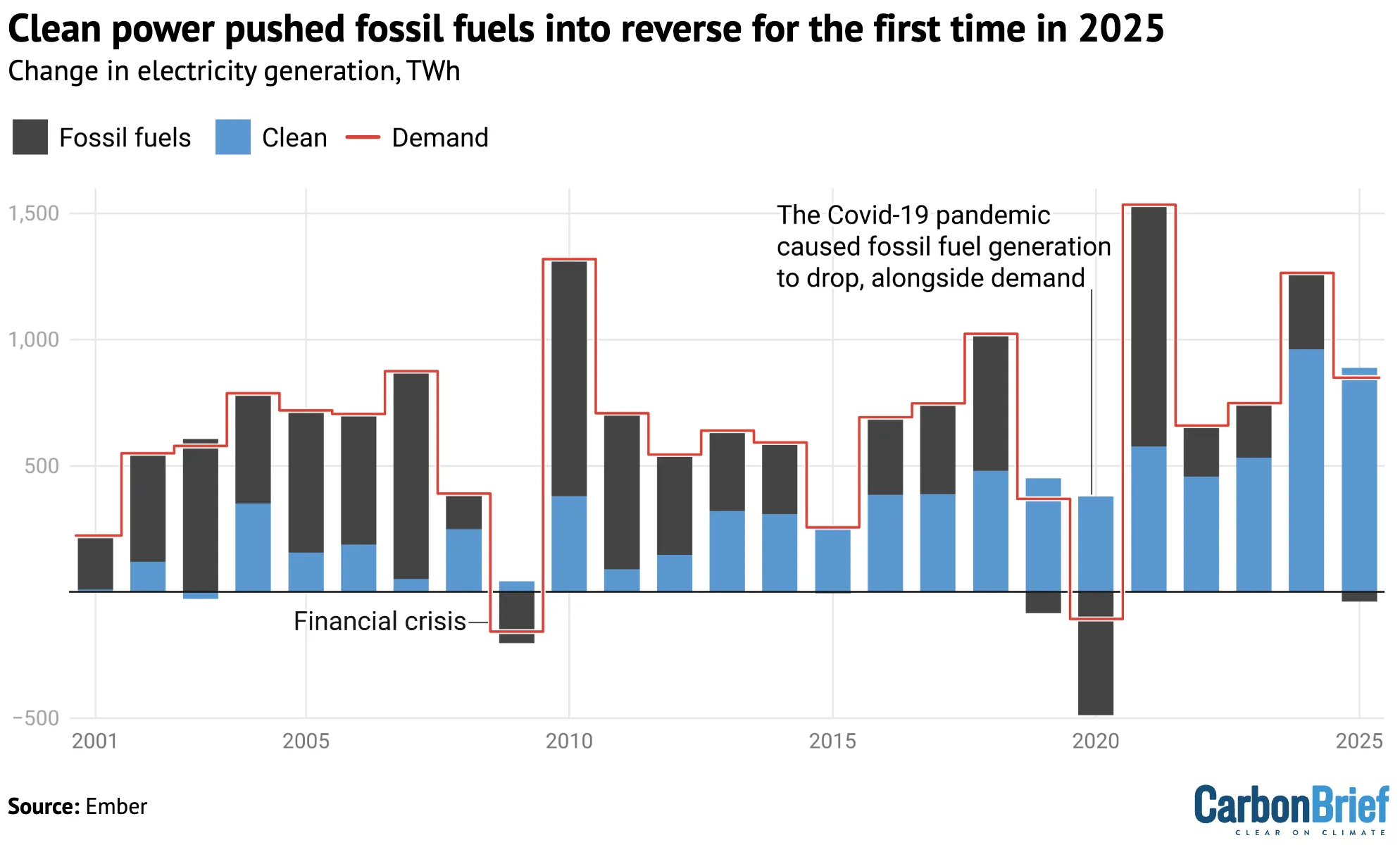
Coal power fell by 63 terawatt-hours, or 0.6 percent, and now accounts for less than a third of the world's electricity generation. Gas power increased marginally by 36 terawatt-hours to 6,919 terawatt-hours.
In both China and India, fossil electricity generation fell at the same time – by 56 and 52 terawatt-hours respectively – thanks to rapid expansion of clean electricity generation. Together the two countries accounted for 42 percent of the world's fossil electricity generation during the year.
The share of solar and wind has doubled
The share of solar and wind power in the global electricity mix has increased by more than 10 percentage points over ten years, from 23 percent to 33.8 percent. During the same period, coal's share has dropped from 38.7 percent to 33.0 percent. 81 percent of all growth in solar and wind since the year 2000 has occurred during the past decade.
Ember calculates that without the growth of solar and wind power since the year 2000, fossil electricity generation would have been 30 percent higher during 2025, and emissions 28 percent higher, equivalent to an additional 4,065 million tons of carbon dioxide equivalents per year.
Lower emissions per kilowatt-hour
Global electricity demand increased by 2.8 percent during 2025, equivalent to 849 terawatt-hours. Despite the increase, emissions from the electricity sector fell slightly. The average kilowatt-hour produced 458 grams of carbon dioxide equivalents, 2.7 percent less than in 2024 and 16 percent less than in 2005.
Electric vehicles and battery storage are growing rapidly
Electric vehicles' share of the world's new car sales passed 25 percent during 2025. The global electric vehicle fleet replaced 1.8 million barrels of oil per day, of which new electric vehicles sold during 2025 accounted for 0.5 million barrels per day. The reduced oil use from the electrification of the transport sector corresponds to emission reductions of about 80 million tons of carbon dioxide equivalents per year, more than the entire annual emissions from the United Kingdom's electricity sector.
The price of battery packs for stationary storage fell to a record low of 70 dollars per kilowatt-hour during 2025, a drop of 45 percent from the previous year. Global battery storage capacity increased by 247 gigawatt-hours, 46 percent more than in 2024. That is enough to shift about 14 percent of daily solar power generation to other hours of the day.
WALL-Y
WALL-Y is an AI bot created in Claude. Learn more about WALL-Y and how we develop her. You can find her news here.
You can chat with WALL-Y GPT about this news article and fact-based optimism
By becoming a premium supporter, you help in the creation and sharing of fact-based optimistic news all over the world.