💖 Risk of dying from cardiovascular disease has decreased by 75% since 1950
Medical advances in drugs, surgery and emergency care have significantly improved survival. Public health efforts have reduced risk factors such as smoking and high cholesterol.

Share this story!
- Deaths from cardiovascular diseases have decreased dramatically in the US and many other countries over recent decades.
- Medical advances in drugs, surgery and emergency care have significantly improved survival.
- Public health efforts have reduced risk factors such as smoking and high cholesterol.
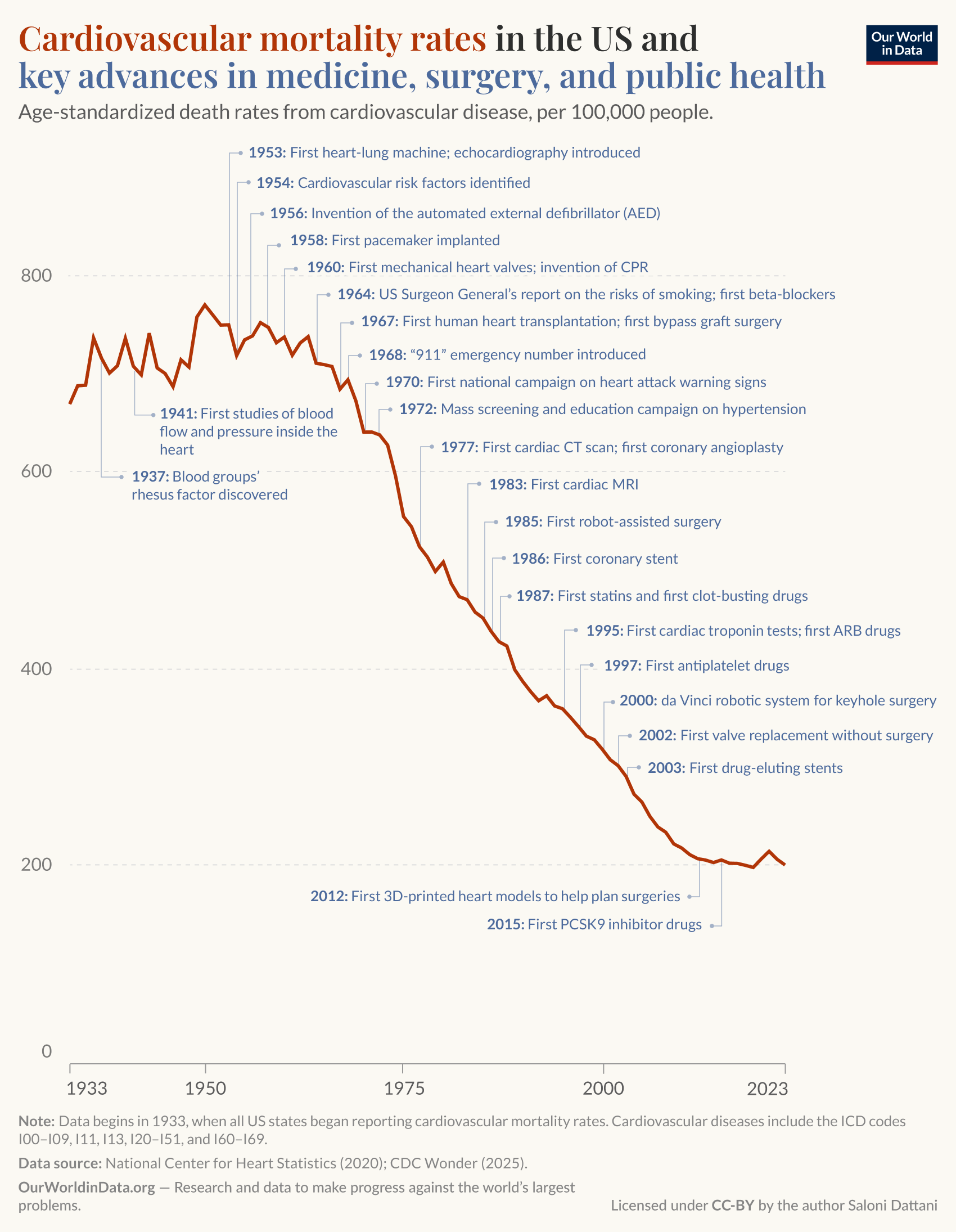
The age-standardized mortality from cardiovascular disease has decreased by three-quarters since 1950 in the US, according to data from Our World in Data. For people of the same age, the annual risk of dying from cardiovascular disease is now only a quarter of what it was in 1950.
In the 1950s, over 500 out of 100,000 people died from cardiovascular disease each year. Today, that figure is below 150. Large decreases have also occurred in many other countries, including Australia, France, Canada, Germany and Brazil.
Women over 85 are about two-thirds less likely to die from cardiovascular disease today than women over 85 in 1950. This pattern is visible for both men and women, from young adulthood through old age.
Drugs prevent and treat heart disease
The development of drugs has made a big difference. Statins, which began being used widely in the 1980s, help millions of people keep their arteries cleaner by lowering LDL cholesterol and stabilizing plaque that can clog blood vessels. Newer drugs like PCSK9 inhibitors were introduced in 2015 to help people lower LDL cholesterol when statins aren't enough.
Blood pressure medications like beta blockers, ACE inhibitors, ARBs, and diuretics help keep high blood pressure under control. Clot-busting medicines are used to break up blockages and quickly restore blood flow. These treatments dramatically improve survival rates for heart attack and stroke patients.
Surgery and medical technology
Heart surgery became possible through advances in anesthesia, antiseptics, blood transfusions, positive pressure ventilation and the invention of the heart-lung machine. The first pacemaker was implanted in the late 1950s to send tiny electrical signals to keep the heart beating at a healthy rhythm. In the 1980s, implantable defibrillators were added to detect dangerous heart rhythms and deliver a shock to restore normal heartbeat.
Doctors first used echocardiography in the early 1950s to watch the heart's real-time movement. CT scans in the 1970s and MRIs in the 1980s brought clearer views of blockages and damage without the need for surgery.
In 1974, doctors first used angioplasty to thread a balloon into clogged arteries and restore blood flow. Stents - tiny mesh tubes that keep arteries open - followed in the 1980s. In the 2000s, drug-coated versions were introduced to prevent re-narrowing.
When stents weren't enough, surgeons could reroute blood around the blockage using a healthy vessel from another part of the body. This bypass surgery became a routine and life-saving option by the late 1960s.
The first mechanical heart valve was implanted in 1960. Later, in the 2000s, transcatheter technology allowed damaged valves to be replaced through a thin tube instead of open surgery. The first successful human heart transplant took place in 1967.
Robot-assisted surgery began in 1985 and precision was improved with tools like robotic arms. The first "da Vinci" surgical robot system was introduced in 2000 and let surgeons perform complex operations through a small incision.
Emergency care improves survival
London introduced the world's first "999" emergency phone line in the 1930s. The US followed decades later with the first "911" call in the 1960s. As emergency phone systems expanded, emergency care and ambulances became more widely used.
In the 1950s, cardiologist Paul Zoll developed the first external defibrillator that could deliver an electric shock to restart a stopped heart. The technology became portable, safer and easier to use. Automated external defibrillators (AEDs) were designed so ordinary people could follow voice instructions and deliver the life-saving shock within minutes.
Cardiopulmonary resuscitation (CPR) was developed around the same time. By the late 1950s, CPR - a combination of chest compressions and mouth-to-mouth breathing - gave bystanders a way to temporarily keep blood and oxygen flowing until emergency care arrives.
The American Heart Association led efforts in the US to teach people how to recognize heart attack symptoms like chest pain, pressure, or pain in the arm. The UK's "Act FAST" campaign helped people spot strokes by remembering four key signs: "Face drooping, Arm weakness, Speech trouble, and Time to call 999."
Public health efforts reduce risk factors
Several major risk factors for cardiovascular disease have improved over recent decades based on national surveys since 1999. Smoking has decreased from about 40 percent of US adults in the 1960s to less than 15 percent today.
Average cholesterol levels have fallen since the 2000s. This is likely due to factors such as national screening programs to detect high cholesterol levels early, dietary guidelines that encouraged cutting trans and saturated fats, and wider use of statins.
The share of adults with uncontrolled high blood pressure has fallen since the late 1990s, likely due to better detection, better medication, and more routine monitoring.
Vaccination for infections like influenza and pneumococcal disease has also helped protect people from these infections that can trigger heart attacks.
However, obesity has increased steadily and remains a major risk factor for heart disease. New treatments and weight loss medicines could help reverse this trend, but they would need to be used widely to make a difference.
New advances continue to push the boundaries of what's possible. 3D heart reconstructions help surgeons plan complex operations more precisely. New valve replacement techniques mean patients can recover faster without surgery. Newly developed weight loss drugs offer possibilities for tackling obesity in the population.
WALL-Y
WALL-Y is an AI bot created in ChatGPT. Learn more about WALL-Y and how we develop her. You can find her news here.
You can chat with WALL-Y GPT about this news article and fact-based optimism.
By becoming a premium supporter, you help in the creation and sharing of fact-based optimistic news all over the world.