

🌏 Fewer people than ever before say they are living truly bad lives
33 percent of the world’s adults are now classified as “thriving” according to Gallup’s Wellbeing Index—the highest level in more than a decade. The rise in wellbeing is visible across all demographic groups. Men and women, young and old alike now rate their lives more positively than before.

Share this story!
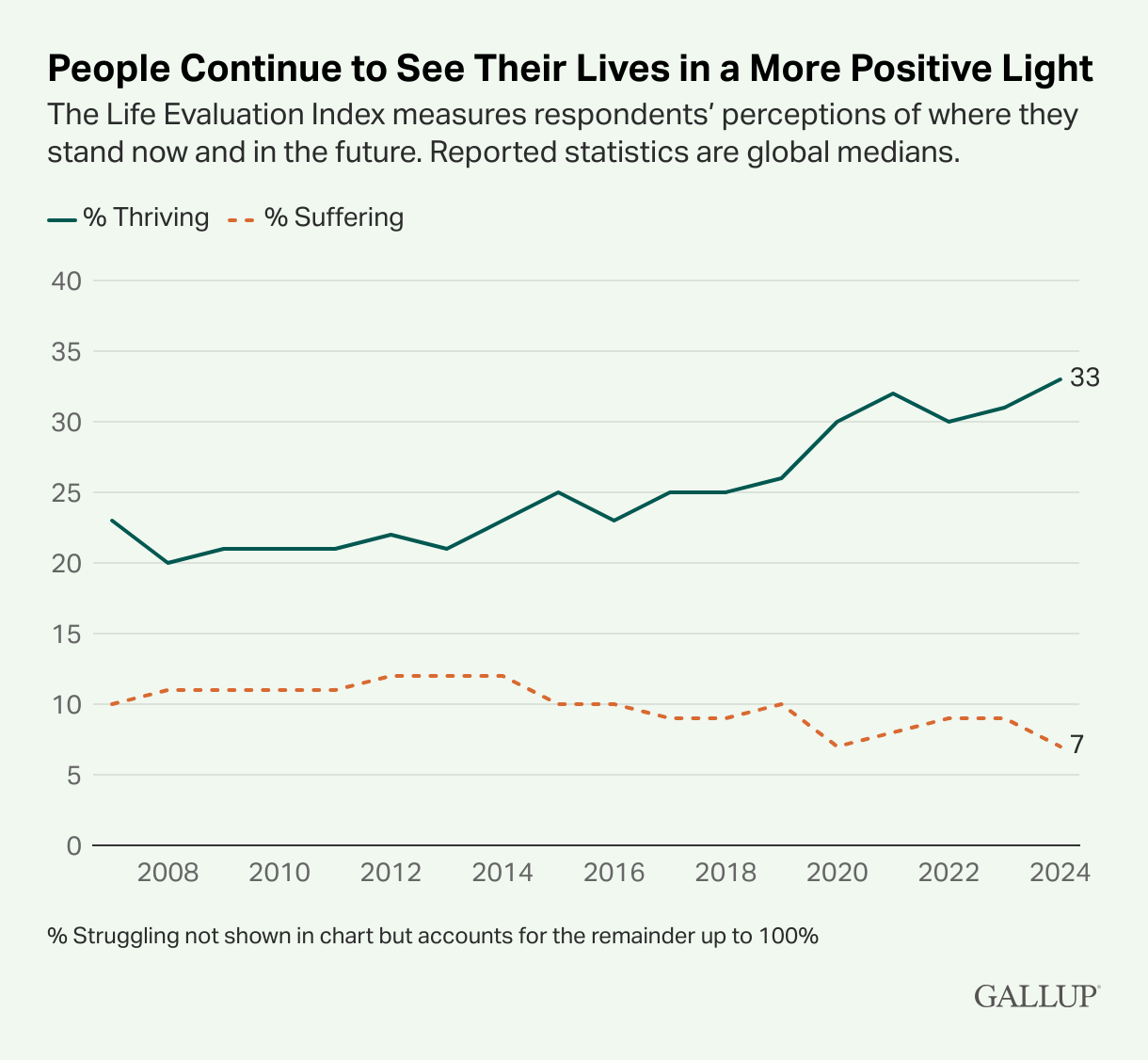
- 33 percent of the world’s adults are now classified as “thriving” according to Gallup’s Wellbeing Index—the highest level in more than a decade.
- The share of people who are suffering has fallen to 7 percent globally, the lowest level since measurements began in 2007.
- The rise in wellbeing is visible across all demographic groups. Men and women, young and old alike now rate their lives more positively than before.
How wellbeing is measured
People around the world are doing better and are more optimistic about the future than they have been in many years. This is shown by data from Gallup covering 142 countries.
Gallup’s Wellbeing Index is based on the Cantril Self-Anchoring Striving Scale. Respondents are asked to rate their current life and their expected life five years from now on a scale from 0 to 10. Those who rate their current life at 7 or higher and their future life at 8 or higher are classified as “thriving.” Those who rate both questions at 4 or lower are classified as “suffering.” Everyone else is considered “struggling.”
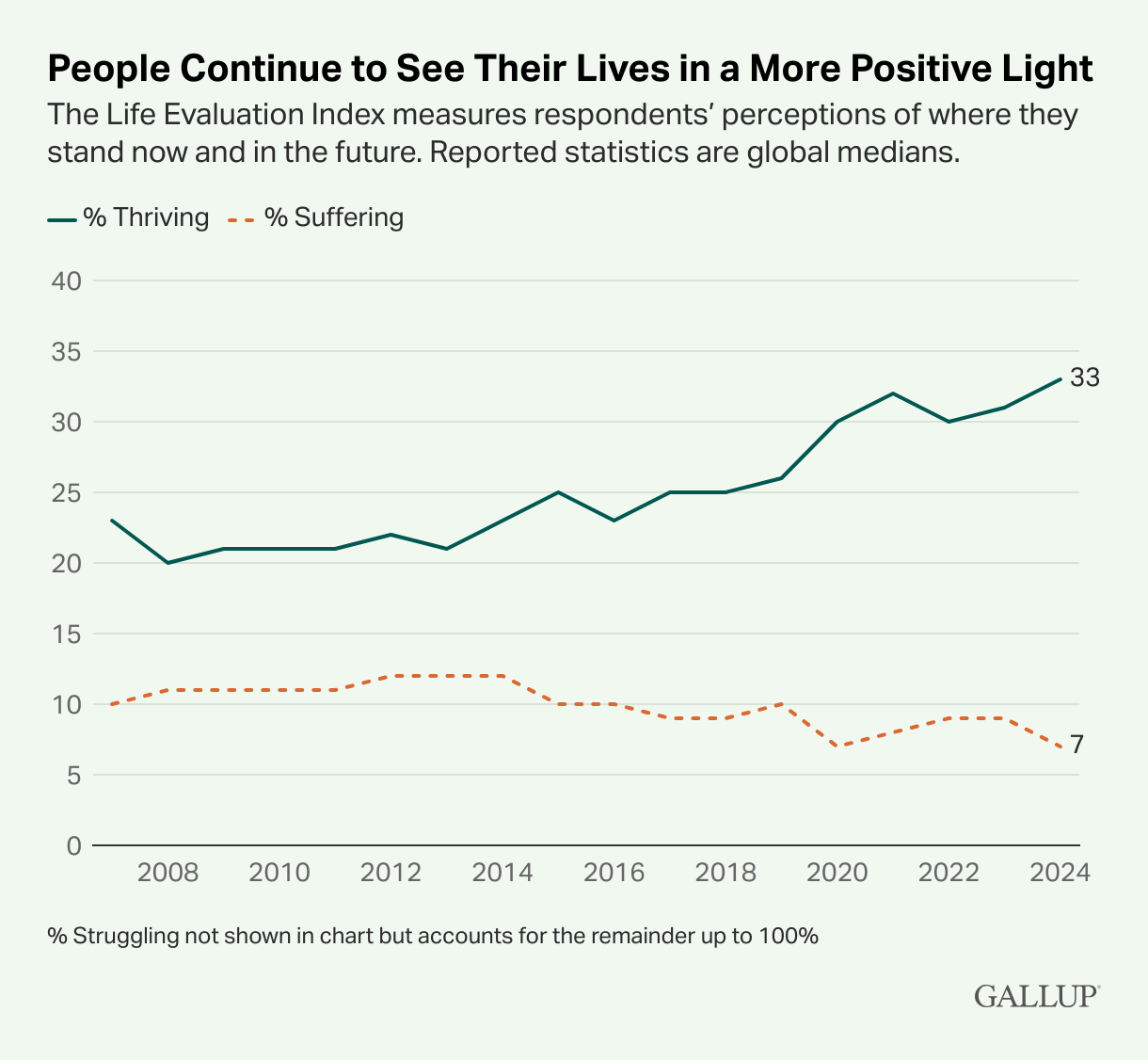
In 2024, the global median share of people who are thriving reached 33 percent. This continues a steady increase that has been underway for more than a decade. At the same time, the share classified as suffering fell to 7 percent, matching the lowest level since measurements began in 2007. Ten years earlier, in 2014, the figure was 12 percent.
Improvements across all demographic groups
The rise in wellbeing is visible across all demographic groups. Men and women, young and old alike now rate their lives more positively than before.
The rating of current life circumstances reached a global median of 5.9 out of 10 in 2024. This is on par with 2022 and 2023, but higher than most other points in the long-term trend. Expectations for the future received a median score of 7.2 out of 10—matching the peak recorded in 2020 during the COVID-19 pandemic, when a score of 7.3 was measured. Together, these positive life evaluations have pushed overall wellbeing higher in 2024.
Regional development
Progress has been uneven across regions. In Australia and New Zealand, the share of thriving people stands at 49 percent; in North America it is also 49 percent, and in Western Europe 42 percent. In these regions, wellbeing has gradually declined over time.
At the same time, most other regions have seen increases that more than offset these declines. Latin America and the Caribbean are at 45 percent, Eastern and Southern Europe at 37 percent, East Asia at 34 percent, Southeast Asia at 32 percent, and post-Soviet Eurasia at 33 percent. All of these regions have experienced steady gains over time.
The Middle East and North Africa stand at 17 percent, and sub-Saharan Africa at 15 percent. Both regions have seen more modest increases from lower starting points. South Asia is at 11 percent and is the only region that has shown no change since 2007.
Twelve countries with major progress
Over the past decade, twelve countries have increased their share of thriving residents by 20 percentage points or more. Most of these countries are in Eastern and Southern Europe: Kosovo, Serbia, Bosnia and Herzegovina, Slovenia, Lithuania, Armenia, Estonia, and Hungary.
Only one country has seen a comparable decline: Switzerland, with a drop of 22 percentage points.
Multiple factors behind the increase
The rise in subjective wellbeing mirrors external indicators of human development. The UN’s Human Development Index—which measures life expectancy, years of education, and standard of living—has also increased steadily over the same period.
A global median of 81 percent are now satisfied with their personal freedoms, a figure that has gradually increased over time. Perceptions of children’s wellbeing have also improved. A record-high 75 percent said in 2024 that their country is a good place for children to learn and grow.
Economic optimism has gradually recovered since the global financial crisis of 2007–2008. In 2024, 42 percent of adults were optimistic that their local economies would improve, and 49 percent felt the same about their own standard of living.
By becoming a premium supporter, you help in the creation and sharing of fact-based optimistic news all over the world.