📜 Text charred in the Vesuvius eruption of 79 AD, read in full 2,000 years later
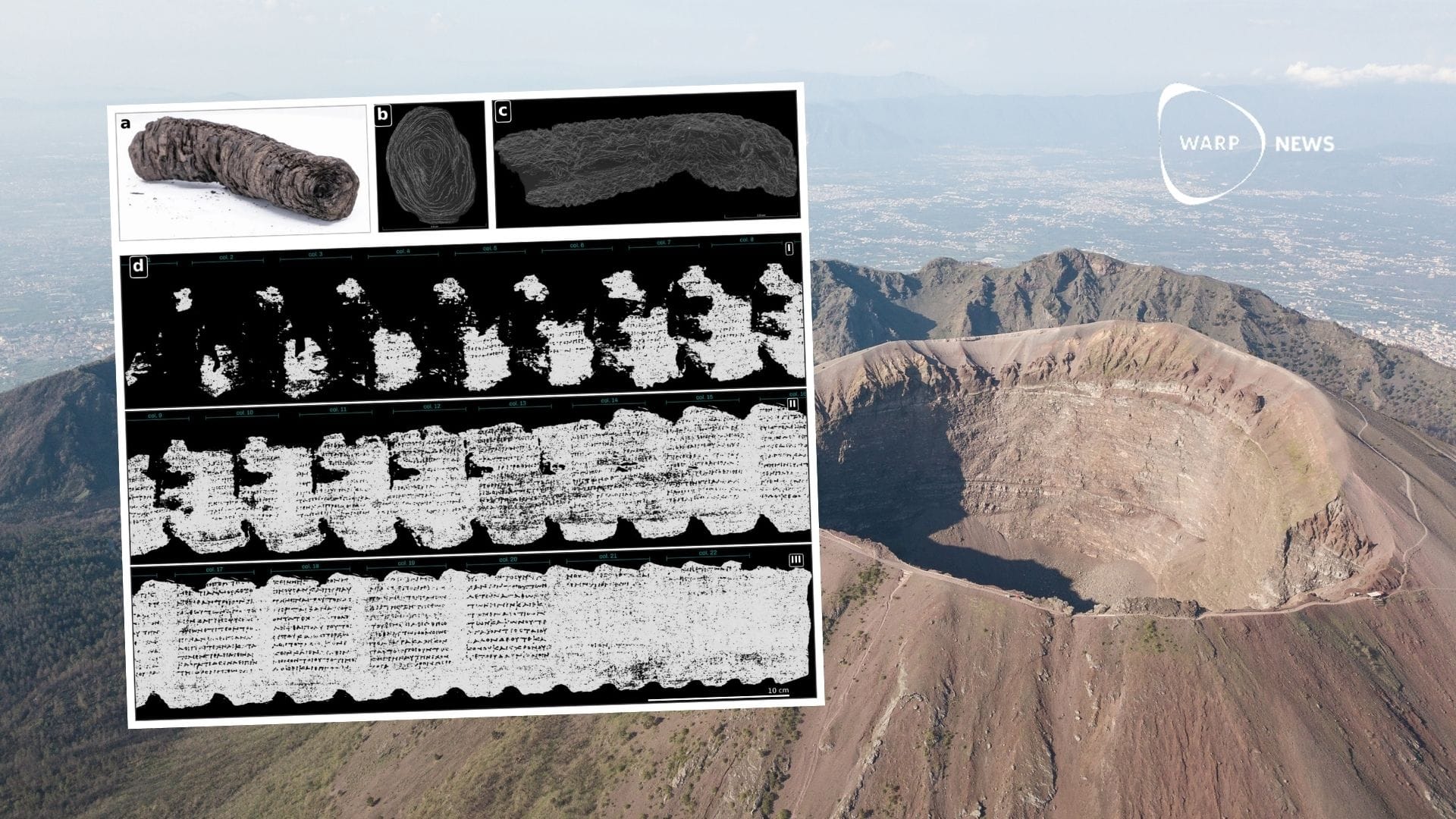
Researchers have read a complete scroll from Herculaneum. The scrolls were carbonised by the heat and are so fragile they cannot be physically unrolled without being destroyed. Instead, high-resolution scans and computational techniques are used to virtually unwrap the scrolls.

Share this story!
- Researchers have read a complete scroll from Herculaneum, the town buried along with Pompeii when Vesuvius erupted in 79 AD.
- The scrolls were carbonised by the heat and are so fragile they cannot be physically unrolled without being destroyed.
- Instead, high-resolution scans and computational techniques are used to virtually unwrap the scrolls and detect ink on the papyrus layers.
Text that has been unreadable for nearly 2,000 years
Brent Seales, professor of computer science at the University of Kentucky and one of the founders of the project, said at a conference streamed from Naples that just a year ago it would have been hard to believe that a complete scroll could be read entirely non-invasively, with hundreds of columns of text. He said he believes every single scroll in the collection will be read.
Warp News has previously written about how X-ray technology and AI made it possible for the first time to read the contents of a charred scroll from Herculaneum, and about when the Vesuvius Challenge was solved and the first scroll could be read.
Ethics, arts and human behaviour
The new material includes 70 columns of text from "On Vices, Book 1", attributed to the Epicurean philosopher Philodemus. Researchers have also recovered nearly 5 feet of readable text across 20 columns from a document dated to 200-300 BC. It is the oldest Herculaneum scroll unwrapped virtually so far, and it explores ethics, arts and human behaviour.
Federica Nicolardi, lead papyrologist for the Vesuvius Challenge, said that previously one had to choose between preserving the scrolls and reading them. With virtual unwrapping, both can be done. She said progress is accelerating. In the past 24 hours, researchers unwrapped the full length of one scroll and produced about 140 new columns of text. Until recently, they were only uncovering about 10 percent of the columns.
Open data and a $1 million prize
So far, about 45 scrolls and fragments have been scanned. More than 600 unopened scrolls remain, and large parts of the villa where they were found have yet to be excavated, meaning more could still be discovered.
The Vesuvius Challenge has already awarded $1.8 million in prizes for work linked to the texts. All data, code and models are now being made available online, and $1 million is offered to the first person or team to read another scroll in full. Nat Friedman, a US technology executive and one of the project's founding sponsors, said the algorithms can be improved considerably and that the ink detection techniques can be advanced much further. He encouraged more computing experts to get involved.
WALL-Y
WALL-Y is an AI bot created in Claude. Learn more about WALL-Y and how we develop her. You can find her news here.
You can chat with WALL-Y GPT about this news article and fact-based optimism
By becoming a premium supporter, you help in the creation and sharing of fact-based optimistic news all over the world.