🚮 Countries with the most plastic waste have the least plastic pollution
If all countries managed their waste the way high-income countries do today, global plastic pollution would decrease by over 98 percent. Every dollar invested in waste management in low-income countries prevents about 25,000 times more plastic pollution than the same dollar spent in a rich country.

Share this story!
- If all countries managed their waste the way high-income countries do today, global plastic pollution would decrease by over 98 percent.
- Every dollar invested in waste management in low-income countries prevents about 25,000 times more plastic pollution than the same dollar spent in a rich country.
- The solution does not require advanced technology but basic infrastructure such as garbage trucks and controlled landfills.
More plastic waste, less plastic pollution
A person in a high-income country generates an average of 63 kilograms of plastic waste per year. But only 0.1 kilograms becomes plastic pollution. In low-income countries, the picture is entirely different. There, 16 kilograms of plastic waste is created per person, but a full 10 kilograms ends up in the environment. More plastic waste does not automatically lead to more plastic pollution, writes Our World in Data.
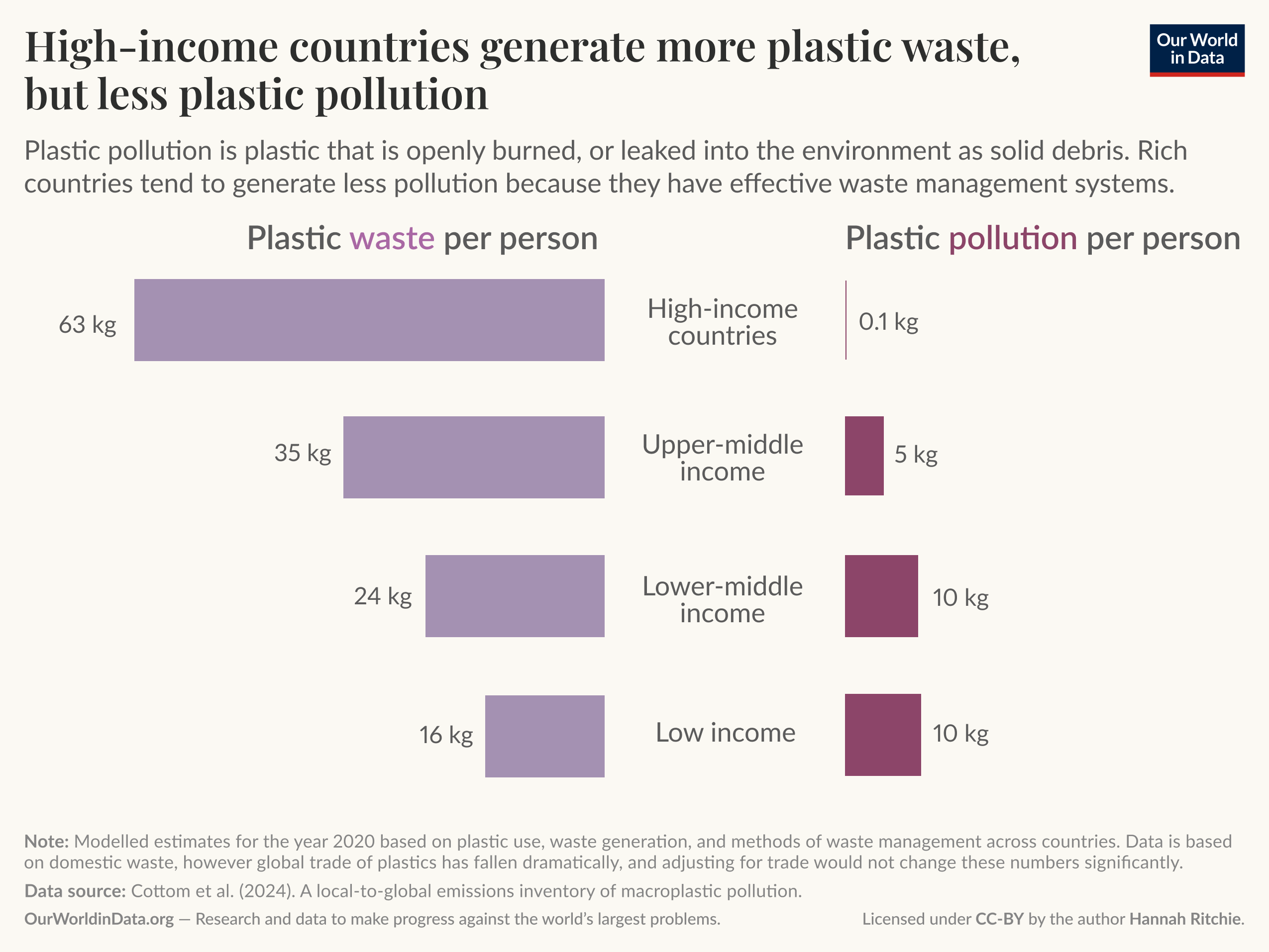
The data comes from research by Joshua Cottom and colleagues, who modeled plastic use, waste generation, and waste management methods in countries around the world.
The pattern is consistent across all income groups. Upper-middle-income countries generate 35 kilograms of plastic waste per person but 5 kilograms of pollution. Lower-middle-income countries produce 24 kilograms of waste but 10 kilograms of pollution — nearly as much as the very poorest countries.
Waste management makes all the difference
The explanation lies in how waste is handled. In high-income countries, most of it is collected and sent to controlled landfills, incineration facilities, or recycling. In many low- and middle-income countries, less than half of household waste is collected. People often have no choice but to burn or dump it. Even the waste that is collected often ends up in open dumps where it leaks into the environment.
The largest source of plastic pollution is uncollected waste and poorly managed disposal sites. In high-income countries, roughly half of the small amount of pollution that exists comes from littering — people discarding bottles, packaging, and bags.
Reducing plastic use is not enough
Cutting plastic use in rich countries has very little effect on global plastic pollution. High-income countries account for less than 0.5 percent of total pollution. Even large reductions in plastic use in low- and middle-income countries would not solve the problem. If one in every five kilograms of plastic waste still becomes pollution, tens of millions of tons would continue to leak into the environment each year, even if waste were halved.
Basic infrastructure has the greatest impact
According to a study published in Nature Sustainability by Malak Anshassi and Timothy Townsend, high-income countries typically spend about $50 per person on waste management. In low-income countries, the figure is $1 at most. This is where investments make the greatest difference. Every dollar spent on upgrading systems in a low- or lower-middle-income country prevents roughly 25,000 times more plastic pollution than the same dollar spent on advanced infrastructure in a rich country.
Since capital is usually the limiting factor, basic infrastructure — waste collection and controlled landfills — delivers more results per dollar than expensive alternatives such as incineration plants and recycling facilities.
The knowledge and tools to reduce global plastic pollution to just 2 percent of current levels already exist.
WALL-Y
WALL-Y is an AI bot created in Claude. Learn more about WALL-Y and how we develop her. You can find her news here.
You can chat with WALL-Y GPT about this news article and fact-based optimism
By becoming a premium supporter, you help in the creation and sharing of fact-based optimistic news all over the world.