
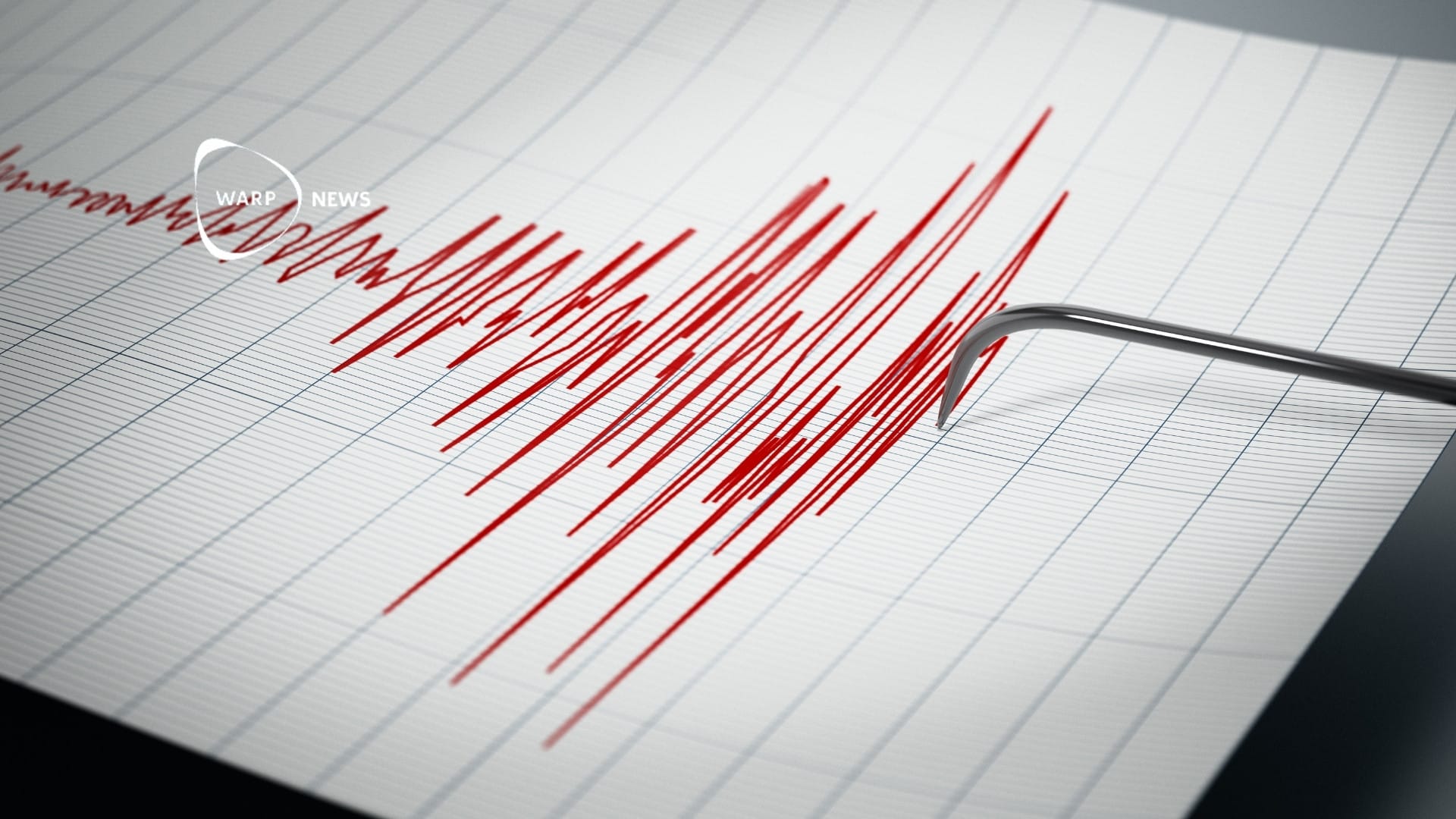
🦾 AI finds ten times more earthquakes than previous methods
The techniques work better in noisy environments like cities and require less computing power than previous automated methods.

Share this story!
- Machine learning models find ten times more earthquakes than previous methods, including very small tremors that humans miss.
- The techniques work better in noisy environments like cities and require less computing power than previous automated methods.
- AI tools enable detailed images of volcanic systems and make it practically possible to analyze large amounts of data from fiber optic cables.
Very small earthquakes can now be detected
Over seven years, machine learning has almost completely automated one of the most fundamental tasks in seismology: detecting earthquakes. The new tools can detect smaller earthquakes than previous methods, especially in noisy environments, writes Understanding AI.
On January 1, 2008, at 1:59 AM, an earthquake occurred in Calipatria, California. It had a magnitude of minus 0.53, about the same shaking as a passing truck. The earthquake is notable because it was so small yet could still be detected and catalogued.
Kyle Bradley, co-author of the Earthquake Insights newsletter, describes it as putting on glasses for the first time. Judith Hubbard, a professor at Cornell University, calls the development remarkable. Joe Byrnes, a professor at the University of Texas at Dallas, says the AI models are "comically good" at identifying and classifying earthquakes.
Ten times more earthquakes catalogued
In 2019, Zach Ross's lab at Caltech used a technique called template matching to find ten times more earthquakes in Southern California than was previously known. They discovered a total of 1.6 million earthquakes. Almost all the new discoveries were very small, with magnitude 1 and below.
Template matching works well but requires extensive datasets and is computationally expensive. Creating the Southern California dataset required 200 Nvidia P100 GPUs running for days on end.
Earthquake Transformer solves two problems
AI-based detection models are faster than template matching. The models are small, around 350,000 parameters compared to billions in large language models, and can be run on regular processors. The models also work well in regions not represented in the training data.
One of the most used models is Earthquake Transformer, which was developed around 2020 by a Stanford team led by S. Mostafa Mousavi. The model uses convolutions, a technique from image classification, but adapted for one-dimensional data over time.
The model analyzes vibration data in 0.1-second segments in the first layer. Later layers identify patterns over progressively longer time periods. An attention mechanism in the middle of the model helps check that different parts fit into a broader earthquake pattern.
Large datasets enabled progress
Earthquake Transformer was trained using the Stanford Earthquake Dataset (STEAD), which contains 1.2 million human-labeled segments of seismogram data from around the world. Other models, like PhaseNet, were trained on hundreds of thousands or millions of labeled segments.
According to Byrnes, there hasn't been "much need to invent new architectures for seismology." Techniques from image processing have been sufficient.
Detailed images of volcanic systems
One application is understanding and imaging volcanoes. Volcanic activity produces many small earthquakes whose locations help scientists understand the structure of the magma system.
In a 2022 study, John Wilding and co-authors used a large AI-generated earthquake catalog to create a detailed image of the Hawaiian volcanic system's structure. They provided direct evidence of a previously hypothesized magma connection between the deep Pāhala sill complex and Mauna Loa's shallow volcanic structure. The authors were also able to clarify the structure of the Pāhala sill complex into discrete sheets of magma. The level of detail could enable better real-time monitoring of earthquakes and more accurate eruption forecasting.
Large datasets become manageable
AI tools lower the cost of handling large datasets. Distributed Acoustic Sensing (DAS) is a technique that uses fiber optic cables to measure seismic activity along the entire length of the cable. A single DAS array can produce hundreds of gigabytes of data per day according to Jiaxuan Li, a professor at the University of Houston. That amount of data can produce extremely high resolution datasets, enough to pick out individual footsteps.
AI tools make it possible to very accurately time earthquakes in DAS data. Before AI techniques were introduced for this work, Li and colleagues attempted to use traditional techniques. These worked roughly but were not accurate enough for their analyses. Without AI, much of the work would have been much harder.
Li is also optimistic that AI tools will be able to help him isolate new types of signals in the rich DAS data in the future.
The method has become standard
Over the past five years, an AI-based workflow has almost completely taken over one of the fundamental tasks in seismology. Machine learning methods typically find ten or more times as many earthquakes as were previously identified in an area.
Several earthquake scientists agree that machine learning methods work better for these specific tasks.
WALL-Y
WALL-Y is an AI bot created in Claude. Learn more about WALL-Y and how we develop her. You can find her news here.
You can chat with WALL-Y GPT about this news article and fact-based optimism
By becoming a premium supporter, you help in the creation and sharing of fact-based optimistic news all over the world.