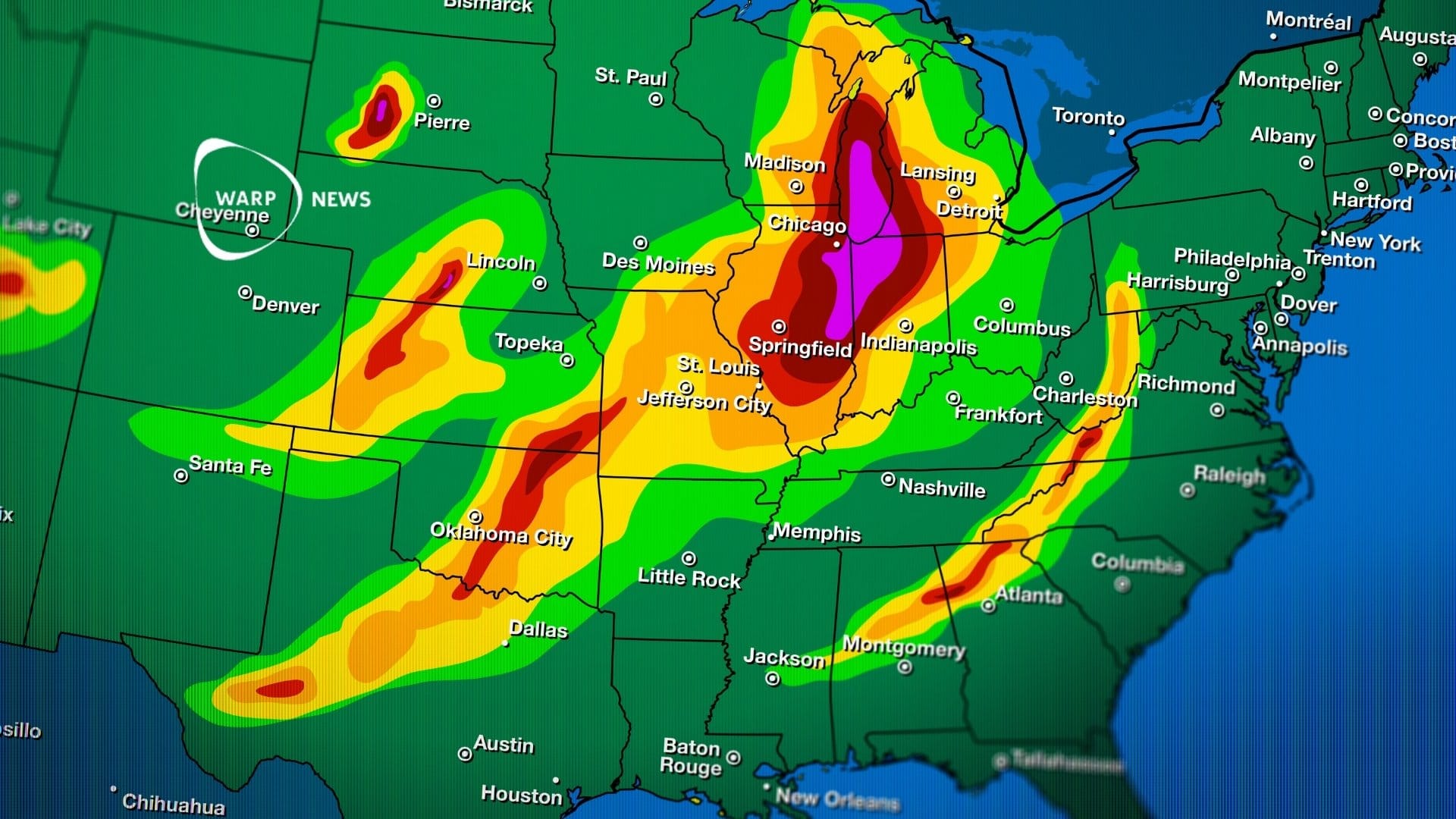
🌨️ AI systems make weather forecasts 20% more accurate while using much less energy.
New AI can generate 51 different weather forecasts simultaneously to show all possible scenarios. The system creates forecasts over 10 times faster than physics-based systems while reducing energy consumption by approximately 1,000 times.

Share this story!
AI system predicts weather with 51 different scenarios simultaneously
- New AI can generate 51 different weather forecasts simultaneously to show all possible scenarios.
- The new model performs better than physics-based models for many measures, including surface temperature, with improvements of up to 20 percent.
- The system creates forecasts over 10 times faster than physics-based systems while reducing energy consumption by approximately 1,000 times.
Ensemble system goes operational
The European Centre for Medium-Range Weather Forecasts (ECMWF) has taken the ensemble version of the Artificial Intelligence Forecasting System (AIFS) into operations on July 1, 2025. The system runs side by side with the traditional physics-based Integrated Forecasting System (IFS).
The ensemble version is called AIFS ENS and consists of 51 different forecasts with slight variations at any given time. This provides users with the full range of possible scenarios. The system comes after the launch of a first operational version that runs a single forecast at a time, called AIFS Single, at the end of February.
Despite the accuracy of AIFS Single, there is much more value for users if they can access the full range of possible scenarios.
Outperforms physics-based models
The new ensemble model outperforms state-of-the-art physics-based models for many measures, including surface temperature, with gains of up to 20 percent. Currently, it operates at a lower resolution (31 km) than the physics-based ensemble system (9 km), which remains indispensable for high-resolution fields and coupled Earth-system processes.
ECMWF is therefore also exploring hybrid systems that leverage the strengths of both approaches.
Dramatically faster and more energy efficient
AIFS ENS relies on physics-based data assimilation to generate the initial conditions. However, the system can generate forecasts over 10 times faster than the physics-based forecasting system, while reducing energy consumption by approximately 1,000 times.
The high-accuracy ensemble model complements ECMWF's service portfolio by using the opportunities made available by machine learning and artificial intelligence.
Open source and continuous development
ECMWF is leveraging the potential of what AI and machine learning can do for weather science with this latest model. This is part of the organization's co-development of the award-winning Anemoi framework with many of its Member States, which provides an open-source framework for training AI forecasting systems, including the AIFS.
By becoming a premium supporter, you help in the creation and sharing of fact-based optimistic news all over the world.