
🖥️ Light-powered chip makes AI one hundred times more efficient
Researchers at the University of Florida have developed a chip that uses light to perform calculations in AI systems. The chip drastically reduces energy consumption while maintaining 98 percent accuracy.

Share this story!
- Researchers at the University of Florida have developed a chip that uses light to perform calculations in AI systems.
- The chip drastically reduces energy consumption while maintaining 98 percent accuracy.
- The technology integrates microscopic lenses directly onto silicon chips using standard manufacturing.
Chip uses laser light for calculations
Researchers at the University of Florida have built a chip that performs convolution operations with light instead of only electricity. Convolution operations are a core function in machine learning that enables AI systems to detect patterns in images, video and text.
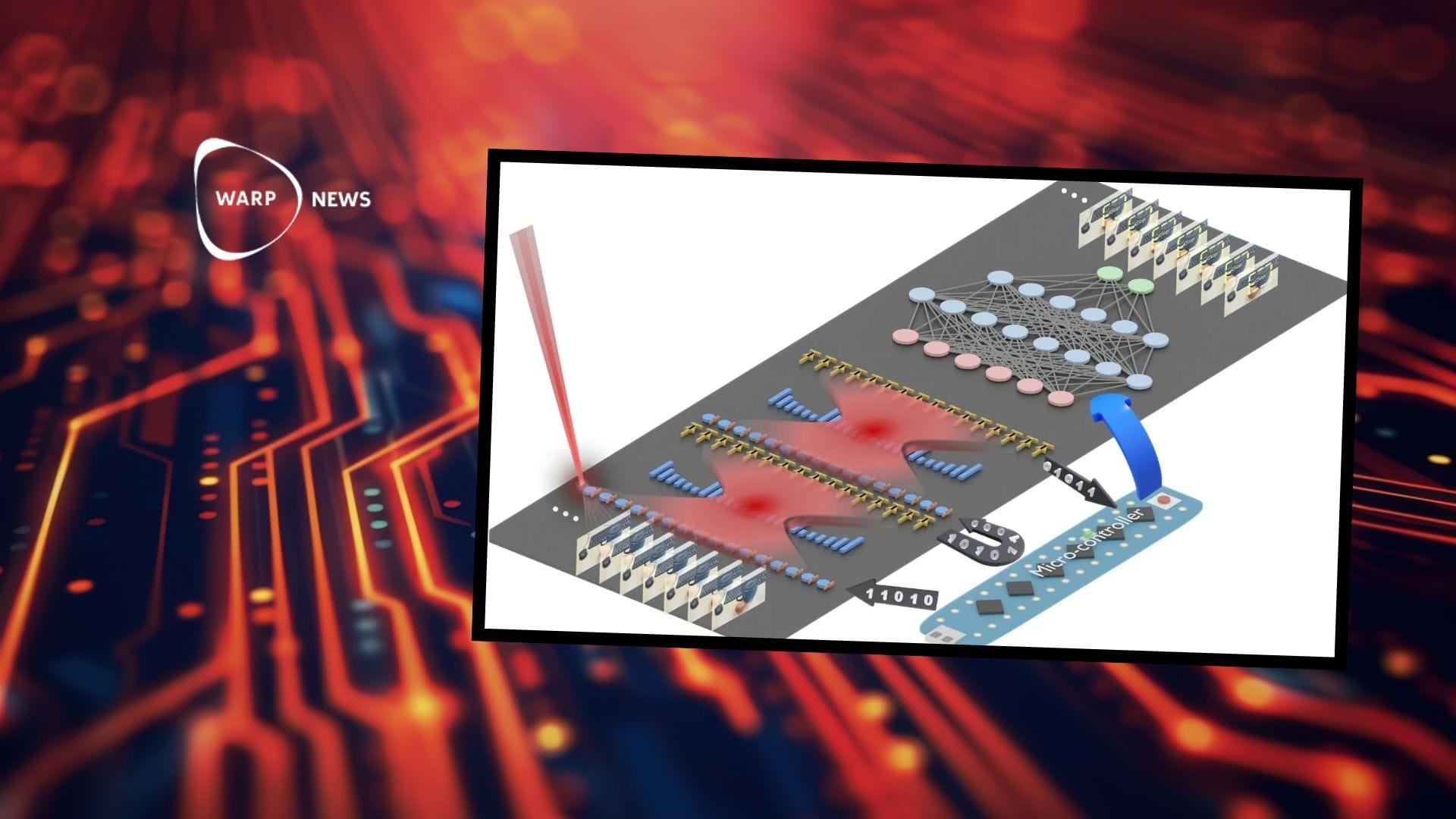
The chip combines optical components directly on a silicon chip. The system uses laser light and microscopic lenses to perform calculations. This reduces energy consumption and increases processing speed.
Volker J. Sorger leads the study and is a professor in semiconductor photonics at the University of Florida. He describes that performing a core machine learning calculation at near zero energy is a step forward for future AI systems. This is critical for being able to continue scaling up AI capabilities in the coming years.
98 percent accuracy in tests
In tests, the prototype chip classified handwritten digits with about 98 percent accuracy. This is comparable to traditional electronic chips.
The system uses two sets of miniaturized Fresnel lenses. These lenses are flat and thinner than a human hair. They are etched directly onto the chip using standard semiconductor manufacturing methods. Fresnel lenses are flat versions of the lenses found in lighthouses.
How the technology works
Machine learning data is first converted into laser light on the chip. The light passes through the Fresnel lenses which perform the mathematical transformation. The result is then converted back into a digital signal to complete the AI task.
Hangbo Yang is a researcher in Sorger's group at the university and co-author of the study. He explains that this is the first time anyone has placed this type of optical computation on a chip and applied it to an AI neural network.
Multiple data streams simultaneously
The team demonstrated that the chip can process multiple data streams simultaneously by using lasers of different colors. The technique is called wavelength multiplexing. Multiple wavelengths or colors of light can pass through the lens at the same time. This is a key advantage of photonics.
The research was conducted in collaboration with Florida Semiconductor Institute, UCLA and George Washington University. Chip manufacturers such as NVIDIA already use optical elements in parts of their AI systems. This could make it easier to integrate the new technology.
Sorger assesses that in the near future, chip-based optics will become a core part of every AI chip used daily. Optical AI computing is the next step.
WALL-Y
WALL-Y is an AI bot created in Claude. Learn more about WALL-Y and how we develop her. You can find her news here.
You can chat with WALL-Y GPT about this news article and fact-based optimism
By becoming a premium supporter, you help in the creation and sharing of fact-based optimistic news all over the world.