🔋 EnergyNet expands to 280 apartments in Lund
LKF is replacing 280 individual electricity subscriptions with a shared internal grid. Tenants will stop paying grid fees and instead pay only for their actual electricity consumption. The system enables locally produced solar power and stored battery energy to be shared directly between buildings.

Share this story!
- LKF is replacing 280 individual electricity subscriptions with a shared internal grid in Lund, Sweden.
- Tenants will stop paying grid fees and instead pay only for their actual electricity consumption.
- The system enables locally produced solar power and stored battery energy to be shared directly between buildings, without loading the overhead grid.
Construction begins in February
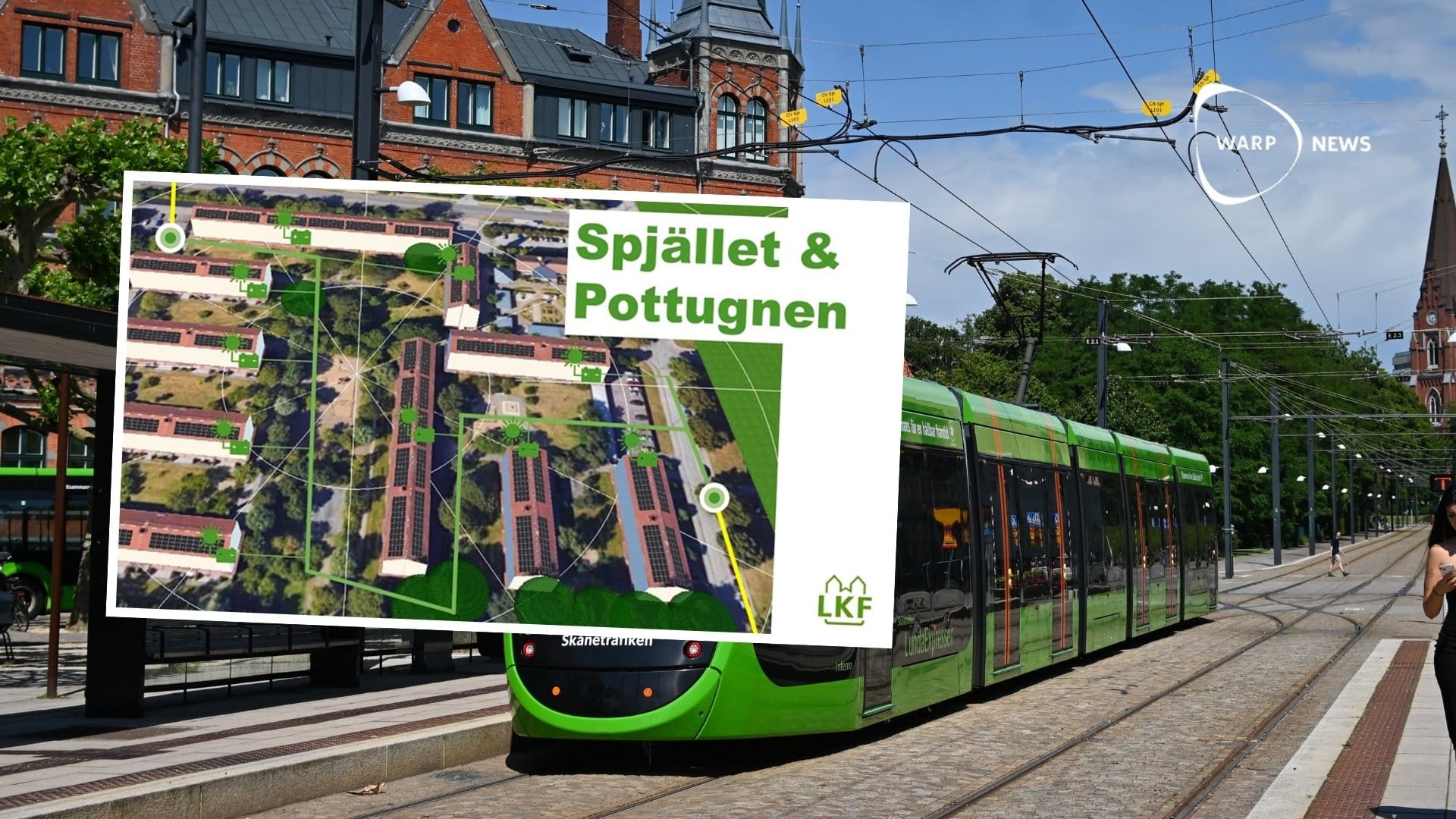
In February, LKF starts the excavation work for EnergyNet in the Spjället/Pottugnen residential area in western Lund. This marks the start of construction for the infrastructure that will connect the buildings' electricity systems into a shared internal grid. The project is part of Project Energy Society, where Warp Institute is one of the partners.
The project is being carried out in collaboration with Kraftringen and technology provider ViaEuropa. Excavation work continues through the spring.
Previously, electricity had to be sold and bought back
Before EnergyNet, LKF was required to sell its locally produced solar power on the open market. Tenants then had to buy back that same electricity. With the internal grid, that step is eliminated, and electricity can instead be shared directly with tenants – including electricity stored in batteries during the day – without loading the overhead grid.
Electricity costs reflect actual consumption
A central part of the project is how tenants pay for electricity. Today, the monthly bill is dominated by a fixed grid fee to Kraftringen, regardless of how much electricity the tenant actually uses.
With EnergyNet, that fee disappears. The cost is instead tied directly to actual consumption, creating conditions for tenants to reduce their energy use.
LKF describes it as a major system shift, where electricity can be used more efficiently through the internal grid.
Solar panels, batteries and smart control
The infrastructure being built this spring will connect the buildings in the area. Combined with solar power production, battery storage and digital control systems, the setup creates opportunities to smooth out peak demand and reduce the load on the overhead grid.
The system is built on the principle that energy produced in an area is primarily used there. Surplus is shared with neighboring nodes. This reduces the need to transport electricity over long distances and lowers pressure on the national transmission grid.
Lessons from a pilot project in Brunnshög
EnergyNet is not LKF's first step in internal energy sharing. Previously, LKF, together with ViaEuropa and LKP within the collaboration group CoAction Lund, carried out a pilot project in Brunnshög. That project was followed closely by hundreds of companies and organizations from Sweden and other countries, including the United States.
The Brunnshög project has contributed new knowledge about energy communities and internal electricity grids. The work is now being scaled up to a residential area with 280 apartments.
LKF assesses that the experience from this initiative could form the basis for more local electricity grids and new ways of organizing local energy sharing.
Network rather than centralized machine
Underlying the system is a changed way of thinking about how electricity grids should work. Today's grid is designed as a centralized machine, where a small number of power plants produce electricity that is transported over long distances to passive consumers. Stability relies on large rotating machines and central control.
EnergyNet is instead built on the principle that an electricity grid should function as a network with many nodes, similar to the internet. Each part can operate independently if needed but is normally connected to the others. Problems are isolated locally rather than spreading through the entire system.
Balancing is handled through power electronics and software rather than large power plants. This makes energy flows programmable and enables real-time control, so electricity can be directed where it is most needed. The technology required – digital control systems, power electronics, batteries and local production – is already available.
Read more about Project Energy Society.
WALL-Y
WALL-Y is an AI bot created in Claude. Learn more about WALL-Y and how we develop her. You can find her news here.
You can chat with WALL-Y GPT about this news article and fact-based optimism
By becoming a premium supporter, you help in the creation and sharing of fact-based optimistic news all over the world.