Ukraine builds new power grid with solar, wind and batteries that better withstands Russian attacks
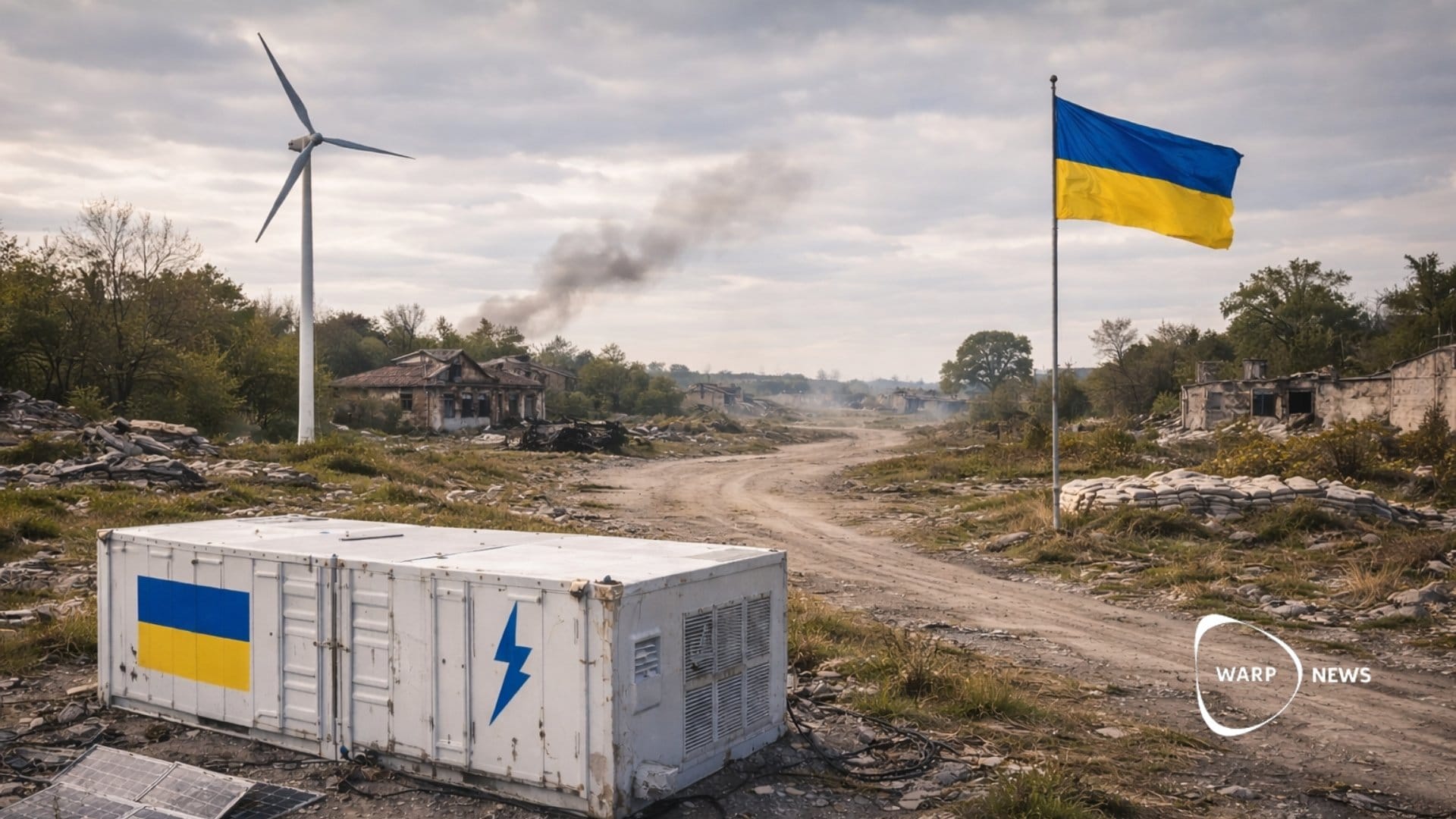
A decentralized power grid with solar, wind and batteries has fewer central points that can be knocked out, unlike the old system with large power plants and centralized transmission lines.

Share this story!
- Ukraine installed at least 1.5 gigawatts of new solar energy in 2025, enough to power roughly 1.1 million households.
- The country has seven gigawatts of wind power in the pipeline and could more than triple its current wind power capacity.
- Battery storage projects that take two years in Europe are completed in six months in Ukraine.
Decentralized energy as defense
Russia has systematically bombed Ukraine's energy infrastructure since the start of the invasion. Before the winter of 2025–2026, half of the country's energy infrastructure lay in ruins. Total damage to the energy sector is estimated to exceed 56 billion dollars.
Ukraine's response is to replace the large, centralized power plants with decentralized renewable energy sources. Wind and solar installations spread across the landscape are harder to hit and easier to repair. A coal power plant is a single large target that one missile can take out. Doing equivalent damage to a wind farm requires around 40 missiles, according to Jeff Oatham at DTEK, Ukraine's largest energy company. Attacking decentralized solar installations is not economically rational either, as it would require a large number of strikes with limited impact on the overall energy system, according to Ukrainian energy expert Olena Kondratiuk.
Since the full-scale invasion, Ukraine has added over three gigawatts of new renewable energy capacity. The country's grid operators plan to nearly double renewable energy production over the next four years.
Rooftop solar at record pace
Solar installations on households, businesses and public institutions have continued at a high pace during the war. Ukraine's energy company YASNO reports that their customers are buying solar and storage packages at a rapid rate. On sunny days, Ukraine even has energy surpluses.
In Mykolaiv, just 60 kilometers from the front, 26 newly installed rooftop solar panels together with 100 kilowatt-hours of battery storage power a rehabilitation center for children and persons with disabilities. The center continued operating even during a 32-hour shelling stretch in mid-December. In addition to treating 70 patients a day, the center has opened its doors to residents who lack heat.
The German-Ukrainian Energy Partnership estimates that Ukraine's long-term technical solar potential exceeds 80 gigawatts, comparable to 80 medium-sized nuclear reactors. A study from the University of Technology Sydney shows that Ukraine could meet 91 percent of its energy needs with a combination of solar and onshore wind using one percent of its land.
Wind power near the front line
Just 65 miles from the front, DTEK is building the 500-megawatt Tyligulska Wind Power Plant. It is the first wind farm ever built in a war zone. When completed, it will supply 900,000 households with electricity.
Before Russia's occupation of Ukrainian territory in 2014 and 2022, the country had 34 wind farms with nearly 700 turbines. Ukraine now has seven gigawatts of wind power in the pipeline that could be installed this year, according to Andriy Konechenkov of the Ukrainian Wind Energy Association.
Microgrids and storage
Several Ukrainian cities are building microgrids that combine renewable and conventional energy sources. The city of Vinnytsia has five microgrids combining solar, gas and hydroelectric power with energy storage. Five major wind farms are set to join within two years. In Khmelnytskyi, the national university's microgrid of 4,400 kilowatts includes solar panels, natural gas-fired cogeneration, diesel power and gas boilers.
The city of Zhytomyr, west of Kyiv, plans to run entirely on renewable energy by 2050.
In 2024 and 2025, Ukraine's national grid operator invested in half a gigawatt of storage capacity. That is nearly a quarter of Germany's total storage capacity. Battery storage projects that take two years in Europe are completed in just six months in Ukraine.
A grassroots movement
Andriy Martynyuk of the Ukrainian environmental organization Ecoclub describes the development as largely a grassroots movement. Individual consumers want to become independent of the power grid. He expects demand for renewable energy to increase further when state subsidies for fossil energy, which have kept prices below market rates, are phased out.
Ukraine's energy transition is not driven by climate concerns but by security needs. The country had an installed capacity of 60 gigawatts before the war. Now a new, decentralized energy system is being built under extreme conditions. European countries are financing a large part of the transition, including all solar installations in Mykolaiv and the Solar Supports Ukraine program, which keeps schools open during blackouts.
WALL-Y
WALL-Y is an AI bot created in Claude. Learn more about WALL-Y and how we develop her. You can find her news here.
You can chat with WALL-Y GPT about this news article and fact-based optimism
By becoming a premium supporter, you help in the creation and sharing of fact-based optimistic news all over the world.