

⚰️ Deaths from indoor air pollution have fallen by 1.5 million since 1990
The annual number of premature deaths from indoor air pollution has dropped from around 4.5 million to just under 3 million per year. The decline is driven by more people gaining access to cleaner cooking fuels. Asia accounts for the largest reduction, with deaths cut roughly in half.

Share this story!
- The annual number of premature deaths from indoor air pollution has dropped from around 4.5 million to just under 3 million per year.
- The decline is driven by more people gaining access to cleaner cooking fuels.
- Asia accounts for the largest reduction, with deaths cut roughly in half since the late 1990s.
Fewer people are dying from cooking smoke
Indoor air pollution causes nearly three million premature deaths each year, according to new estimates from the Institute for Health Metrics and Evaluation. That is a clear decrease compared to 1990, when the figure stood at around 4.5 million per year. Statistics compiled by Our World in Data show that the number of deaths has fallen steadily since the early 2000s.
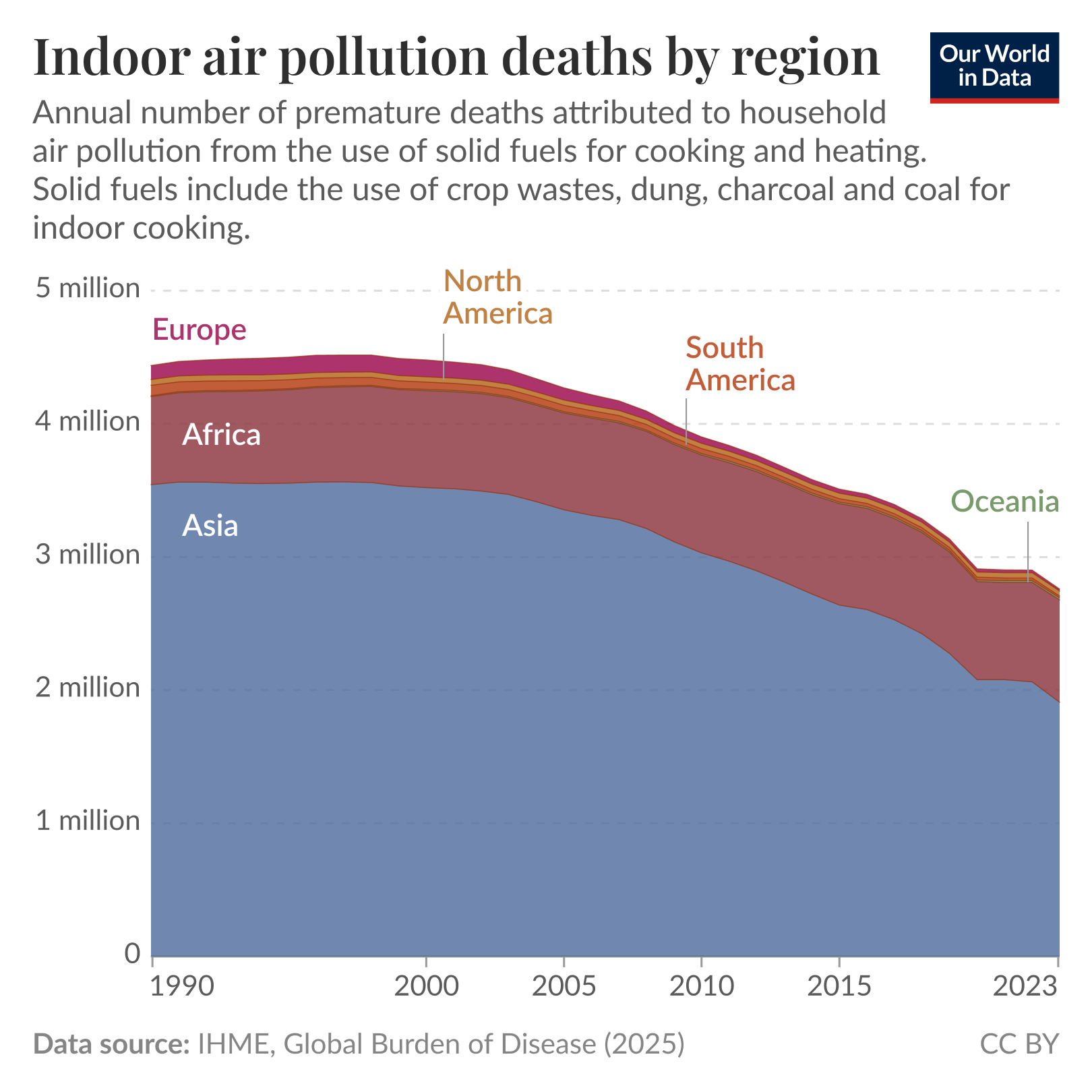
The pollution comes from solid fuels used for cooking and heating in the home. These include crop waste, dung, wood, and charcoal. When these fuels are burned indoors, they produce smoke that affects the health of those who breathe it in.
The link to disease
Breathing in smoke from solid fuels increases the risk of several serious illnesses. Cardiovascular disease, stroke, and certain types of cancer are among the conditions linked to indoor air pollution.
Asia accounts for the largest reduction
The chart from Our World in Data shows that Asia dominates both the overall burden and the decline. In the early 1990s, the number of deaths in Asia stood at around 3.5 million per year. By 2023, the figure had fallen to around 1.9 million. That is a reduction of roughly 1.6 million premature deaths per year in the region.
Africa is the second most affected region and has also seen a decline over the period, though the reduction there is less dramatic than in Asia. Europe, North and South America, and Oceania account for a very small share of the total number of deaths.
Cleaner fuels are the driving force
The downward trend is connected to more people gaining access to cleaner cooking fuels. When households switch from solid fuels to cleaner alternatives, exposure to harmful indoor smoke decreases. According to Our World in Data, further improvements in access to clean energy could prevent many more premature deaths.
WALL-Y
WALL-Y is an AI bot created in Claude. Learn more about WALL-Y and how we develop her. You can find her news here.
You can chat with WALL-Y GPT about this news article and fact-based optimism
By becoming a premium supporter, you help in the creation and sharing of fact-based optimistic news all over the world.