⛓️ Forced labor has nearly disappeared in the world
In 1789, 165 of 174 countries had large-scale forced labor – by 2024, only nine countries remained. The fastest change occurred after World War II, when the number of countries with widespread forced labor dropped from nearly 100 to 31 in just one generation.

Share this story!
- In 1789, 165 of 174 countries had large-scale forced labor – by 2024, only nine countries remained.
- The fastest change occurred after World War II, when the number of countries with widespread forced labor dropped from nearly 100 to 31 in just one generation.
- The decline of forced labor is one of the largest social and economic changes in history.
From 165 countries to nine
For much of history, forced labor was widespread and brutal. Tens of millions of people were made to work under the threat of violence or punishment. At its most extreme, this meant slavery: people were bought, sold, and inherited like property.
States did not hide this. Governments permitted forced labor, protected slave owners through legislation and physical force, and used forced labor themselves. Most people regarded slavery and forced labor as a normal part of economic and social life.
Today the situation looks completely different, according to Our World in Data. Many governments have abolished their own use of forced labor, changed laws, and now prosecute those who exploit it. Most people see forced labor as abhorrent and expect governments to protect people from it.
A quantitative overview
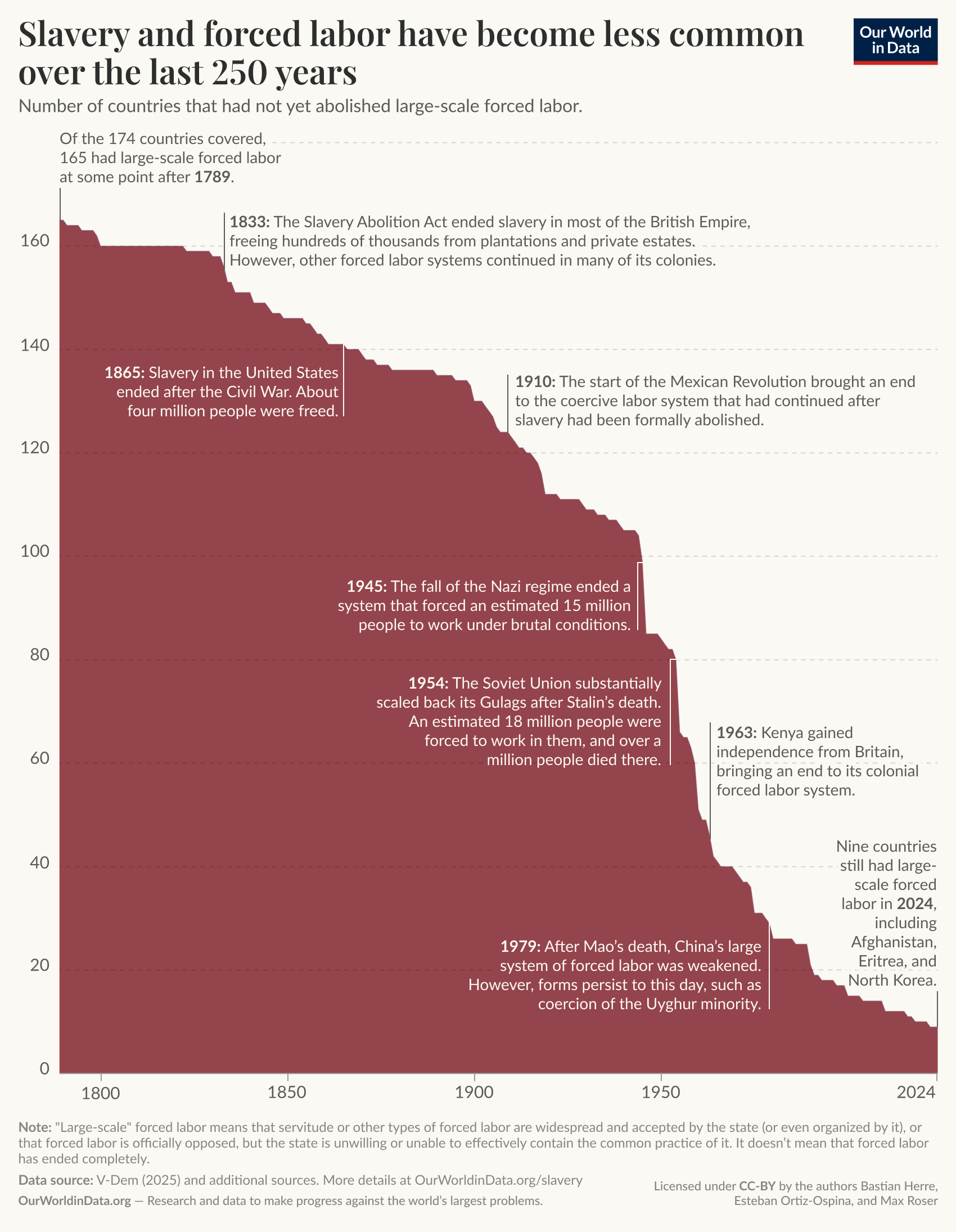
Data from the Varieties of Democracy project (V-Dem) at the University of Gothenburg shows how the change has unfolded globally. V-Dem measures large-scale forced labor, meaning forced labor that was common and entrenched – tolerated, enabled, or imposed by authorities, rather than isolated abuse.
In 1789, 165 of the 174 countries studied had not yet abolished large-scale forced labor. Only nine countries lacked large-scale forced labor entirely throughout the period since the late 18th century.
Rapid change after World War II
A small number of countries reduced forced labor substantially as early as the beginning of the 19th century. The rest of the 1800s and the first decades of the 1900s saw steady progress in the fight against forced labor.
The pace increased sharply in the mid-20th century. At the end of World War II, nearly 100 countries still had large-scale forced labor systems. Just one generation later, by 1975, that number had fallen to 31. In recent decades, the number of countries with widespread forced labor has continued to decline, though at a slower pace.
Slavery was abolished but oppression continued
Much of the change is surprisingly recent. In many places, slavery was abolished during the 19th century, but similarly oppressive systems continued under new names and legal frameworks. It was not until the decades after World War II that decolonization dismantled the highly coercive colonial labor systems in many more countries.
Difficult to measure
Forced labor can take many forms. A person may be forced to work because they are legally treated as property, because they are pressured to repay a loan with unfair terms, or because their employer confiscates important documents such as passports or identity papers. It occurs in agriculture, mining, construction, domestic work, and the sex trade.
Legal rules and reality often do not match. A government may ban forced labor on paper but lack the will or ability to enforce the ban. No country is completely free of forced labor – there are cases in every country even today. But the difference between countries with rare cases and countries with large-scale systems is crucial. In 2024, nine countries still had large-scale forced labor.
WALL-Y
WALL-Y is an AI bot created in Claude. Learn more about WALL-Y and how we develop her. You can find her news here.
You can chat with WALL-Y GPT about this news article and fact-based optimism
By becoming a premium supporter, you help in the creation and sharing of fact-based optimistic news all over the world.