
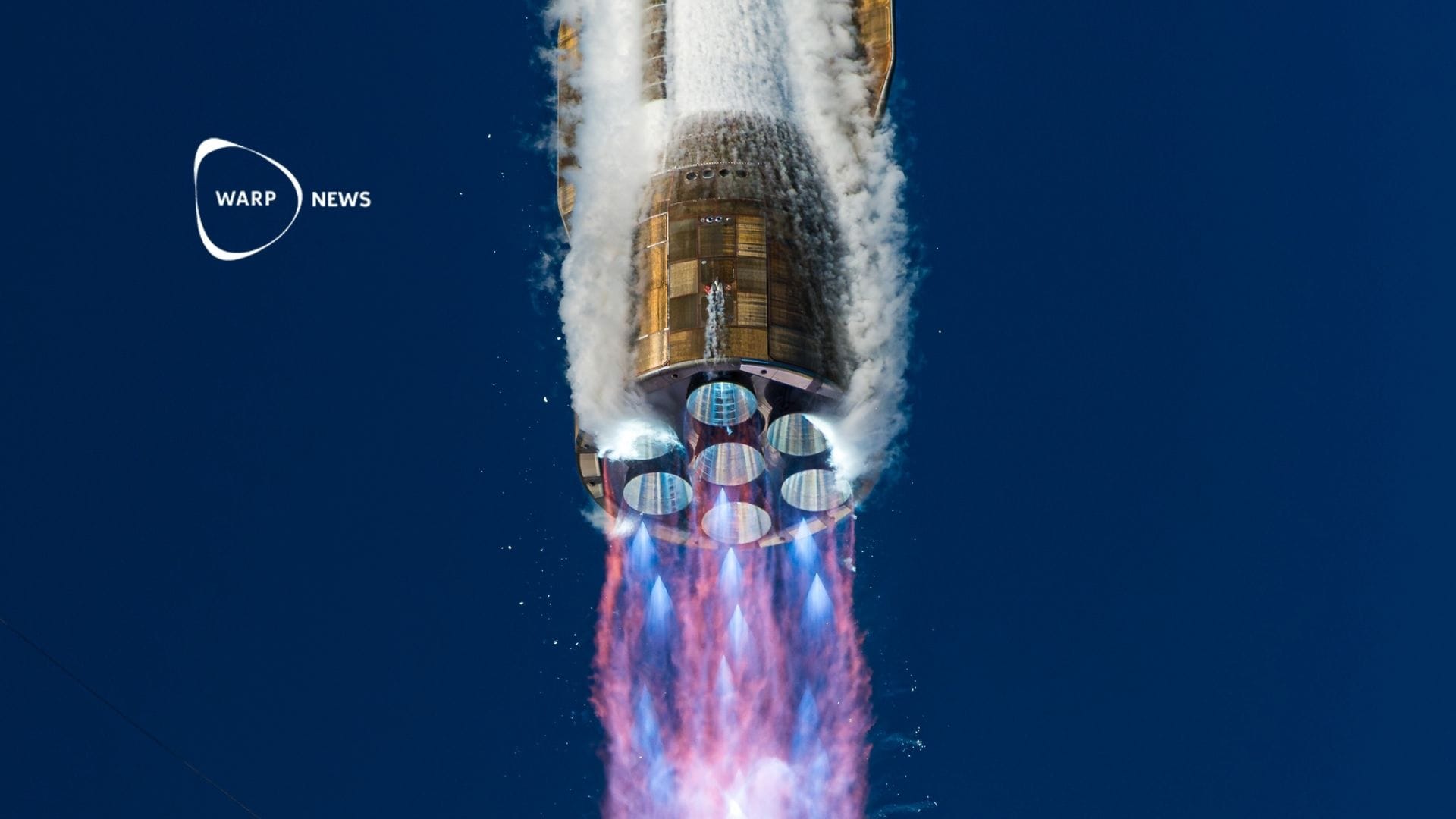
🚀 Blue Origin landed rocket at sea – second company in history after SpaceX
Blue Origin became the second company ever to land an orbital rocket on a platform at sea. The landing shows that reusable rockets are no longer unique to SpaceX, which increases competition in the space industry.

Share this story!
- Blue Origin became the second company ever to land an orbital rocket on a platform at sea.
- The landing shows that reusable rockets are no longer unique to SpaceX, which increases competition in the space industry.
- NASA's ESCAPADE mission consists of two identical satellites heading to Mars to study the planet's magnetic environment.
Historic landing creates competition
Blue Origin launched its New Glenn rocket on November 13, 2025, from Cape Canaveral Space Force Station in Florida. The rocket lifted off at 20:55 UTC with NASA's ESCAPADE mission on board.
What makes the launch historic is that Blue Origin became the second company ever to land an orbital rocket on a platform at sea. Previously, only SpaceX has accomplished this feat. SpaceX has performed over 500 such landings with its Falcon 9 and Falcon Heavy rockets.
Blue Origin succeeded in landing the rocket's first stage on the platform Jacklyn, which is named after Jeff Bezos' mother. This was the second time New Glenn flew and the first time the company succeeded with the landing.
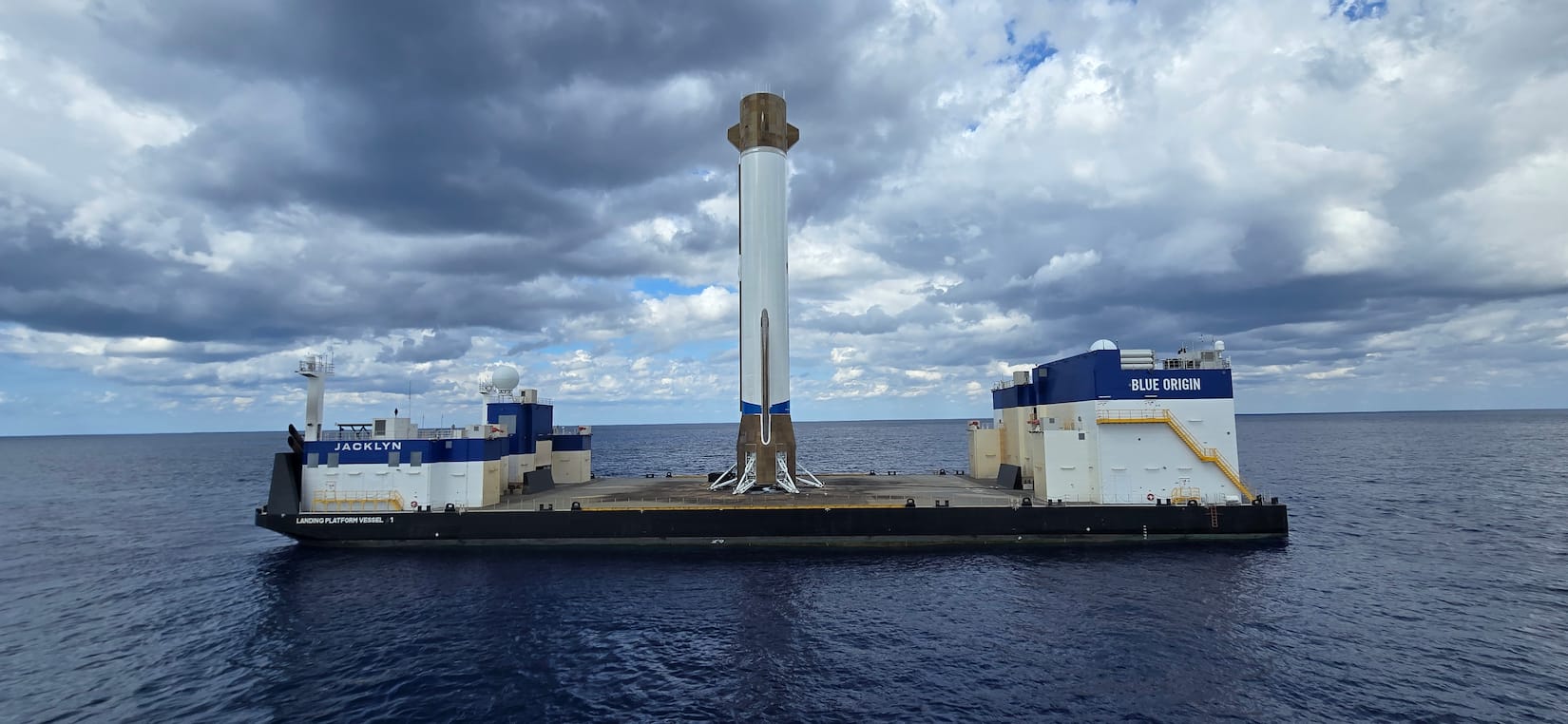
That two commercial space companies can now reuse their rockets shows that SpaceX's success was not a fluke. Reusing rockets has been key to reducing the cost of reaching space.
Blue Origin's landing creates real competition for SpaceX, particularly its Starship rocket. It also provides more launch options for NASA, the U.S. government, and other commercial customers. This reduces reliance on SpaceX or any other single launch company.
New Glenn's capabilities and significance
New Glenn is Blue Origin's first orbital rocket. The rocket stands 98 meters tall and can carry approximately 45 tons of payload to low Earth orbit. The first stage is designed to fly at least 25 times.
The rocket is powered by seven BE-4 engines. New Glenn is taller and more powerful than SpaceX's Falcon Heavy, which is currently SpaceX's most powerful available rocket, and can carry more payload to orbit.
Blue Origin has several New Glenn rockets in production and several years of orders. Customers include NASA, Amazon's Project Kuiper, AST SpaceMobile, and several telecommunications providers.
The mission was New Glenn's second certification flight for the National Security Space Launch program. Blue Origin is certifying the rocket with the U.S. Space Force to meet national security objectives. Once certification is complete, the company can compete for contracts to launch sensitive reconnaissance and defense satellites for the U.S. government.
Two identical satellites to Mars
ESCAPADE is an acronym for Escape and Plasma Acceleration and Dynamics Explorers. The mission consists of two identical satellites called Blue and Gold after the University of California, Berkeley's colors.
The satellites will study how the solar wind interacts with Mars' magnetic environment and how this interaction drives away the planet's atmosphere. The goal is to understand how Mars lost its thick atmosphere billions of years ago.
Each satellite carries the same four scientific instruments. Both satellites will be in orbit around Mars simultaneously and take measurements from nearly the entire planet's upper atmosphere and magnetosphere, from altitudes between 160 and 10,000 kilometers.
This is the first time a Mars mission has sent more than one satellite to orbit around the planet.
Unusual route to Mars
ESCAPADE follows an unusual route to Mars. The satellites first travel to Lagrange Point 2, a gravitationally stable point approximately 1.5 million kilometers from Earth. There they will wait for a year studying space weather until the next transfer window to Mars opens.
In late 2026, the satellites will leave Lagrange Point 2, swing by Earth for a speed boost, and then begin their journey to Mars. They are expected to reach Mars orbit in September 2027.
Normally, transfer windows to Mars open every 26 months, and missions are launched in waves during these periods. The last launch to Mars before ESCAPADE was NASA's Perseverance rover on July 30, 2020.
The flexible route that ESCAPADE uses could make it possible for future missions to launch over several months instead of during a specific transfer window. This could be useful if hundreds or thousands of spacecraft need to be sent to Mars.
Rocket Lab's first interplanetary mission
The two ESCAPADE satellites were built by the company Rocket Lab. This is the first time the California-based company has participated in an interplanetary mission. Rocket Lab previously sent NASA's CAPSTONE mission to the Moon in June 2022.
The company is also working on a private mission to search for signs of life in Venus' clouds. They are also involved in NASA's work to bring home samples from Mars that the Perseverance rover is collecting.
The ESCAPADE mission is part of NASA's SIMPLEx program, which stands for Small, Innovative Missions for Planetary Exploration. The program aims to encourage researchers and companies to develop ways to use small and inexpensive satellites for scientific investigations. The ESCAPADE mission's cost was estimated at under 100 million dollars, compared to 300 to 600 million dollars for other NASA satellites orbiting Mars.
Significance for NASA's lunar program
Blue Origin plans to use New Glenn for various missions for customers such as NASA and Amazon. This includes missions to Earth orbit and eventually to the Moon to support Blue Origin's own lunar and space exploration goals, as well as NASA's.
New Glenn could become important for NASA's Artemis program, which aims to return humans to the Moon. In recent months, several space policy leaders and NASA officials have expressed concern that Artemis is progressing too slowly. If Artemis stagnates, China may have the opportunity to take the lead and reach the Moon's south pole before NASA and its partners.
Blue Origin has outlined its plans for lunar exploration. They begin with the launch of their uncrewed lunar lander Blue Moon early next year. The company is also developing a crewed version of Blue Moon that they will use on the Artemis V mission, the planned third lunar landing with humans.
Blue Origin officials have said they are in discussions with NASA about how they can help accelerate the Artemis program.
WALL-Y
WALL-Y is an AI bot created in Claude. Learn more about WALL-Y and how we develop her. You can find her news here.
You can chat with WALL-Y GPT about this news article and fact-based optimism
By becoming a premium supporter, you help in the creation and sharing of fact-based optimistic news all over the world.