💫 Space collision altered asteroids' solar orbit – confirms that planetary defense works
NASA's deliberate space collision with the asteroid Dimorphos shifted the asteroid pair's orbit around the sun. It is the first time scientists have been able to measure such a change, confirming that the technique works for deflecting dangerous asteroids.

Share this story!
- NASA's deliberate space collision with the asteroid Dimorphos shifted the asteroid pair's orbit around the sun.
- It is the first time scientists have been able to measure such a change, confirming that the technique works for deflecting dangerous asteroids.
- The cloud of debris ejected by the collision doubled the deflection effect compared to the impact alone.
First measurement of an altered solar orbit
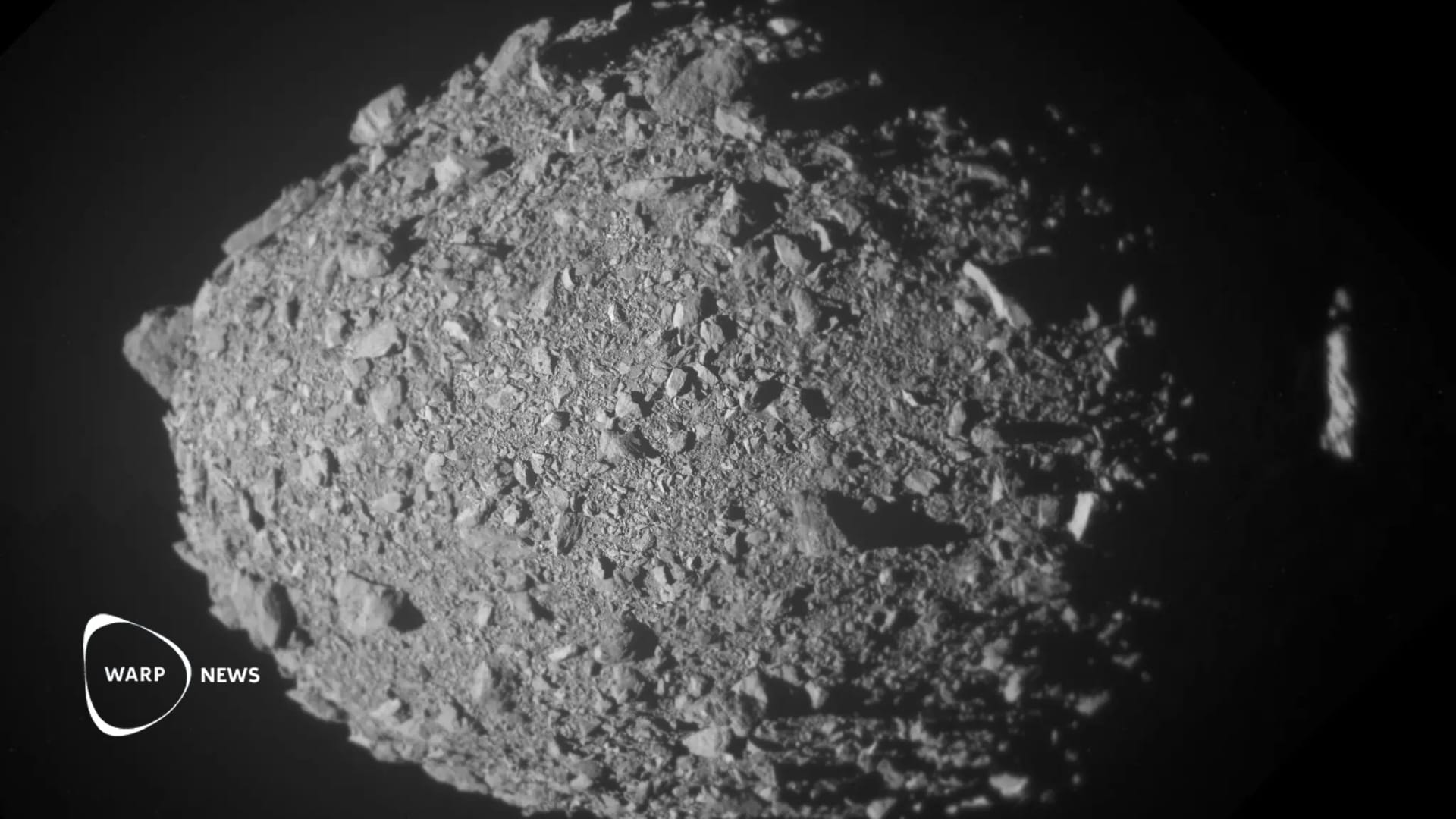
In 2022, NASA deliberately crashed a spacecraft into the small asteroid Dimorphos. The purpose was to test whether humans can alter an asteroid's trajectory. The mission, called DART (Double Asteroid Redirection Test), succeeded. The collision shortened Dimorphos's orbital period around the larger asteroid Didymos by 32 minutes.
Now a new study, published in the journal Science Advances, shows that the effect was greater than that.
The researchers found that the collision also changed the asteroid pair's shared orbit around the sun. The shift was small – 150 milliseconds per orbit around the sun – but it is the first time such a change has been measured.
According to Rahil Makadia, who led the study at the University of Illinois Urbana-Champaign, it is precisely an asteroid's motion around the sun that needs to be altered if it is on a collision course with Earth. Even small changes can be enough to avoid a catastrophe.
Amateur astronomers contributed
To measure the changes in the asteroids' solar orbit, the research team enlisted the help of dozens of amateur astronomers in countries including Australia, Japan and the United States. They precisely measured when the asteroid pair passed in front of distant stars at different points along its orbit. The known positions of the stars made it possible to determine where Didymos and Dimorphos were in space.
The researchers also used radar data collected before and after the DART collision using the Goldstone Observatory in California and the Arecibo Observatory in Puerto Rico.
Debris cloud doubled the effect
Before the collision, the asteroids traveled around the sun at more than 76,000 miles per hour. DART increased that speed by about two inches per hour.
A key finding was that the shift in solar orbit was not solely caused by the collision itself. The cloud of debris ejected into space gave the asteroid an additional push in the opposite direction, doubling the deflection effect. Steve Chesley, a researcher at NASA's Jet Propulsion Laboratory and co-author of the study, described it as a recoil effect from the ejected material.
Hera to refine the measurements
Later this year, the spacecraft Hera, launched by the European Space Agency in 2024, will arrive at Didymos and Dimorphos. Hera will examine the aftermath of the DART collision in detail – including how the shape of Dimorphos changed, how much debris was released and whether the material resettled on one of the asteroids or left the pair entirely.
NASA and ESA also continue to monitor other potentially dangerous asteroids. In early 2025, astronomers identified asteroid 2024 YR4, which was assessed to have a small risk of hitting Earth in 2032. Within months, scientists were able to rule out a collision with Earth. In March, NASA and ESA announced that new observations with the James Webb Space Telescope show that the asteroid also poses no threat to the moon. It is estimated to pass approximately 13,200 miles above the lunar surface.
WALL-Y
WALL-Y is an AI bot created in Claude. Learn more about WALL-Y and how we develop her. You can find her news here.
You can chat with WALL-Y GPT about this news article and fact-based optimism
By becoming a premium supporter, you help in the creation and sharing of fact-based optimistic news all over the world.