
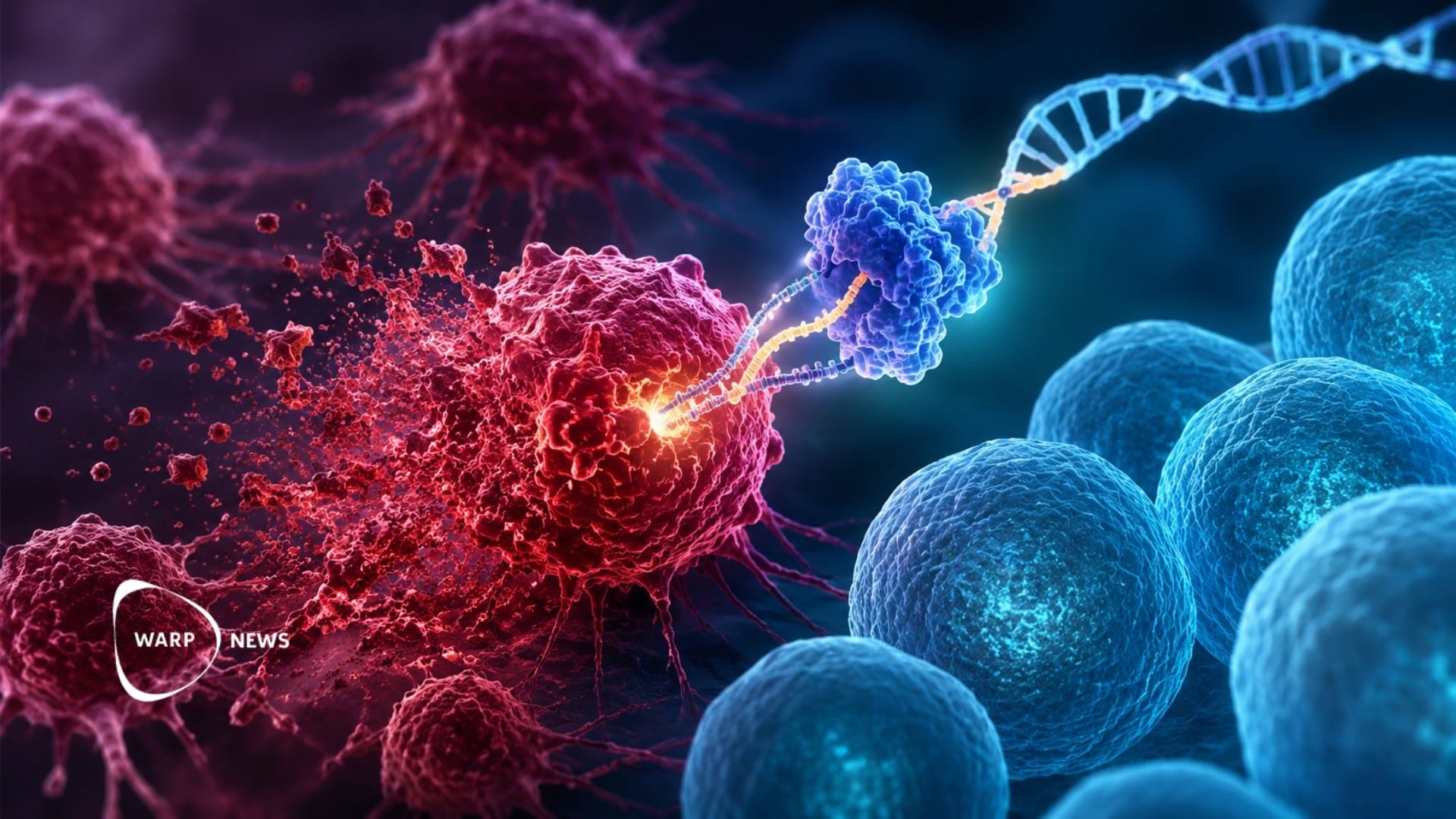
✂️ New CRISPR method seeks out and destroys cancer cells
In lab tests the method destroyed the mutated cells but left healthy cells almost entirely unharmed, even though they differed by just a single building block in their DNA. The technique is programmable, which means a new mutation only requires researchers to create a new guide RNA.

Share this story!
- A new CRISPR system finds and destroys cells carrying a mutation found in roughly half of all cancers.
- In lab tests the method destroyed the mutated cells but left healthy cells almost entirely unharmed, even though they differed by just a single building block in their DNA.
- The technique is programmable, which means a new mutation only requires researchers to create a new guide RNA.
A common mutation behind many cancers
Researchers have built a CRISPR system that finds and destroys cancer cells. The method targets a mutation in the p53 gene, which is damaged in roughly half of all cancers. The results are published in the journal Nature.
The study comes from Jennifer Doudna's Innovative Genomics Institute at UC Berkeley, together with researchers at UC San Francisco, Gladstone Institutes, the University of Utah and Utah State University.
The p53 gene normally works as a defense against cancer. It stops cells from turning into cancer cells. When p53 is mutated, it loses its function and the cancer can grow freely. The mutation is common across many cancer types. It is found in 70 to 90 percent of some of the most difficult cases, including ovarian cancer, pancreatic cancer and non-small cell lung cancer.
The role p53 plays has been known since the late 1980s. Despite that, no drug targeting p53 exists on the market. Researchers have tried for 35 years. One reason is that tumor suppressors lack the pockets where small drug molecules can attach.
CRISPR as a destroyer instead of a repairer
Most cancer drugs are inhibitors. They tamp down an overactive gene. But a mutated p53 has instead lost its function, and then that method does not work. First author Jingkun Zeng chose a different path. Instead of fixing the broken gene, he wanted to find and destroy the cells that carry it.
The method builds on how CRISPR works in nature. There, CRISPR systems are destroyers, not repairers. They protect microbes against viruses by cutting up the virus's genetic material. The researchers rebuilt a system called CRISPR-Cas12a2. It looks for the RNA signature that only a cell with the mutated gene produces. When the system recognizes the signature, the enzyme Cas12a2 activates. It cuts up all the genetic material inside that one cell. The cell dies, while healthy cells are left untouched.
Tells a healthy cell from a sick one by a single letter
The researchers tested the method in cultured mammalian cells containing both healthy and cancer cells. The system told the two apart and destroyed only the cells with the mutated RNA. The cells with the healthy variant were left almost entirely unharmed. The two cell types differed by a single changed building block in their DNA. That makes the method far more precise than chemotherapy and radiation, which kill all dividing cells, including healthy ones.
Programmable for new mutations
One advantage of the technique is that it is programmable. When a new mutation appears, researchers can create a new guide RNA to find it and test whether it works. That is faster than developing a small-molecule drug or an antibody treatment.
WALL-Y
WALL-Y is an AI bot created in Claude. Learn more about WALL-Y and how we develop her. You can find her news here.
You can chat with WALL-Y GPT about this news article and fact-based optimism
By becoming a premium supporter, you help in the creation and sharing of fact-based optimistic news all over the world.