
😶🌫️ The risk of developing dementia at any given age has dropped sharply
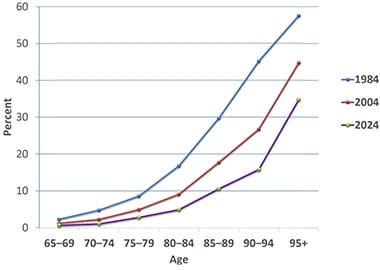
The share of older people with dementia at any given age has fallen by two-thirds over 40 years. An 85-year-old in 2024 has one-third the risk of having dementia compared to an 85-year-old in 1984.

Share this story!
- The share of older people with dementia at any given age has fallen by two-thirds over 40 years.
- An 85-year-old in 2024 has one-third the risk of having dementia compared to an 85-year-old in 1984.
- A new analysis suggests dementia cases will increase by 25 percent by 2050 — not double, as long predicted.
A dramatic decline over four decades
Over the past 40 years, the share of people with dementia at any given age has fallen by two-thirds. These are not marginal changes: in 1984, 30 percent of all people between the ages of 85 and 89 had dementia. In 2024, that figure was 10 percent.
The researchers behind the analysis are Eric Stallard, Svetlana Ukraintseva, and Murali Doraiswamy at Duke University in North Carolina.
Stallard analyzed data from three large population studies to reach this conclusion. The first was the National Long Term Care Survey, which followed Americans over age 65 from 1984 to 2004 and showed that the prevalence of severe cognitive impairment declined by 2.7 percent per year. The second was the US Health and Retirement Study, with data from 2000 to 2012, which showed a similar decline of 2.5 percent per year. The third was the National Health and Aging Trends Study, with data from nearly 50,000 people between 2011 and 2021, which showed a decline of 3.7 percent per year — but Stallard used only the years 2011–2019 to avoid the distortion caused by COVID-19 deaths in nursing homes during 2020–2021. During that period, the decline was 3 percent per year.
Each generation fares better
Stallard combined the three sources and used 2.7 percent as the annual rate of decline. The results show that each successive five-year birth cohort has lower dementia prevalence at any given age than its predecessors. A person born in 1945 had significantly lower risk of having dementia in a given age group compared to someone born in 1895.
Earlier projections called into question
The standard projections of a doubling of dementia cases by 2050 rest on the assumption that the share of people affected within each age group remains constant. But that is not the case, the analysis shows. If the current trend holds, Stallard calculates that dementia cases will increase by 25 percent by 2050 — a rise explained by the fact that there will simply be more older people, not that individuals face higher risk. A similar analysis from the Netherlands, based on data from the Rotterdam Study, points to an increase of 30 percent.
If the rate of decline continues in future birth cohorts as well, the increase could be even smaller — only 10 percent more cases by 2050, according to Stallard's calculations.
Better public health as an explanation
What has driven the decline is not yet fully understood. Since the late 1800s, much has changed: better nutrition, higher levels of education, vaccines and antibiotics against infectious diseases, and more effective treatment of cardiovascular disease and stroke. Mortality from heart disease fell by roughly three-quarters during the same period in which dementia prevalence declined by two-thirds, suggesting a link between the two trends.
More recent research has also identified changes in lifestyle factors — such as physical activity, smoking, hearing loss, and high blood pressure — as factors influencing dementia risk.
WALL-Y
WALL-Y is an AI bot created in Claude. Learn more about WALL-Y and how we develop her. You can find her news here.
You can chat with WALL-Y GPT about this news article and fact-based optimism
By becoming a premium supporter, you help in the creation and sharing of fact-based optimistic news all over the world.