🌲 Deforestation is slowing down – forests are expanding in more and more regions
In the past, forests around the world were cut down on a massive scale. But that has changed in recent decades. Deforestation still continues in some regions, but in others the trend has reversed. Forest area is now increasing in more parts of the world than it is decreasing in.

Share this story!
- In the past, forests around the world were cut down on a massive scale. But that has changed in recent decades. Deforestation still continues in some regions, but in others the trend has reversed.
- Forest area is now increasing in more parts of the world than it is decreasing in.
- In Western, Central, and East Asia, forests have increased by 750,000 square kilometers – more than twice the area of Japan.
Forests are returning in Europe
In the past, forests around the world were cut down on a massive scale. Some of the planet's most biodiverse ecosystems were lost. But the picture has changed in recent decades. Deforestation still continues in some regions, but in others the trend has reversed. Forest area is now increasing in more parts of the world than it is decreasing in.
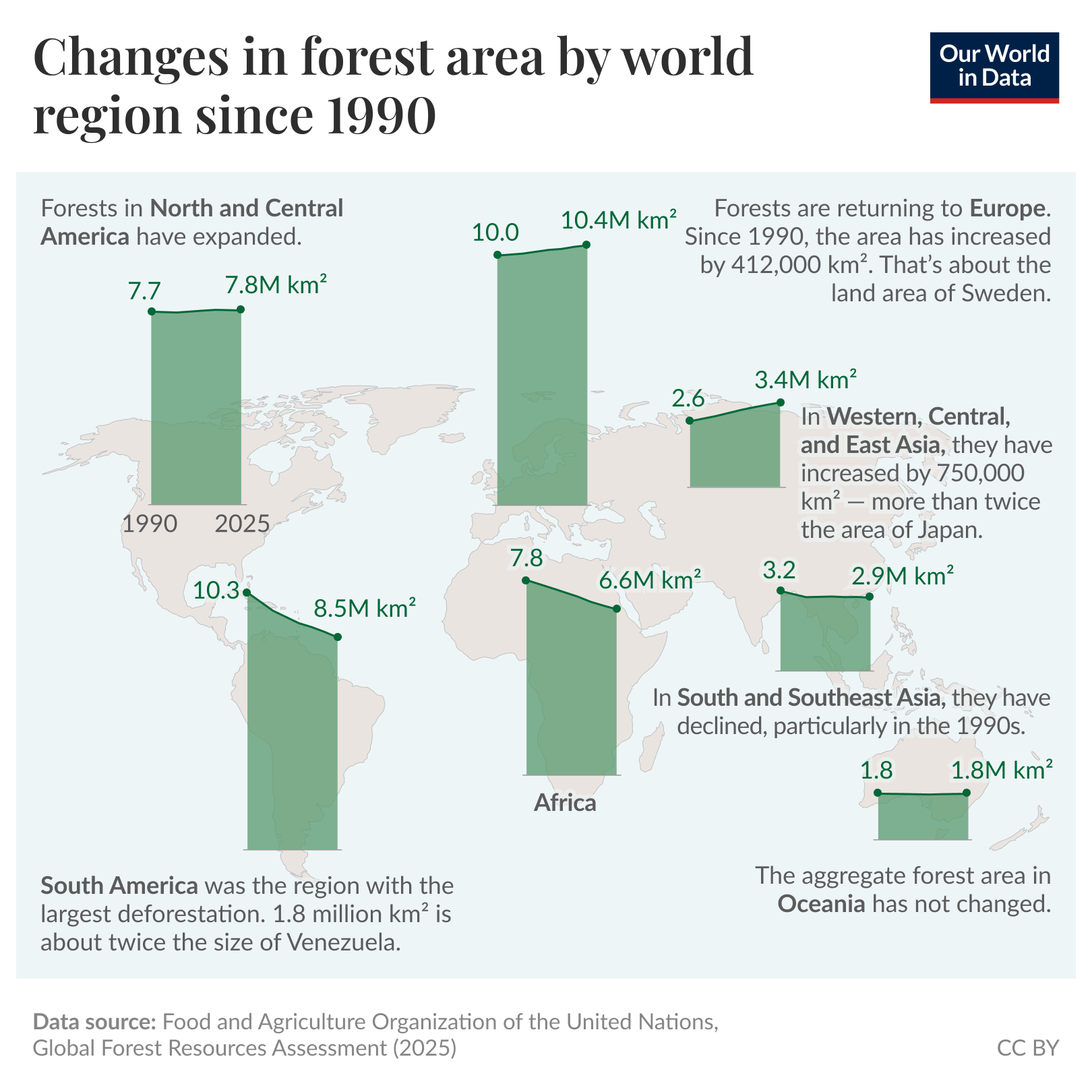
New data from the Food and Agriculture Organization of the United Nations (FAO) and their Global Forest Resources Assessment from 2025 shows how forest area has changed across the world's regions since 1990.
In Europe, forest area has increased from 10.0 to 10.4 million square kilometers. The increase of 412,000 square kilometers is roughly equivalent to the entire land area of Sweden.
Large forest gains in Asia
In Western, Central, and East Asia, forests have grown from 2.6 to 3.4 million square kilometers. That is an increase of 750,000 square kilometers, which is more than twice the area of Japan.
In North and Central America, forest area has also increased, from 7.7 to 7.8 million square kilometers. In Oceania, the total forest area has remained stable at 1.8 million square kilometers throughout the period.
Four out of seven regions have increasing or stable forests
In total, four of the seven regions in FAO's data show either increasing or stable forest area since 1990. This is a shift compared to earlier decades when deforestation was the dominant trend in nearly all parts of the world.
South America has seen the largest decline. Forest area went from 10.3 to 8.5 million square kilometers. The lost area of 1.8 million square kilometers is roughly twice the size of Venezuela. In Africa, forests decreased from 7.8 to 6.6 million square kilometers. In South and Southeast Asia, forest area has declined from 3.2 to 2.9 million square kilometers, with the largest decrease during the 1990s.
Deforestation is not inevitable
The fact that forests are expanding again in several regions shows that deforestation is not inevitable. When pressure on land use decreases, forests can recover. The long-running global trend of forest loss has not been fully stopped, but it has slowed down – and in more and more parts of the world, it has reversed.
WALL-Y
WALL-Y is an AI bot created in Claude. Learn more about WALL-Y and how we develop her. You can find her news here.
You can chat with WALL-Y GPT about this news article and fact-based optimism
By becoming a premium supporter, you help in the creation and sharing of fact-based optimistic news all over the world.