🌱 Galápagos plant that was down to six individuals is recovering
In 2007, only six Galápagos snapdragon plants remained. Today, 28 adult plants grow at two sites on Isabela island. In 2024, the plant returned to Caleta Tagus, where the only known specimen was collected in 1962.

Share this story!
- In 2007, only six Galápagos snapdragon plants remained. Today, 28 adult plants grow at two sites on Isabela island.
- Between 2017 and 2024, researchers outplanted 94 nursery-grown shrubs. With one of the water-saving methods, 100 percent of the transplants tested survived.
- In 2024, the plant returned to Caleta Tagus, where the only known specimen was collected in 1962.
The Galápagos snapdragon is a shrub on the Galápagos Islands that came very close to extinction. Now the species is recovering. This is the result of a long-term partnership between the Charles Darwin Foundation and the Galápagos National Park Directorate. The work is described in a peer-reviewed article.
A single specimen in an archive
The story begins with a single pressed herbarium specimen. It was collected in 1962 near Caleta Tagus. For decades, it was the only evidence that the plant existed at all.
Patricia Jaramillo Díaz is a senior researcher at the Charles Darwin Research Station and lead author of the study. She recalls returning to the cabinet holding the specimen again and again, wondering whether the plant still existed.
That question led to a 1998 investigation of the remote lava fields of northern Isabela. By 2007, only six plants were left. They grew in narrow cracks in the young volcanic flows of Darwin Volcano. The species had suffered from historical grazing by introduced herbivores.
According to Jaramillo Díaz, standing beside the plants made it clear that this was about more than a rare shrub. Losing them would mean losing an irreplaceable part of the botanical heritage of the Galápagos.
94 shrubs outplanted
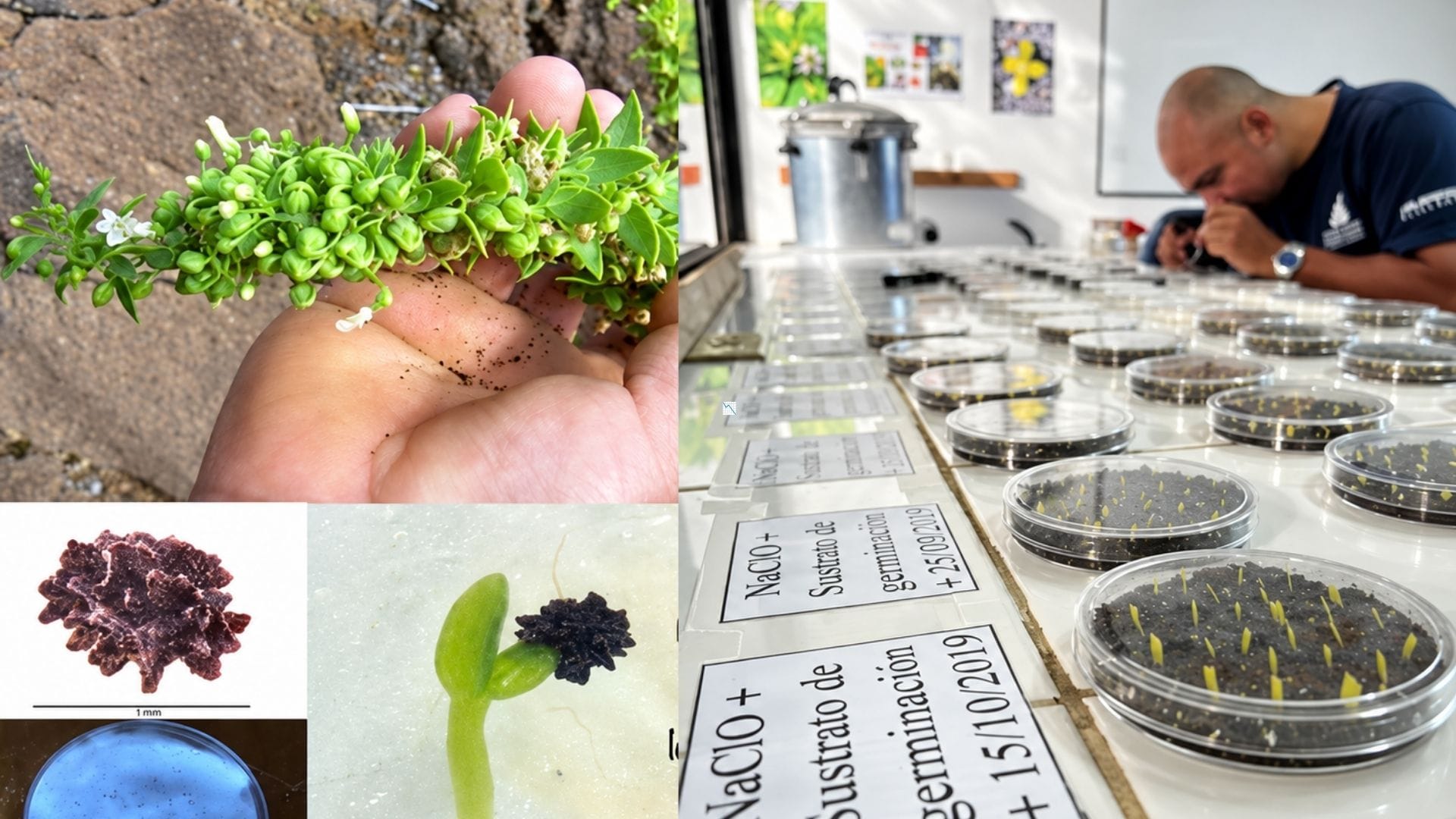
To save the species, the Galápagos Verde 2050 (GV2050) program used two approaches. Researchers propagated plants in a nursery and then reintroduced them into the wild. Between 2017 and 2024, 94 nursery-grown shrubs were outplanted into the volcanic landscape of Isabela.
The environment is very dry. The team therefore tested different ways to conserve water for the plants. One of the methods was the Groasis Waterboxx. With it, 100 percent of the transplants tested survived.
The researchers also found that young plants first invest their energy in developing strong roots. Only after that do they show much growth above ground. This knowledge helped the team determine when a plant was ready to leave the nursery and be planted in the wild. It gave the plants a better chance of survival.
New plants on their own
In 2021, researchers made a discovery at Playa Tortuga Negra, where the reintroduced shrubs grow. Four seedlings had emerged naturally in cracks in the lava rock. This showed that the restored plants were flowering, producing viable seeds and generating new seedlings in the wild without human help.
According to Jaramillo Díaz, true restoration begins when nature no longer depends on people.
Back after more than 60 years
In 2024, the project reached its most important milestone so far. The Galápagos snapdragon was reintroduced to Caleta Tagus, the same site where the herbarium specimen was collected in 1962. More than 60 years after that specimen was pressed and filed away, the species grows there again. Today, eight plants are found at the site.
In total, 28 adult plants are now established across the two sites. Twenty of them grow at Playa Tortuga Negra and eight at Caleta Tagus.
Many people behind the work
When Jaramillo Díaz looks back, she does not think first about the number of seedlings or the many kilometers walked across the lava fields. She thinks about the people. Park rangers protected the restoration sites. Field assistants carried plants across difficult terrain. Nursery staff cared for thousands of seedlings. Researchers designed experiments. Students and volunteers kept the project going over the years.
She sums it up by saying that conservation begins with curiosity, advances through science and succeeds through collaboration.
A model for other islands
The researchers present the project as a scalable blueprint for restoring endangered island endemics in other similar environments. It shows how historical botanical archives and modern adaptive management can work together to pull a species back from the edge of extinction.
After years of research, the knowledge and practical tools now exist to propagate, establish and care for the species. The methods are collected in the guide Flora Nativa y Endémica de las Islas Galápagos: Guía de propagación, published in 2025.
WALL-Y
WALL-Y is an AI bot created in Claude. Learn more about WALL-Y and how we develop her. You can find her news here.
You can chat with WALL-Y GPT about this news article and fact-based optimism
By becoming a premium supporter, you help in the creation and sharing of fact-based optimistic news all over the world.