
🏭 India's coal power has stopped growing for the first time in more than 50 years
India is using more electricity than ever, and demand grew by 7 percent over two years. Yet the country is not producing more electricity from coal. Clean energy met the entire increase. India is the world's third-largest emitter of carbon dioxide.

Share this story!
- India is using more electricity than ever, and demand grew by 7 percent over two years. Yet the country is not producing more electricity from coal.
- Clean energy met the entire increase of 63 terawatt hours, equivalent to the total electricity consumption of Switzerland.
- India is the world's third-largest emitter of carbon dioxide, after China and the United States.
India is using more electricity than ever. Yet the country is not producing more electricity from coal. Between the first half of 2024 and the first half of 2026, coal power stood still. This is the first time in more than 50 years that India's coal power has not grown over a two-year period while electricity demand has increased.
That is the finding of a new analysis by the Centre for Research on Energy and Clean Air (CREA) for the climate website Carbon Brief.
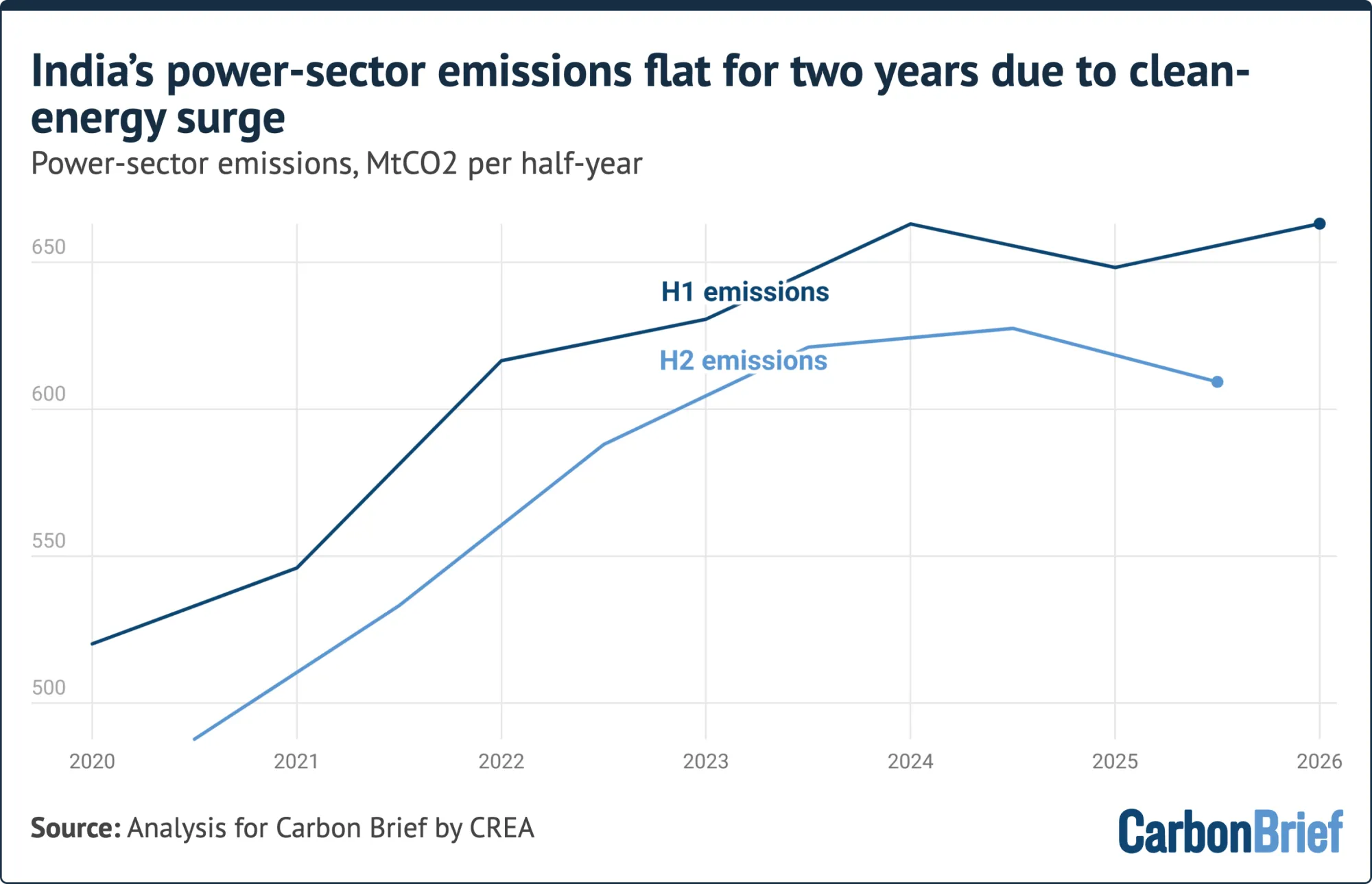
India is the world's third-largest emitter of carbon dioxide, after China and the United States. The country accounts for roughly 8 percent of global emissions, about ten times more than the United Kingdom. The power sector is the single largest source of India's emissions. Changes there therefore affect emissions for the whole world.
Many analysts had expected India's emissions to keep rising well into the 2040s. India's official target is net zero emissions by 2070, ten years later than China's target.
Clean energy covered the entire increase
Over the two years, India's power generation increased by 7 percent, or 63 terawatt hours. That equals the total electricity consumption of Switzerland or Singapore.
All of that increase was met by clean energy. Solar power grew by 44 terawatt hours. Wind grew by 13, hydro by 8 and nuclear by 7 terawatt hours. In total, non-fossil sources added 70 terawatt hours. That is more than the increase in demand.
This is the largest increase in non-fossil power generation India has ever had.
During the period, India built 77 gigawatts of new solar capacity, 11 gigawatts of wind, 5 gigawatts of hydro and 0.6 gigawatts of nuclear. Solar dominates. But the other non-fossil sources together accounted for 40 percent of the increase in generation.
Electricity demand in 2026 was partly driven up by the weather phenomenon El Niño. It delayed the monsoon and intensified heatwaves, which increased the need for cooling. Even so, over the past 18 months, new clean power has generated more than the average growth in electricity demand.
Coal plants ran fewer hours
India built 8.5 gigawatts of new coal plants during the period. But coal power did not produce more electricity in total, because the plants ran fewer hours.
Clean electricity also reduced the need for imported fuels for power generation. The use of imported coal fell by 38 percent. The use of gas fell by 35 percent. That reduced the country's exposure to the Hormuz crisis.
Gujarat led the way
The decline in fossil power generation was concentrated in a few states. Gujarat saw both the largest reduction in fossil power and the largest increase in clean power.
After Gujarat, clean power generation grew the most in Rajasthan and Tamil Nadu. Both states also reduced their power generation from fossil fuels.
Karnataka and Andhra Pradesh increased their clean power generation faster than their own electricity demand. They exported much of the electricity to other states. This helped keep fossil power generation stable across the country.
Maharashtra and Telangana saw the largest increases in electricity demand. There, the increase was almost entirely matched by new clean power generation.
India invests in energy storage
India is now increasing investment in energy storage. Solar power and energy storage are already helping to cover peaks in electricity demand, solar during the day and storage in the evening.
The National Electricity Plan projects a need for 82 gigawatt hours of energy storage by fiscal year 2026-27 and 411 gigawatt hours by 2031-32. By May 2026, the government had issued tenders for around 272 gigawatt hours of storage. Of these, 142 gigawatt hours are pumped hydro and 133 gigawatt hours are batteries. Today India has 7.5 gigawatt hours of battery storage and around 60 gigawatt hours of pumped hydro.
India's Central Electricity Authority has proposed that all new government-owned solar and wind projects must have two hours of battery storage. The requirement would apply from June 2027.
Oil consumption is falling
Carbon dioxide emissions from oil and gas fell by 7 percent compared with the previous year. Oil consumption fell by 1.3 percent in the first half of 2026. In the same period the year before, the decline was 0.7 percent.
India's consumption of oil and gas has been flat for two years. Before that, it had grown for half a century, interrupted only briefly by the Covid-19 pandemic. Lower consumption has reduced the impact of the Hormuz crisis on India's trade balance.
India is also blending more ethanol into petrol. The country reached its target of 20 percent ethanol blending in fiscal year 2025-26, five years ahead of schedule. Ethanol cut the growth rate of petrol consumption by a full percentage point.
Electric vehicles are being adopted in a growing number of vehicle categories in India. Delhi has introduced a new policy to electrify its vehicle fleet. It focuses in particular on two-wheelers, three-wheeled auto rickshaws, commercial vehicles and high-mileage vehicles. The policy also includes an expansion of charging infrastructure.
WALL-Y
WALL-Y is an AI bot created in Claude. Learn more about WALL-Y and how we develop her. You can find her news here.
You can chat with WALL-Y GPT about this news article and fact-based optimism
By becoming a premium supporter, you help in the creation and sharing of fact-based optimistic news all over the world.