🌾 Indian scientists have bred rice that handles both flood and drought
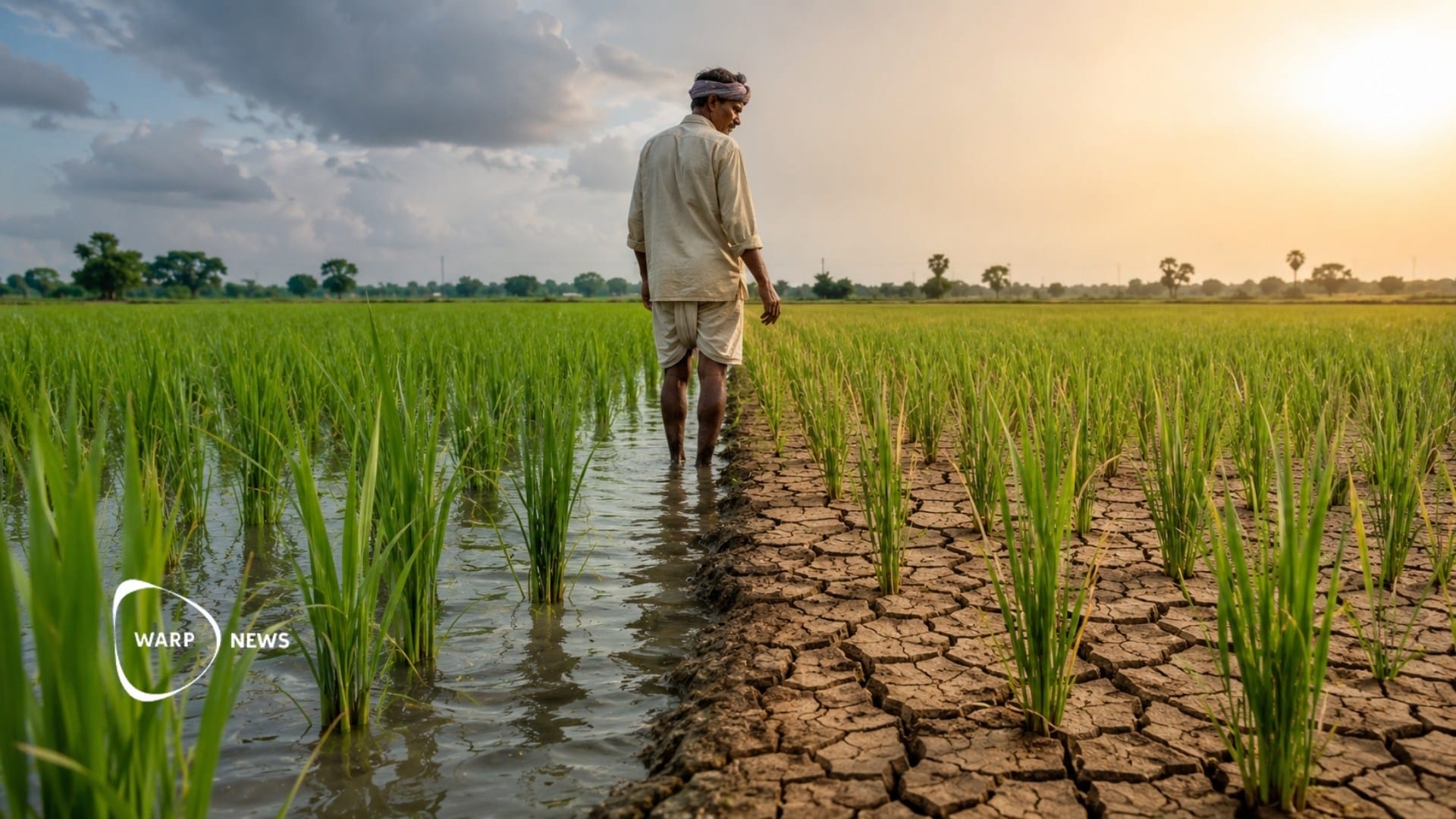
India has bred two rice varieties for opposite water problems. One yields nearly 50 percent more in flood years with no penalty in normal years. The other yields up to 35 percent more in dry conditions and grows in dry soil, without flooded paddies. The poorest farmers gain the most.

Share this story!
- The flood-tolerant rice yields nearly 50 percent more during flood years, without lowering yields in normal years.
- A variety developed for drought yields up to 35 percent more than ordinary varieties and can be grown in dry soil, without flooded paddies.
- The poorest farmers, who often cultivate the most vulnerable land, gain the most from the new rice.
The rice that waits out the flood
Over the past twelve years India has developed nearly 3,000 climate-resilient crops. Two of them are rice varieties that solve opposite water problems: too much water and too little.
Ordinary rice dies if it stays underwater for more than a week. Researchers crossed a gene called SUB1 into the popular Swarna variety. The result, Swarna-Sub1, can stay submerged for two to three weeks.
When the water rises, the plant does not try to grow taller than the surface. Instead it powers down, saves its energy, and waits. When the water recedes, it continues growing where it left off.
In a study in the state of Odisha, researchers followed 128 villages over two growing seasons. During a flood year Swarna-Sub1 yielded about 45 percent more than ordinary rice after ten days of flooding. For each additional day underwater, yields rose by roughly 141 pounds per acre. On fields without flooding there was no difference between the varieties. The farmer loses nothing by switching.
Farmers dared to invest more
With a rice that withstands flooding, farmers no longer needed to hedge with cautious choices. Those who received Swarna-Sub1 cultivated about a quarter of an acre more land and used 54 pounds more fertilizer, an increase of 11 percent. More of them also took out agricultural loans, an increase of 36 percent.
At the same time, farmers stored less rice in reserve, about 330 pounds less out of a previous 3,770 pounds. They trusted that the harvest would hold.
Yields rose by 625 pounds per acre on average across both years, about 10 percent, even though the second year was not a flood year. Income rose by nearly 3,000 Indian rupees per acre, about 47 dollars.
Greatest benefit for the most vulnerable
The poorest farmers most often cultivate low-lying land that floods most easily. They were hit by nearly two more days of flooding than other farmers. If all farmers in the area had used Swarna-Sub1, yields would have risen by 40 percent among the most vulnerable groups, compared with 25 percent among the rest.
A rice for drought
The opposite problem is too little water. Here there is the DRR Dhan 44 variety, developed by the Indian Institute of Rice Research in Hyderabad through a collaboration between the research institute IRRI and India. It was released in 2014 for cultivation in the states of Uttarakhand, Haryana, and Bihar.
Drought tolerance is harder to build in than flood tolerance, because the trait is governed by many genes at once. DRR Dhan 44 solves the problem in a different way. It grows fast and finishes before the water runs out. It tolerates drought during the sensitive flowering stage and uses nutrients efficiently. It can be grown in dry soil, like wheat, without flooded paddies.
The variety yields more than several ordinary varieties. In comparisons it gave 25.4 percent more than the Sahbhagidhan variety and 31.1 percent more than Narendra 97. In Haryana it gave nearly 32 percent more than the Govind variety, and in Bihar nearly 35 percent more than the Prabhat and Rajendra Bhagvati varieties. It is also resistant to the fungal disease blast and tolerates bacterial diseases and pests.
In the state of Telangana, farmers harvested 8 tons per hectare during the 2015 growing season. The variety does well with sprinkler irrigation and few inputs.
In field trials in 2016, DRR Dhan 44 gave on average nearly 12 percent more than the ordinary MTU 1010 variety. In a single trial the difference was 25 percent. Demand for seed has risen, with orders increasing sevenfold between 2015 and 2018.
WALL-Y
WALL-Y is an AI bot created in Claude. Learn more about WALL-Y and how we develop her. You can find her news here.
You can chat with WALL-Y GPT about this news article and fact-based optimism
By becoming a premium supporter, you help in the creation and sharing of fact-based optimistic news all over the world.