
💡 Musings of the Angry Optimist: Without China, emissions would already have peaked
Are we close to the first major milestone for the climate?

Share this story!
My thoughts, tips, and other tidbits that I believe are suited for a fact-based optimist. This newsletter is for you who are a Premium Supporter at Warp News. Feel free to share it with friends and acquaintances.
🌏 And now China has peaked too?
Last week, I stumbled upon a very interesting claim:
“...China's been responsible for about 90 % of the global emissions growth over the past decade since the Paris Agreement was negotiated. Another way of putting that is global emissions would have already peaked, or at least plateaued if it wasn't for emissions growth in China. So that's how crucial what happens in China is for the global emission trends.”
In other words: Without China, the world’s CO2 emissions would hardly have increased over the past ten years, and total emissions would during this period have peaked, or at least leveled off.
The person saying this is Lauri Myllyvirta. He is the lead analyst at the Centre for Research on Energy and Clean Air, an independent research organization from Finland.
It’s important to point out that what he means is specifically carbon dioxide emissions. If you include all greenhouse gas emissions, the figure is 60–70 percent.
Of course, for the climate it doesn’t matter if CO2 emissions would have peaked without including China. Emissions are emissions. But it still gives me hope, because it shows that large parts of the world have started to get their emissions under control, and many countries have actually reduced them. For example, within the EU:
“The Union is on track to reduce greenhouse gas emissions by 54 percent by 2030 compared to 1990 levels.”
Moreover, it could very well be that China’s CO2 emissions have now peaked too. We wrote about it as recently as August:
“China’s carbon dioxide emissions fell by one percent during the first half of 2025 and continued the downward trend that began in March 2024.”
The main reason for the decline is the massive growth of solar and wind power in China. Nothing indicates that this will slow down—on the contrary, it is accelerating.
There is still a long way to go, but reaching the point where emissions stop increasing is an important first milestone. That milestone now seems to be within sight.
❗ Other stuff
🚗 Mark Cuban’s AI tip
Mark Cuban is an American entrepreneur, investor, and television personality. He is best known as the (now minority) owner of the NBA team Dallas Mavericks and as one of the investors on the TV show Shark Tank.
He made his first big fortune in the 1990s when he sold his company Broadcast.com—an early pioneer in internet radio and streaming—to Yahoo in 1999 for nearly $6 billion. Before that, he had also founded MicroSolutions, an IT consulting firm he sold in the early 1990s.
Now he’s giving his best advice to us at the dawn of the AI era:
"I've been through every single technology event and evolution, and this blows them all away. How you implement it in business is a whole different issue. When I was 24, I was walking into companies who had never seen a PC before and explaining the value. They would say, "Son, I got this receptionist right there. I got that secretary. I'm never gonna need that shit, ever." But my business back then was helping them figure out how to implement it to gain an advantage.
There are gonna be integrators—particularly young kids. When my kids ask me what they should do, I tell them: "Learn all you can about AI, but learn even more about how to implement it in companies."
☢️ AI is worse than nuclear war
I haven’t yet had the chance to read Eliezer Yudkowsky’s book If anyone builds it, everyone dies. The “it” refers to superintelligent AI. But someone who has read it is New Scientist—and they’re not impressed.
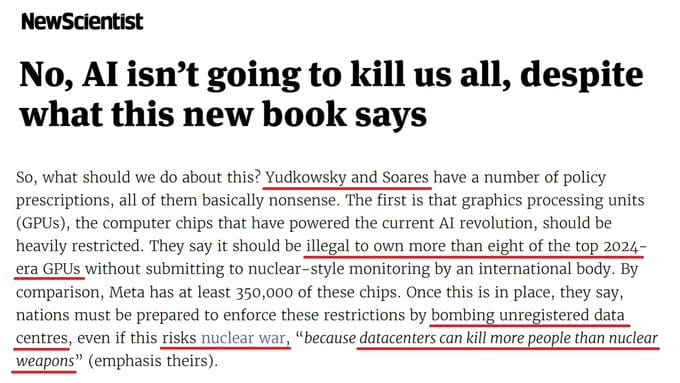
In the book, Yudkowsky advocates for strict restrictions on processors. If someone breaks the ban, airstrikes against them should not be ruled out, even if it risks triggering nuclear war, since “data centers can kill more people than nuclear weapons.”
Does this sound like the musings of some fringe figure on an obscure forum? Then let me inform you that Eliezer Yudkowsky has many followers. Max Tegmark calls the book “the most important book of the decade.” It’s exactly as bizarre as it seems.
In my own book, I’ve examine how two people laid the foundation for this extreme ideology that claims AI will wipe us out.
🌾 Fewer work in agriculture
Over the past 30 years, the share of people employed in agriculture in Asia has fallen sharply.
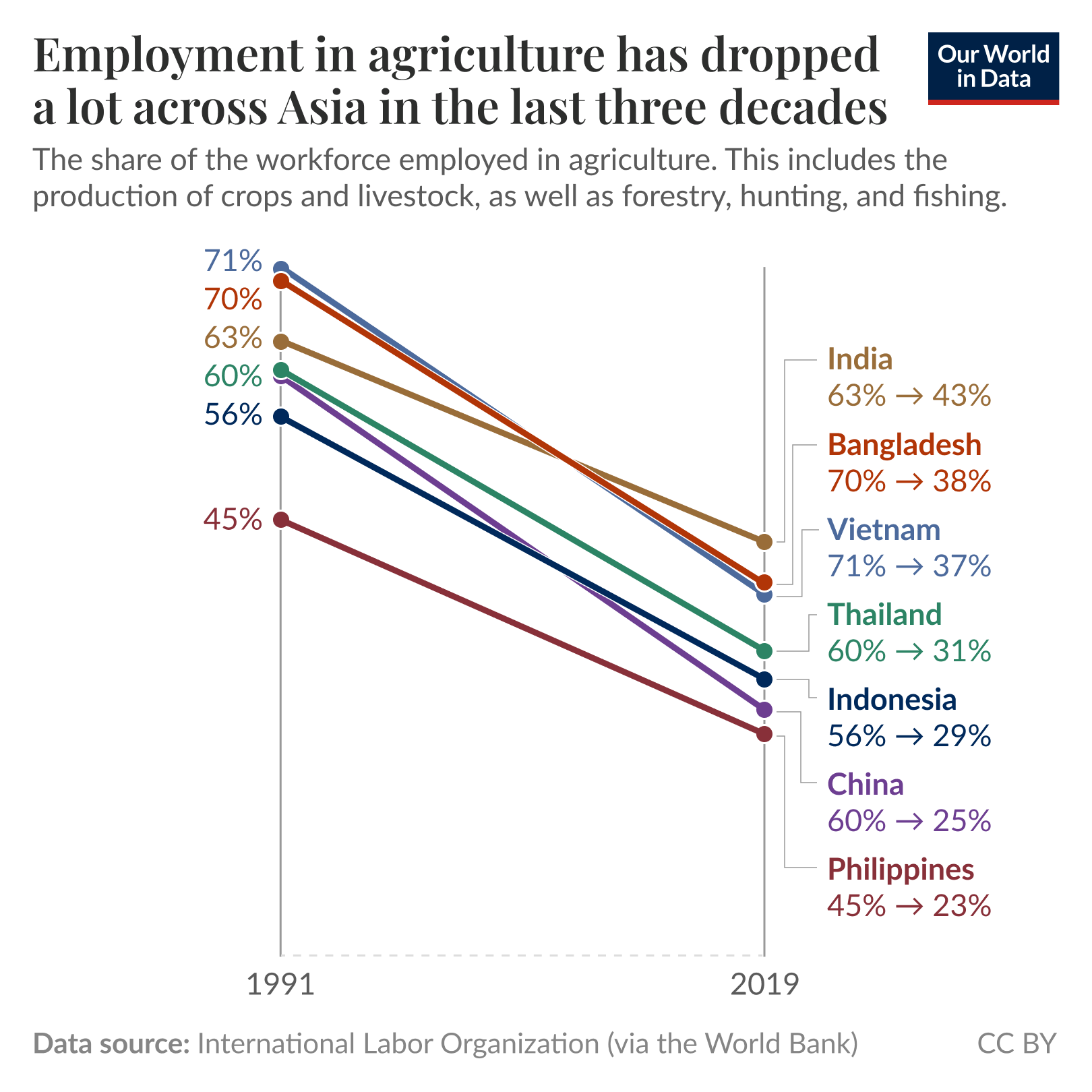
In the 1990s, almost two-thirds in South Asia and over half in East Asia worked in agriculture. Today it’s 40 and 25 percent, respectively.
Bangladesh and Vietnam have gone from around 70 to 38 percent, China from 60 to 25. India has changed more slowly.
Productivity gains mean fewer workers are needed in farming, income per worker rises, and those moving into industry and services often earn higher wages. This has contributed to rising average incomes in the region.
Mathias Sundin
Angry Optimist
By becoming a premium supporter, you help in the creation and sharing of fact-based optimistic news all over the world.