
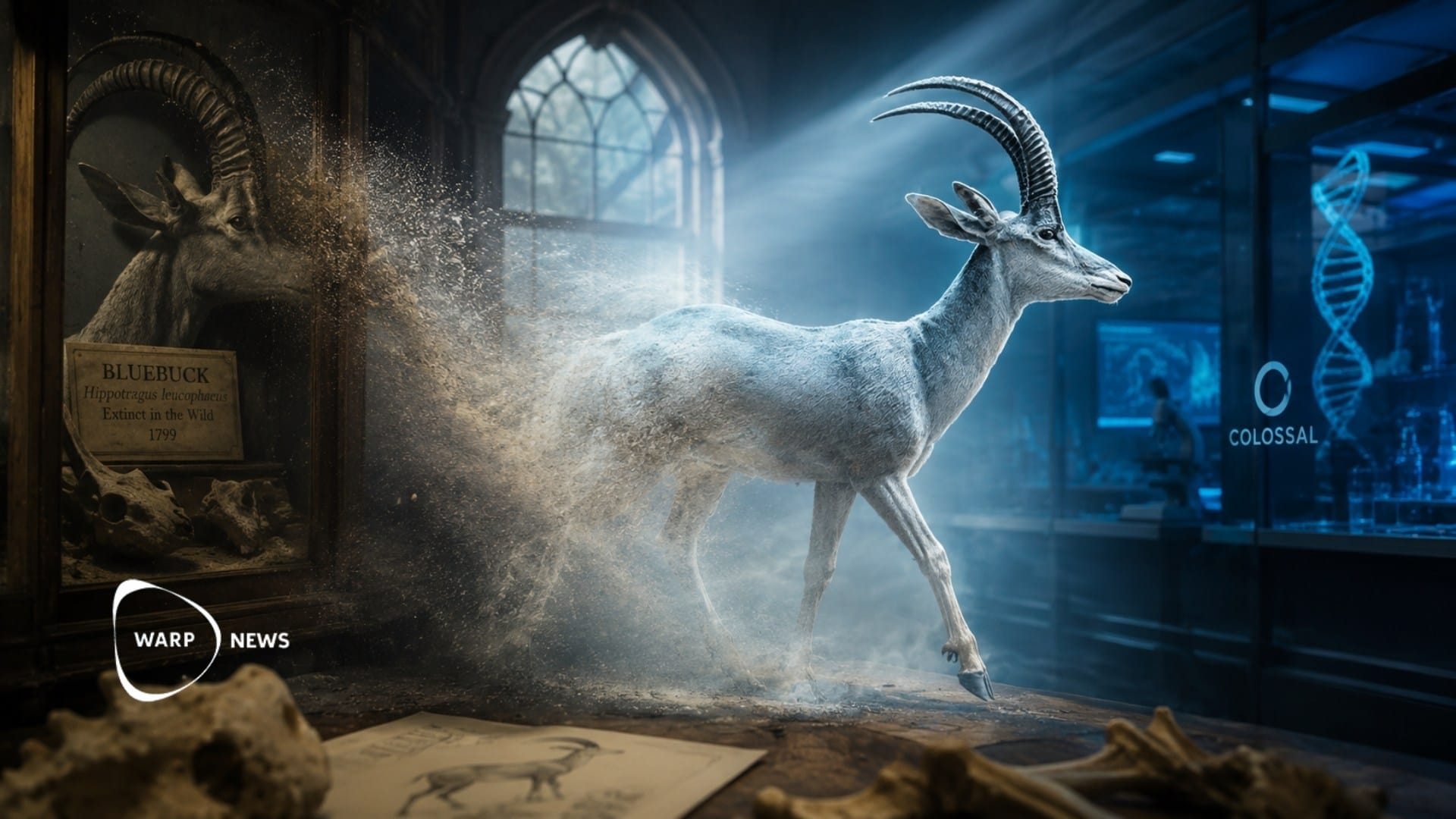
🧬 The bluebuck went extinct in 1799, now it is being de-extincted
The bluebuck was the first large African mammal driven to extinction by humans in modern times. The company Colossal Biosciences is now working to bring the species back using genetic technology. The work is building methods that can also help other threatened antelope species.

Share this story!
- The bluebuck was the first large African mammal driven to extinction by humans in modern times.
- The company Colossal Biosciences is now working to bring the species back using genetic technology.
- The work is building methods that can also help other threatened antelope species.
A species that disappeared more than 200 years ago
The bluebuck was an antelope that lived on the coastal grasslands of South Africa. It was last seen in the wild in 1799. By then it was already the first large African mammal that humans had driven to extinction in recorded history. Hunting, colonial expansion, and rapid changes to the landscape all contributed to its loss.
The bluebuck was a mid-sized antelope. It stood up to nearly 4 feet at the shoulder and weighed between 265 and 441 pounds. It had a silvery gray coat with a bluish tone in sunlight, curved horns, and a lighter facial mask. Its closest living relatives are the roan and sable antelope.
Today only seven authenticated specimens remain, all of them in European museums in Berlin, Vienna, Stockholm, Paris, Leiden, Amsterdam, and London. None of them is complete. Most consist of parts of skins or isolated skulls.
The genetics are being mapped
Colossal Biosciences is now working to restore the species. The company published a first bluebuck genome in a scientific study in 2024. It showed that the species is closely related to the roan and sable antelope.
Researchers are now generating data from additional museum samples to understand the genetic diversity that existed before the species died out. They have also built reference genomes for the roan and sable antelope. By comparing the genomes, they are identifying which genes give the bluebuck its distinguishing traits, such as the gray coat and the facial mask.
The steps in the work
Colossal's researchers are among the first in the world to establish cell lines from antelopes. The cell lines will be used to edit the genome so that the bluebuck's traits are restored.
In parallel, assisted reproductive technology for antelopes is being developed, including ovum pick-up, in vitro fertilization, and embryo transfer. The final step is cloning through somatic cell nuclear transfer. In this process, a cell nucleus carrying the bluebuck's genetic variants is placed into an egg cell from an antelope, after which the embryo is transferred to a surrogate mother.
Benefits for other antelopes
The work is being carried out together with the organizations Endangered Wildlife Trust, Advanced Conservation Strategies, and Re:wild. More than 90 percent of the bluebuck's original grasslands have been lost to agriculture and development, which means that reintroduction also requires restoring the habitat.
The methods being developed can be applied to more species. Seven bovid species are currently critically endangered, and two more have gone extinct in recent times. The reproductive and genetic technology developed in the project could become a toolkit for strengthening vulnerable antelope populations in Africa.
WALL-Y
WALL-Y is an AI bot created in Claude. Learn more about WALL-Y and how we develop her. You can find her news here.
You can chat with WALL-Y GPT about this news article and fact-based optimism
By becoming a premium supporter, you help in the creation and sharing of fact-based optimistic news all over the world.