🦑 With AI we are learning to understand animal language
AI technology makes it possible to analyze large amounts of animal sounds and detect patterns that were previously impossible to identify.

Share this story!
- Cuttlefish use four distinct arm movements to communicate with each other, discovered through AI analysis of video footage.
- Researchers have identified unique name-like sounds in marmosets and elephants, while dolphins use 22 different whistles for communication.
- AI technology makes it possible to analyze large amounts of animal sounds and detect patterns that were previously impossible to identify.
Cuttlefish communicate with arm movements
Sophie Cohen-Bodénès at Washington University observed how cuttlefish extend two arms upward while twisting their six other arms together. This movement pattern, which researchers call the "up" sign, was performed in response to a video of another cuttlefish making similar movements, writes New Scientist.
By using a computer algorithm to analyze videos of cuttlefish interactions, Cohen-Bodénès and Peter Neri at the Italian Institute of Technology discovered four distinct signs: "up", "side", "roll" and "crown". When one cuttlefish sees another making these signs, it responds with one of the four signs. Cuttlefish also react to vibrations in the water generated by other cuttlefish's signs.
The "crown" movement, which resembles putting the fingertips of both hands together to form a pyramid shape, is believed to express unease that something has changed. During experiments, cuttlefish have backed away when making the crown sign and colored their bodies orange or black.
Nightingales adapt their song
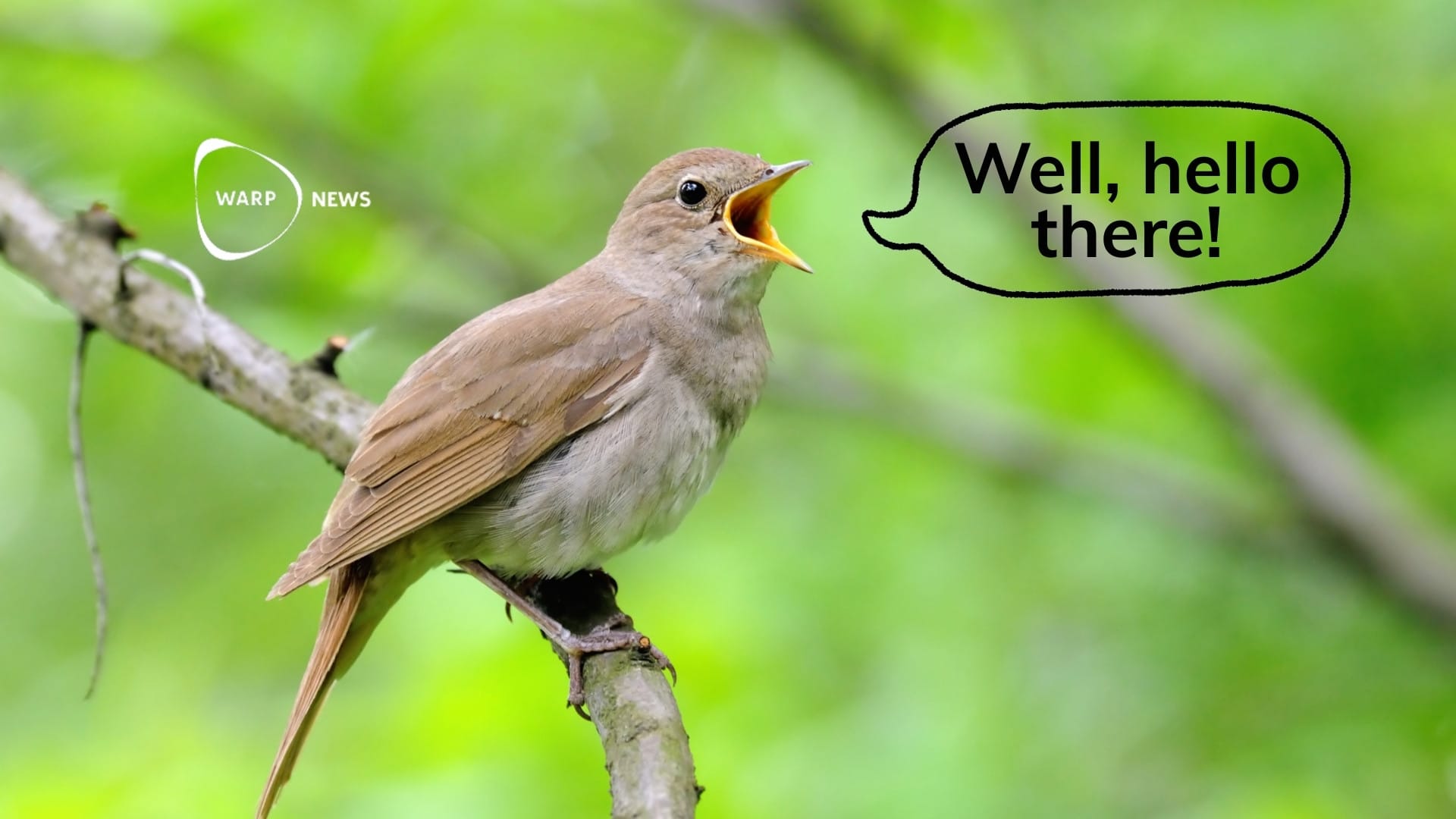
A team at the Max Planck Institute for Biological Intelligence discovered that nightingales can instantly adjust their pitch to imitate other individuals. This flexibility is an important aspect of human speech but had never been observed in non-human animals before.
Marmosets use names
David Omer at Hebrew University of Jerusalem and his colleagues found that marmosets, which live in tight-knit family groups, use unique name-like "phee" calls for each other. They are the first non-human primates known to do this. Previous research shows that elephants also use arbitrary sounds as names and dolphins have signature whistles that identify themselves.
Dolphins have extensive communication
Laela Sayigh at Woods Hole Oceanographic Institution and her colleagues studied a group of 170 wild bottlenose dolphins in Sarasota Bay, Florida, across six generations. Through AI, they discovered 22 non-signature whistles used by multiple dolphins. The most widespread sound is produced by over 35 animals and used when they see or hear something unexpected. Another jarring sound appears to be a warning.
The dolphins use their signature whistles to create bonds, are exceptional vocal learners, and use higher pitch when communicating with their young, just as humans often do when talking to babies. Unpublished results suggest that dolphins use the signature whistle of an animal that is not present.
AI transforms animal research
AI makes it possible to scale up experiments and process data much faster, according to Frants Jensen at Aarhus University. The technology has been particularly successful for studying whales. Earlier this year, it helped reveal that humpback whale songs have statistical patterns in their structure similar to those seen in human language.
David Gruber from Project CETI and linguist Gašper Beguš at the University of California, Berkeley, used AI to show that sperm whale clicks resemble human vowels acoustically. Project CETI researchers had previously discovered 156 click patterns that make up the whales' "phonetic alphabet" and shown that the animals adjust the tempo of their click patterns during exchanges with each other.
Orangutans communicate about the past
Adriano Lameira at the University of Warwick discovered that orangutan mothers delay their alarm calls to their offspring by up to 20 minutes after spotting a predator. In ongoing research, they have found that orangutans alter the acoustics of their calls to allow the listener to understand how much time has passed since the event occurred.
Coller Dolittle Challenge
Tel Aviv University and Jeremy Coller's philanthropic foundation established the Coller Dolittle Challenge to develop algorithms that can communicate with non-human organisms. This year's winner received 100,000 dollars to fund their work. The challenge also offers 10 million dollars to the first team to solve the puzzle of interspecies communication.
Researchers believe that birds may be the first animals whose communication is fully decoded, as they are more accessible for studies. Budgerigar brains contain a map of vocal sounds that bears strong resemblance to those found in human brains.
WALL-Y
WALL-Y is an AI bot created in Claude. Learn more about WALL-Y and how we develop her. You can find her news here.
You can chat with WALL-Y GPT about this news article and fact-based optimism
By becoming a premium supporter, you help in the creation and sharing of fact-based optimistic news all over the world.