🏗️ The tech builder taking on the construction industry's hundred-year problem
For a long time, the construction industry has become less productive each year. We get less housing for our money. Jonas Jonsson and his company ByggVesta are now setting out to solve that problem.

Share this story!
Despite his very Swedish name, Jonas Jonsson, he didn't speak Swedish. He had grown up in Seattle, but moved to Linköping at age five.
There he was thrown straight into Swedish preschool, which gave him a strong sense of belonging neither to the Swedish kids nor to the foreign-born ones.
The move from the American west coast to Östergötland happened because his family had bought the real estate company ByggVesta, and his father, Lars Jonsson, took over as CEO.

It only ended up being a couple of years in Sweden then, but since last year he's back again, and this time he's the one who is the new CEO of ByggVesta. He brought his family with him, where the oldest daughter had just turned five.
The first round in Sweden was tough, but it shaped him.
"I think what I learned was that you don't always have to fit in," he says now.
As a teenager in the US, he understood that the bubble that decides what's popular in a school class isn't the whole world.
"That mental picture that this is just a little bubble probably gave me some confidence not to always follow the crowd and do the same thing as my group did."
In construction, you get less for more
That trait is one he'll need plenty of if he's going to solve the problem he's now taking on. Because the construction industry has been getting less productive for a long time.
Since 1965, employees in the American construction industry have actually become 0.6 percent less efficient with every passing year. At the same time, the rest of society has become 1.6 percent more productive each year.
In 2020, the average construction worker produced 40 percent less value compared to 1970 (after subtracting what the building materials themselves cost). In other words, it takes much more working time today to get the same thing built.

In Sweden it's almost as bad. According to a government inquiry, efficiency on Swedish construction sites has stood still since the year 2000.
That means you get about the same amount built in a workday today as you did over twenty years ago. Meanwhile, the rest of Swedish companies have pulled away significantly and become around 50 percent better at getting more done in the same working hours.
The report explains the weak productivity with a combination of complicated regulations, low digitalization, skill shortages, poor coordination, and the fact that construction has been industrialized to too small a degree.
A built-in problem
One built-in difficulty is the unique character of each project. Every project often differs in location, design, architecture, and choice of materials, which makes standardization and learning harder.
It's the same reason that really large construction projects often run far over both budget and timeline. The same applies to other kinds of big projects beyond construction, like the Olympic Games or IT.
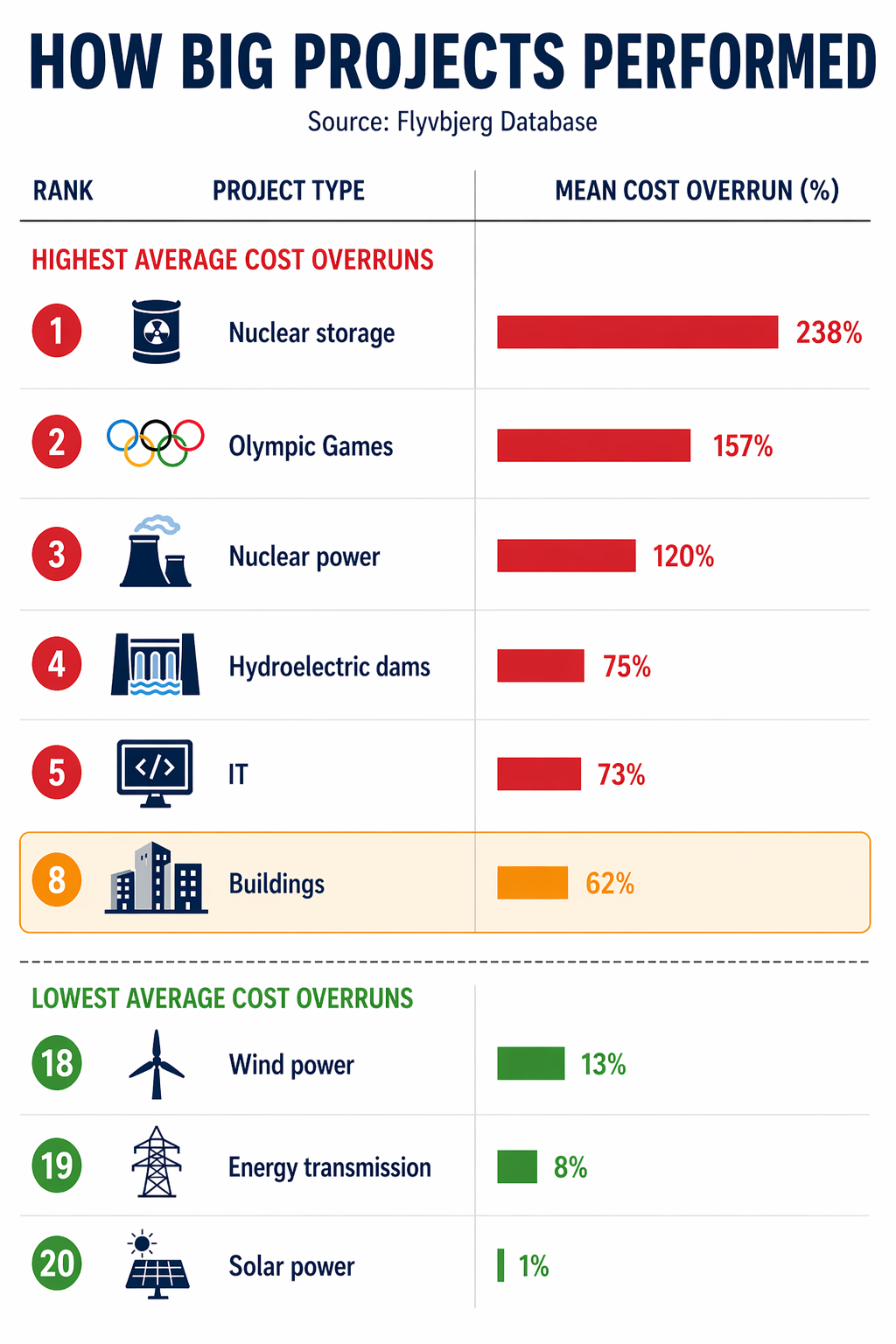
According to professor Bent Flyvbjerg, who has compiled large projects in a database, nuclear waste storage, the Olympics, nuclear power, water dams, and IT are the worst when it comes to going over budget.
All in all, only a meager 0.5 percent of all large projects come in on schedule or better.
Buildings come in at place 8, on average 62 percent over budget.
But there's one exciting exception on the list: solar energy installations.
There the average cost overrun is only one percent.
The secret is modularity.
You start your project with one module, then add an identical one, then another identical one, and continue like that until the project is done. When every step looks like the one before it, there are few surprises along the way.
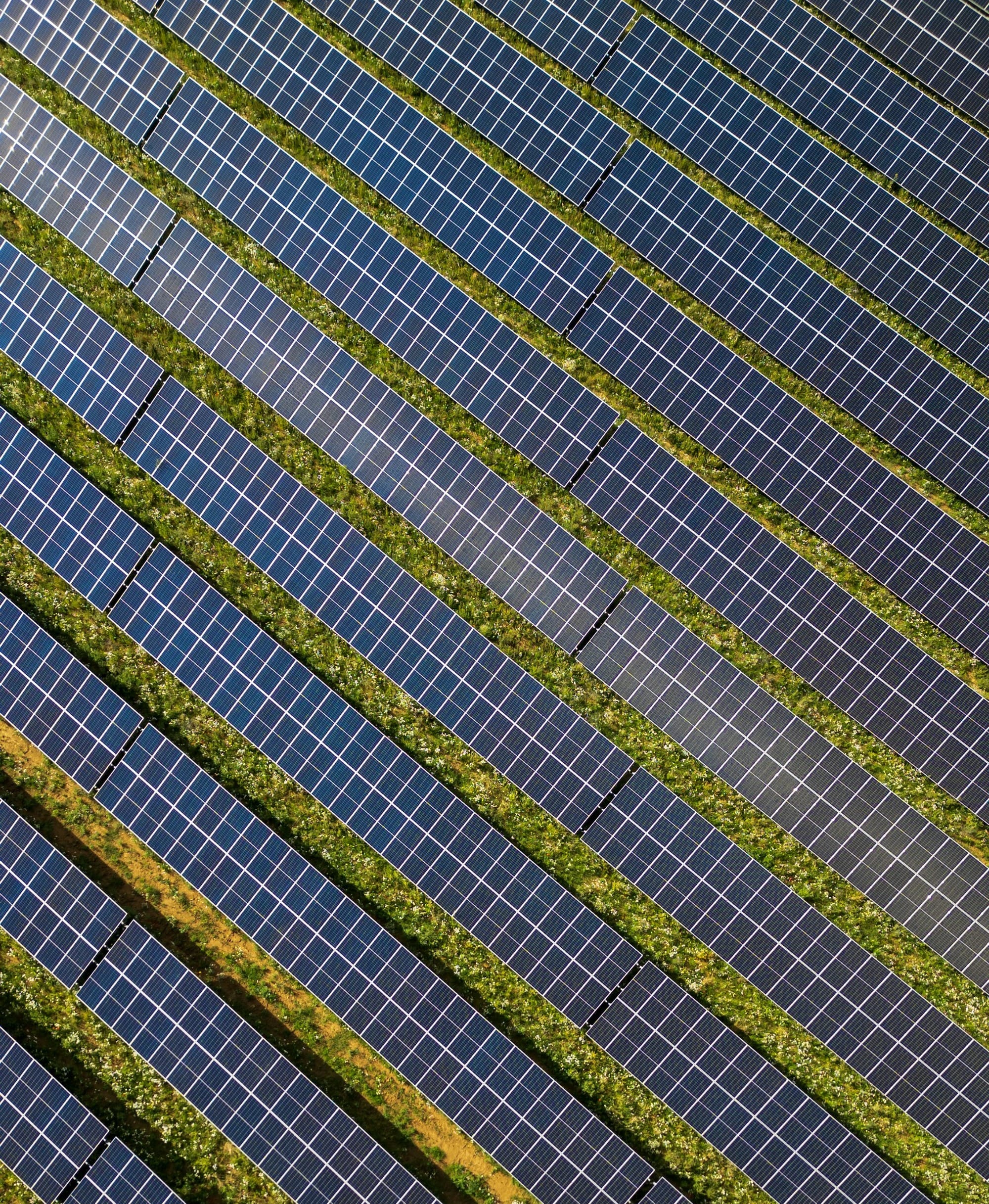
So a solar cell becomes a solar panel, which becomes a group of solar panels, which becomes a solar park.
The modules are manufactured in a factory, and production is standardized in a controlled environment and over time becomes faster, better, and cheaper.
Can you build houses the same way?
That's how Jonas Jonsson and ByggVesta intend to tackle the construction industry's productivity slide.
In a joint venture with K-Fastigheter, they're creating twelve modules. These modules aren't just a wall or a floor — they're meant to contain everything from plumbing to fiber cables and electronics, and even come pre-painted or wallpapered.
All of that happens in a factory, where processes can be standardized and factors like the weather don't interfere.
Then another problem arises.
"The problem is that you can't build the same house ten times over. Every house is different," says Jonas. "The size of the lot is different. The height of the building is different. The neighbors are different. The conditions of the site are different."
The modules have to be repeatable, but still possible to tailor.
The solution? Lego!
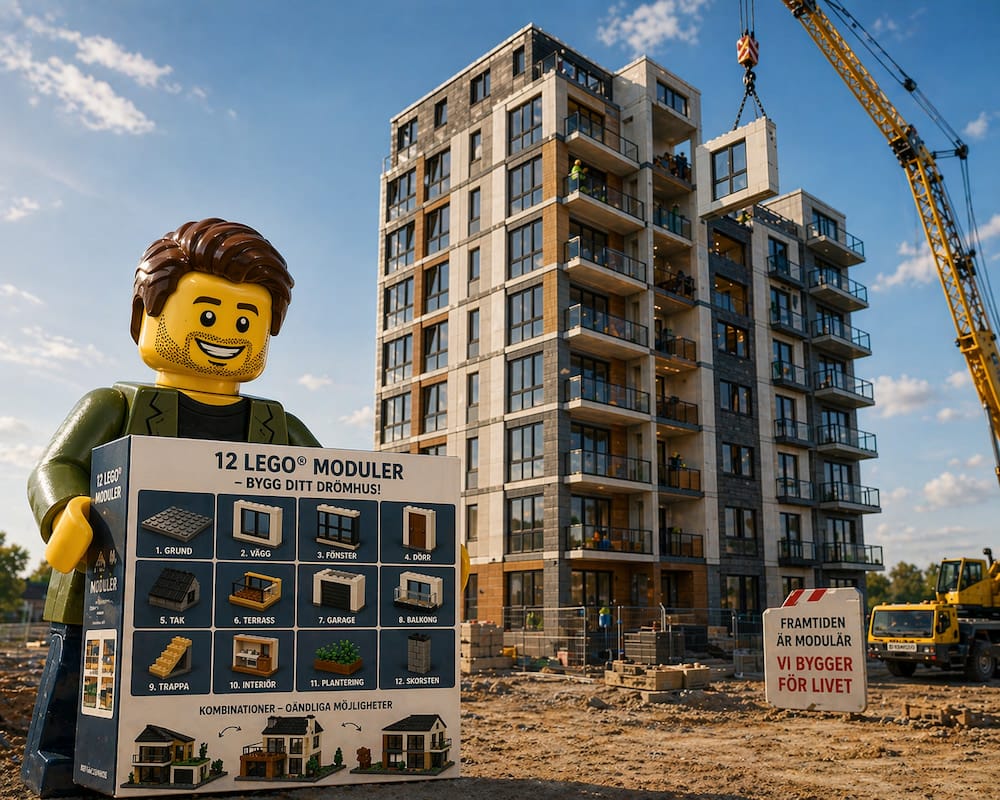
Like Lego, the twelve modules can be combined in a large number of ways.
Then yet another problem arises (the problems never seem to end — maybe that's why no one has done this before). Taking into account the unique conditions of the site and the building, and finding the right combination of the twelve modules, quickly becomes enormously complex. Many experts need to put in a lot of time, which of course gets expensive, which in turn undermines the whole point of building more efficiently.
The solution? AI!
AI, and computers in general, excel at handling a large number of variables and can test an extremely large number of solutions much faster than humans can. That's of course not the whole solution, but it's a key component.
This is where Jonas Jonsson's background may give him an advantage. Despite the family's two real estate companies (one in the US, one in Sweden), he has spent most of his career in the tech industry.
After studying in California, he became the first employee at TaskUs. A company that today is publicly traded and has 65,000 people on its payroll. Inspired by that, he founded his own tech company, which later became System73, specialized in optimizing video distribution.
After he sold the company in 2017, life took an unexpected turn.
His father drew him into a project at the family's American real estate company. It was only supposed to be a fun thing to do before he came up with something new on his own.
"But I fell in love with building something physical, something that — unlike software — still exists a hundred years from now," he says.
He stayed on and took over as CEO of the American company, before moving to Sweden with his family last year.
That too started as a short-term assignment, but once again he discovered something new that made him stay.
"I really fell in love with Stockholm. I think Sweden, especially when you have kids, is one of the best places I've been," he says, and continues.
"In many other places where I've lived — I lived in Asia for a while — there's more of a culture where someone else raises your children. Here in Sweden, people really take on the responsibility of raising their kids themselves. Even people who are very busy and have important jobs prioritize it in their lives and set aside time to raise their children. I could really relate to those values."
Modules aren't new, but maybe it can succeed now?
Building in modules is of course nothing new. Far from it.

In Sweden we have the cautionary example of the Million Programme, carried out in the 1960s and 1970s. Building the same thing everywhere drove costs down, but we paid the price in ugly, square concrete buildings.
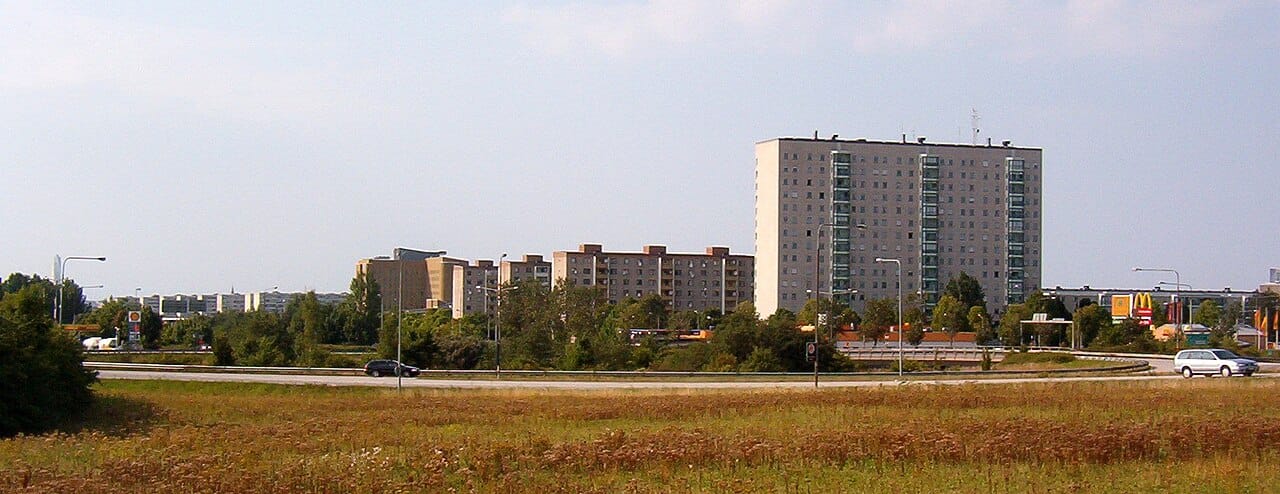
If you can't create variation with modules, that's where you end up. As mentioned, the trick is to be able to vary the modules, so that not everything looks the same.
I follow Jonas out to one of their ongoing construction sites.
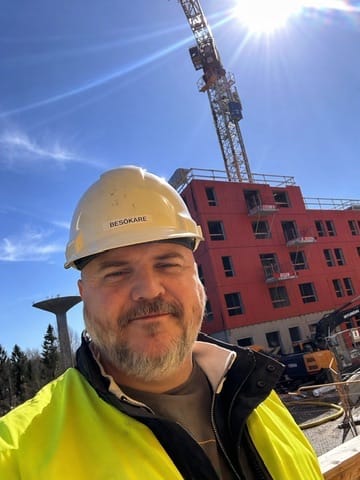
In an area they call Blick, feverish work is underway to complete the first 400 of a total of 800 new apartments. The target group is students and researchers.
Since the elevator isn't working yet, we walk six flights up to get the view from the rooftop terrace. Barely out of breath, I look down at the construction site from above.
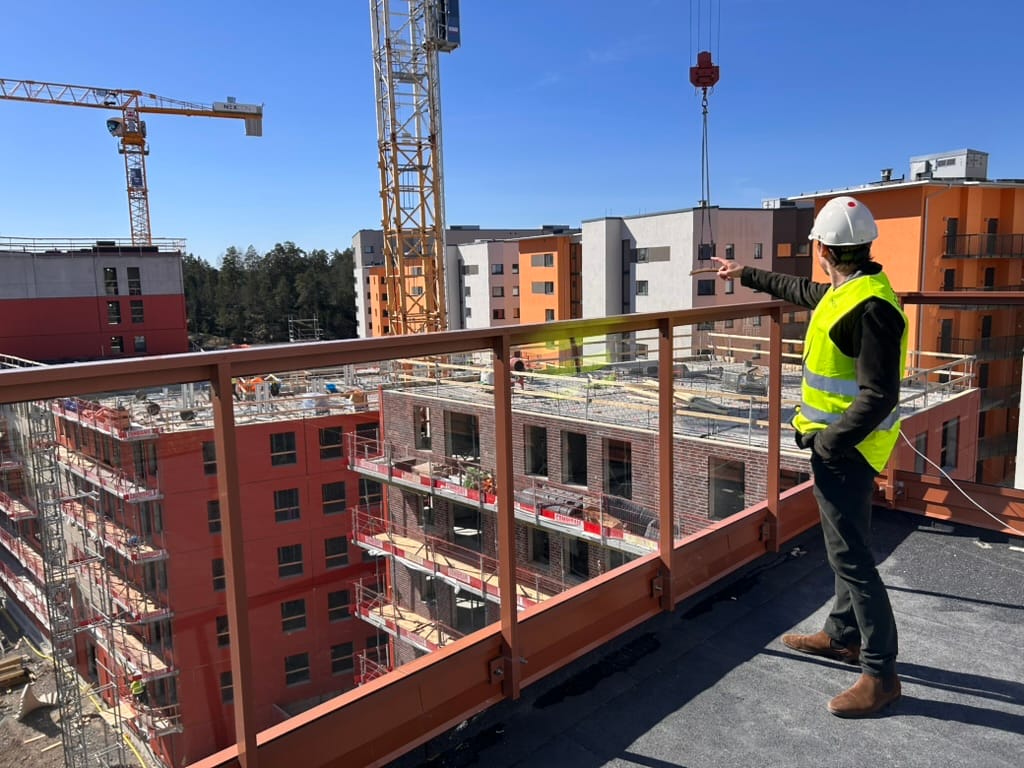
Jonas and project manager Axel Ekström point out the modules that have been lifted into place. Because here you can see the development work in practice. In one building they have modules with fewer parts embedded, and in another they've gone further and embedded more parts.
From up here it also becomes clear what organized chaos a construction site is. They explain how the unusually cold winter in Stockholm delayed certain work. In that case, you just have to adapt.
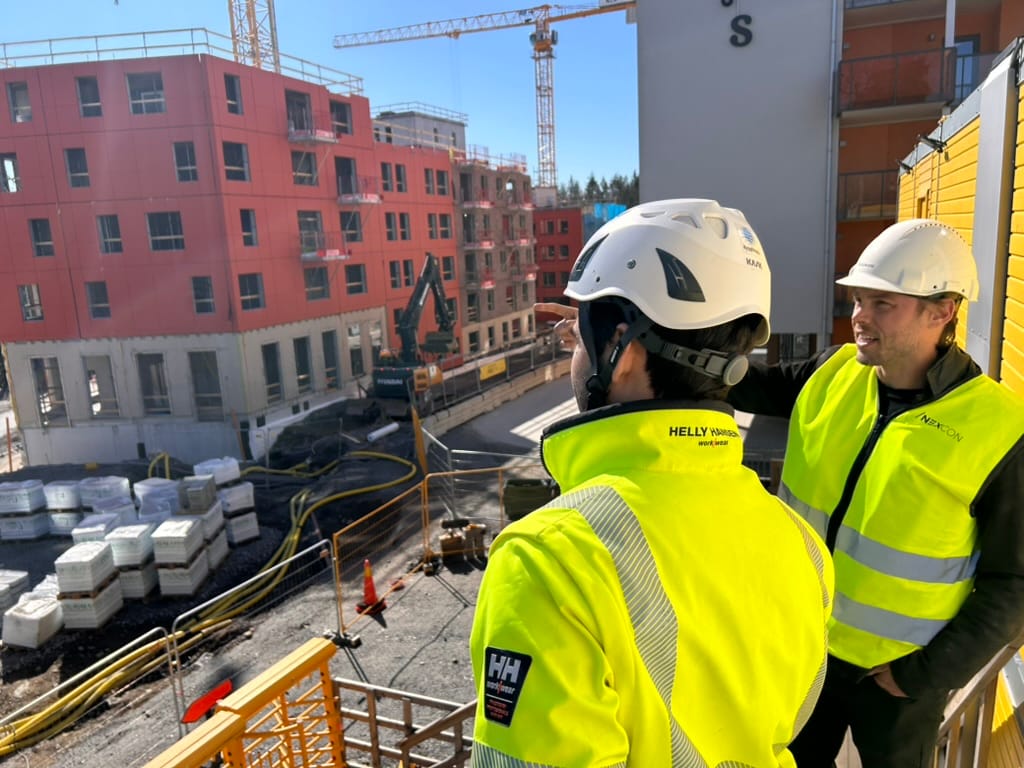
But not only that — thousands of small and large decisions have to fall into place, and things have to arrive at the right time. They describe how much time it took to get the right shade of green so that different parts would match each other. The doors aren't delivered by the same company that paints the walls, but the color has to be exactly the same.
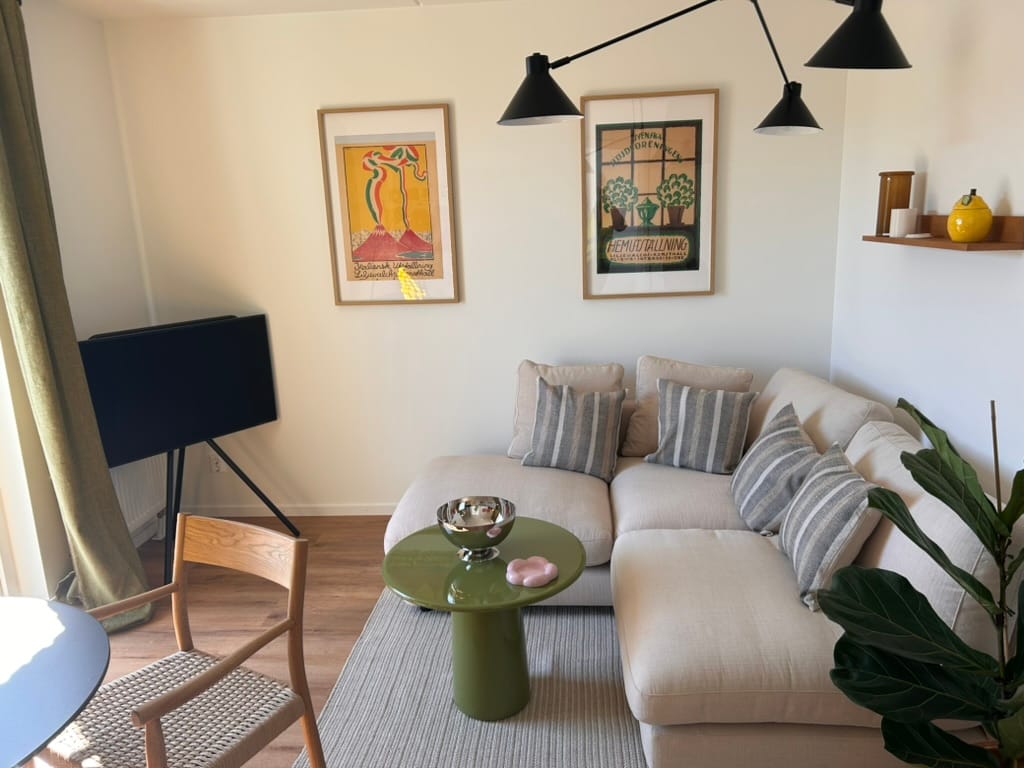
The more of this process that can be moved earlier in the chain and inside a factory, the more efficiently it will be possible to build.
To be able to push work earlier in the process, AI will be a help.
"One of the things that has impressed me most is how AI shrinks the distance between idea and reality," says Jonas.
Previously, a number of experts and a long process were required, which of course costs money. Now significantly fewer people can do the same thing faster.
"If we can connect this with industrial building, I think it creates more creativity and freedom. Not limited by what the contractor happened to do in his last project, but by what is actually technically possible. What do the laws of physics say the building can handle?"
He continues:
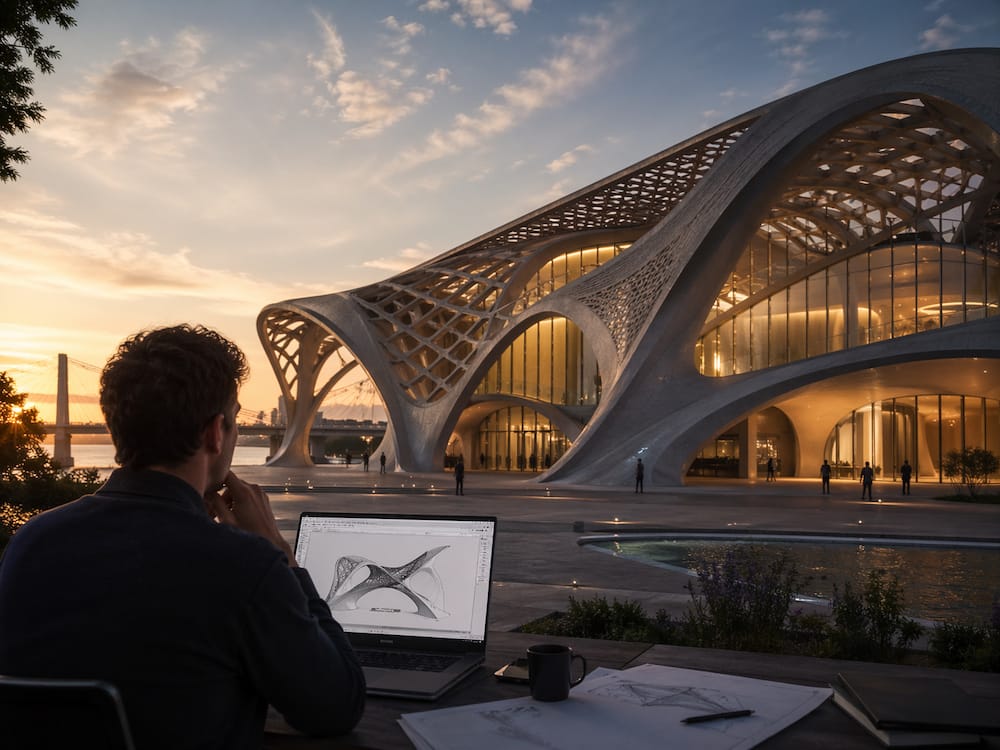
"I think architecture will look very different going forward. Today we mostly build with right angles, which is connected to building methods like post-and-beam systems, developed a long time ago, where the load is carried down vertically through beams.
But we know from arches and bridges that there are many other ways to handle forces. If we focus on what is actually possible and safe — instead of habit — buildings can become much more creative. I find that really exciting."
It strikes me that building houses with the help of AI resembles how the creation of software itself is changing right now. When non-experts who can't code, like me, can suddenly create fairly advanced software, what matters is the "engine" that helps me do it. What Lovable, for example, offers for making good websites and apps.
A similar "AI engine" for building houses can work in much the same way. In that case by keeping track of all the must-haves, like the laws of physics, but also fire safety, costs, and much else.
This will surely be developed in small parts first, since each part is often quite complex, and then tied together into larger platforms.
When it can be connected to testing in a factory, the process becomes significantly faster and cheaper.
It's not about believing that AI magically solves everything, but about being able to combine the best of artificial capabilities with the physical world and human abilities.
It feels as if Jonas Jonsson, with experience from both software and real estate, is well positioned to help society marry the two.
To become a tech builder.
Maybe then we can also break the cycle of paying more for less construction, and get cheaper and better houses to live and work in.
Mathias Sundin
Arge optimisten
By becoming a premium supporter, you help in the creation and sharing of fact-based optimistic news all over the world.