🗺️ A small proposal for a new world order
The modern world is based on the nation state. The next step is to base it on human beings.

Share this story!
One day, as I was driving home after picking up my son from preschool, I came up with a new world order.
I usually have the radio tuned to Sweden's public broadcaster, and my son, sitting in the back seat, sometimes asks about what he hears.
What is war? Who is the king? How old is the king? Where is China?
One day they were talking about the United Nations on the radio. So he asked:
"What is the UN?"
Once again, it made me think about how outdated the current world order is, and how it ought to be changed.
A fleeting thought twenty years in the making
The idea did not come completely out of nowhere.
My opposition to geopolitical realpolitik was what first drew me into politics more than twenty years ago. Instead, I wanted to see a pro-democracy foreign policy.
Realpolitik means that power and self-interest take precedence over human rights. It becomes an excuse to accept dictatorship, abuses, or betrayals of smaller actors because doing so is considered beneficial to one's own state and power.
The dictators behave worst, but even democracies have a tendency to become guided by realpolitik when it comes to foreign affairs.
Later, after being elected to the Swedish Parliament (with a seat on the Foreign Affairs Committee), I proposed the creation of an Alliance of Democracies (which absolutely nobody joined me in supporting). After leaving politics, I became involved with the Alliance of Democracies Foundation.
So for more than twenty years I have thought, read, debated, written, and voiced opinions about geopolitics, while reflecting on what kind of world order we should have.
Stronger tyrants gave us democracy
In 1648, after years of negotiations, the Peace of Westphalia ended the Thirty Years' War in Europe and established the modern principle of sovereignty. In other words, each country would decide for itself on its internal affairs: laws, politics, system of government, economy, and religion.
Previously, power in Europe had been overlapping and highly hierarchical, with the Pope and the Holy Roman Emperor serving as supranational authorities capable of intervening in the affairs of local rulers.
The peace settlement established that each state and its ruler had exclusive authority over its own territory.
States recognized one another's borders and right to self-determination, creating an international system of formally equal states that, in principle, were not supposed to interfere in one another's internal affairs. This gave us the sovereign territorial state.
The kings and princes were delighted. At last they were king of their own castles!
But all good things come to an end.
By establishing fixed geographic borders and the principle that a central authority held exclusive power within them, the territorial state created a unified arena for politics.
To compete in this new system of rival states, rulers were forced to build strong military organizations, which in turn required bureaucracies capable of collecting taxes and maintaining order. This concentration of power led to royal absolutism, but it also created an effective state apparatus.
When the ideas of popular government spread, both in thought and in action, the people could take over this state apparatus and thereby govern the country themselves. In this way, more and more countries became democratic.
The problem with sovereign states
At the same time that the sovereign state enabled the rise of democracy, it also became the dictator's best friend. Since states were not supposed to interfere in the internal affairs of other states, tyrants were free to tyrannize as they pleased.
A person who murders, tortures, starves, and oppresses people at home is welcomed by the international community as "Mr. President," or people pretend that they are royalty. In 1932, the Al Saud family declared themselves royalty. In international contexts, such as the United Nations, their king is addressed as His Majesty King Salman bin Abdulaziz Al Saud.
Immoral and ridiculous at the same time.
In the current world order, democracy and dictatorship are treated as equals because it is territory and nationhood that possess rights (despite all declarations of human rights). As a result, a democratically elected leader enjoys the same rights as an absolute ruler. Nor does the democrat have any right to interfere in the dictator's internal affairs.
After the Rwandan genocide in the 1990s—when someone really should have interfered in their internal affairs—this principle began to erode somewhat, but the fundamental idea remains in place today.
Human sovereignty
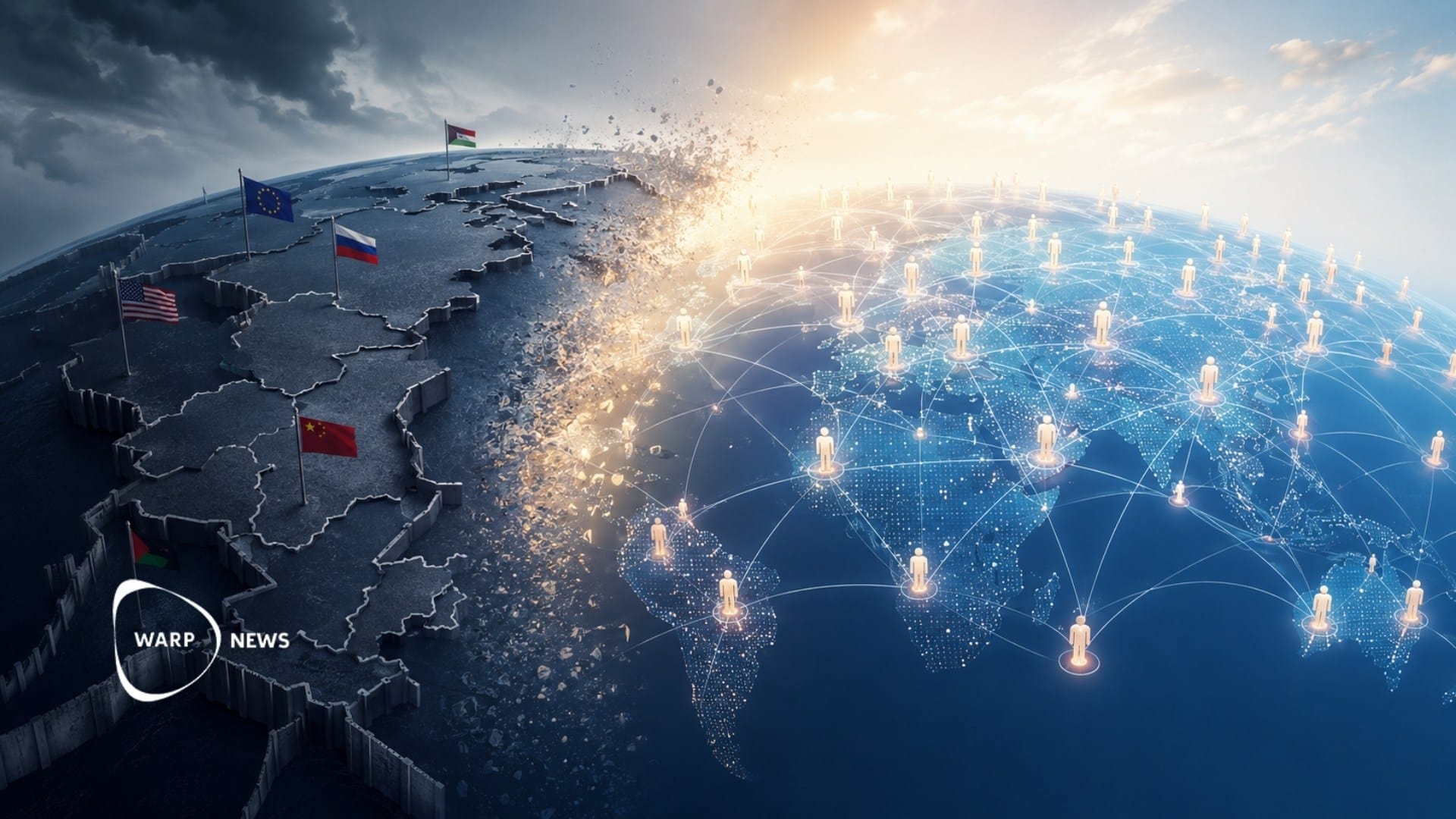
Instead of tying political power to a geographic territory, this new world order begins with the individual human being.
From the sovereignty of nations to the sovereignty of individuals.
Every human being is the fundamental political unit.
All people should possess a form of world citizenship that stands above citizenship in any nation.
Decisions affecting the world should not be made by national representatives of peoples, but directly by the people themselves.
(I am certainly not the first person to have this idea.)
I believe people would be more central if people themselves made the decisions directly. There would be less focus on national power interests and the immoral actions that often follow from them.
Global issues in particular suffer from competition between nations. It would be considerably better if all countries were democracies, but even then there would remain an inherent power problem.
Global issues must be handled better and should be decided directly by the many people affected by them.
Most importantly, however, we must establish the principle that every human being belongs to themselves. A person is human because they are human, not because they belong to a particular nation. A nation does not automatically have the right to govern me simply because I happened to be born there.
Even though many countries have democratized their systems of government, the underlying foundation still assumes that the individual is subordinate to the territory into which they were born.
When value instead begins from the premise that each person belongs to themselves, and that rights are attached to human existence itself rather than to a passport issued by a state, part of the space that states currently use to justify abuses disappears.
If a system instead rests on voluntarism, consent, and the right to choose one's own communities, then all institutions are forced to deliver genuine value in order to earn people's participation. They can no longer demand obedience simply by pointing to a border drawn on a map hundreds of years ago.
What happens to my country?
Perhaps you enjoy being American, Chinese, or Swedish. And who are we supposed to cheer for in the World Cup if countries disappear?
I do not believe geographic belonging or local cultures will disappear. It is deeply human to feel connected to the place where one lives and to the people who live there.
What will change is the power that nations possess, not whether you love or hate seeing Norway win all the gold medals at the Winter Olympics.
But how would it work?
Such a new principle naturally raises a million practical questions.
How would decisions be made?
Would billions of people have to vote all the time?
I am actually not worried about that.
We will find answers to all those questions. Human beings are good at that.
The transition from today's system will not happen through revolution or because governments voluntarily surrender their power. Instead, parallel systems will emerge that are so superior that they gradually outcompete nation-states as decision-makers.
But first we must establish a new foundational principle.
United humans
We can already see that the current world order is beginning to crack.
The way it is happening is not good, but we do need a new world order. The current one is immoral.
It is time to take the next step.
In principle, this means moving sovereignty one step further.
From a world order built on the sovereignty of nations to one built on the sovereignty of every individual.
Mathias Sundin
Angry Optimist
By becoming a premium supporter, you help in the creation and sharing of fact-based optimistic news all over the world.