
🥃 The glass is neither half full nor half empty
Fact-based optimists don't care whether the glass is half full or half empty. They see the world in a different way.

Share this story!
Sometimes, when people find out that I am an optimist, I face a dilemma. It so happens that they say some variation of this:
"I like people who see the glass as half full!"
I do too, but my dilemma lies in the fact that I am not that kind of optimist. I am a fact-based optimist, not someone who simply views the world in a bright and positive light.
It is, however, a bit of a killjoy move to say this to someone who just paid you a compliment, but sometimes I do it anyway and get the counter-question: What do you mean?
I am an optimist because I see in the facts that the world has been improving for a long time—and that as long as the conditions for that development are in place, progress will continue.
Furthermore, it is often the case that if you closely examine the contents of the glass, it turns out to be more than 50 percent full.
Child mortality is a good example of this. Roughly five million children under the age of five die every year. A terribly high number. The glass really feels half empty.
But.
In the 17th century, roughly every other child died before the age of five. Since then, that figure has dropped drastically, to about 4 percent today. In the 21st century alone, the number of child deaths per year has been halved, from ten to five million. As I said, still a terribly high number, but the trend is very positive.
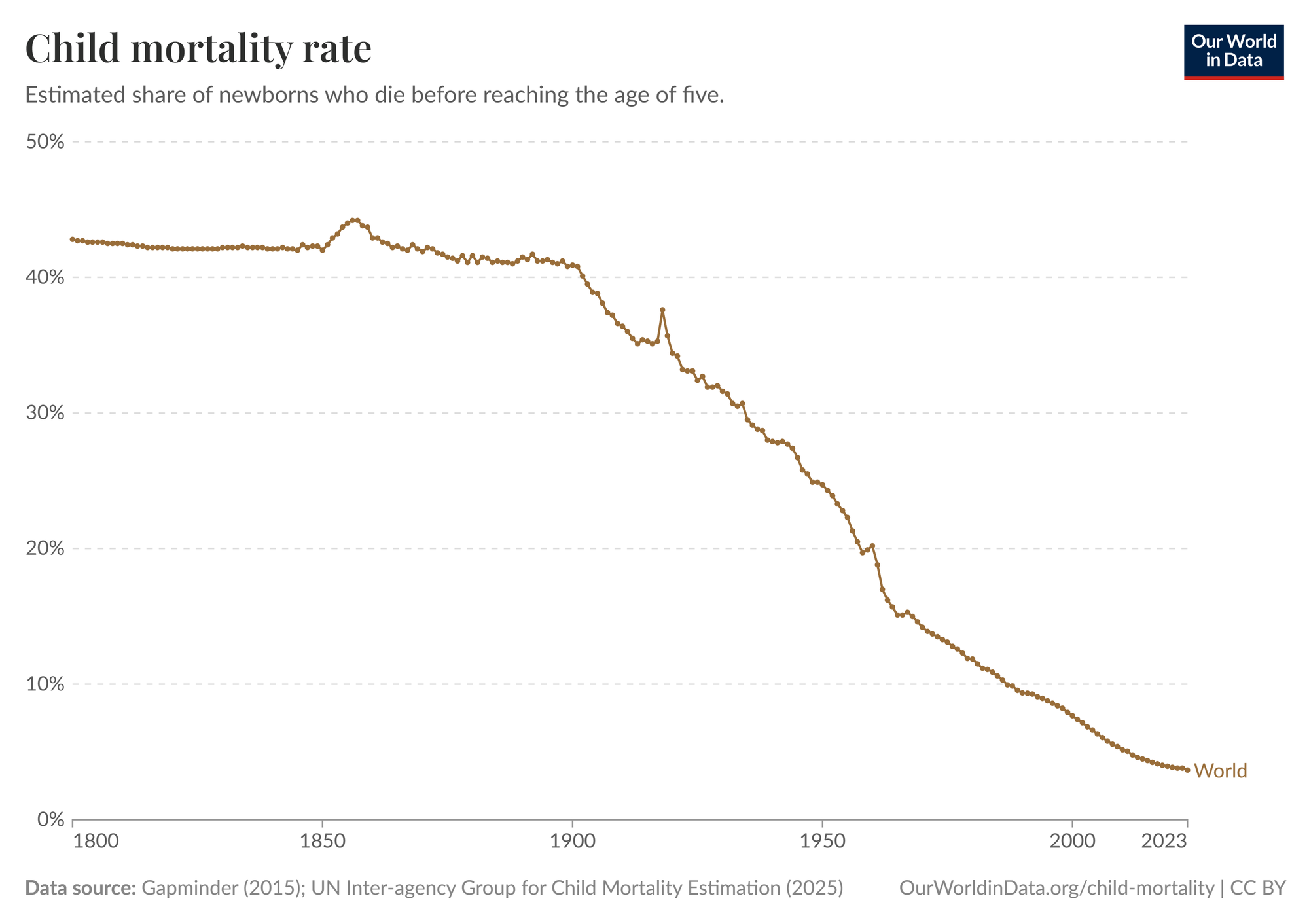
Child mortality has decreased through increased prosperity and increased democratization, which has led to more education—especially for women—and stronger institutions. This, in turn, has made it possible to expand healthcare, provide vaccines, secure clean water and sanitation, improve nutrition, and introduce simple but effective treatments such as oral rehydration, antibiotics, and mosquito nets.
If we maintain or improve these conditions, this positive development will continue. I can know this, because some countries have done just that. The richest and most developed countries in the world have reduced child mortality even further. Sweden is at 0.25 percent. The glass is more than half full.

This applies not only to child mortality but to all kinds of development. In other areas as well. Democracy gives us more and better ideas, which leads to increased knowledge and higher prosperity, which leads to more progress.
Under such conditions, we humans are phenomenal at solving problems. Much of this work consists precisely of solving problems. Some very broad and long-term, as with child mortality; others more precise and short-term, like the vaccines against Covid-19, which were developed in record time.
As long as these conditions are in place, I am an optimist. Should they change, and we end up in a world where everyone lives in a dictatorship and new ideas and research are oppressed, progress will slow down and cease. In such a world, development could even start to go backward. Then I wouldn't go around seeing the glass as half full.
Naturally, I have nothing against people who have a positive view of their surroundings (even if the most extreme positivists can be quite annoying). But I believe fact-based optimism gives you better tools to handle and influence the future. It reduces the risk of being fooled by both pessimism and blind optimism.
But sure, sometimes it doesn't hurt to have a little naive optimism too.
Mathias Sundin
Angry Optimist
By becoming a premium supporter, you help in the creation and sharing of fact-based optimistic news all over the world.