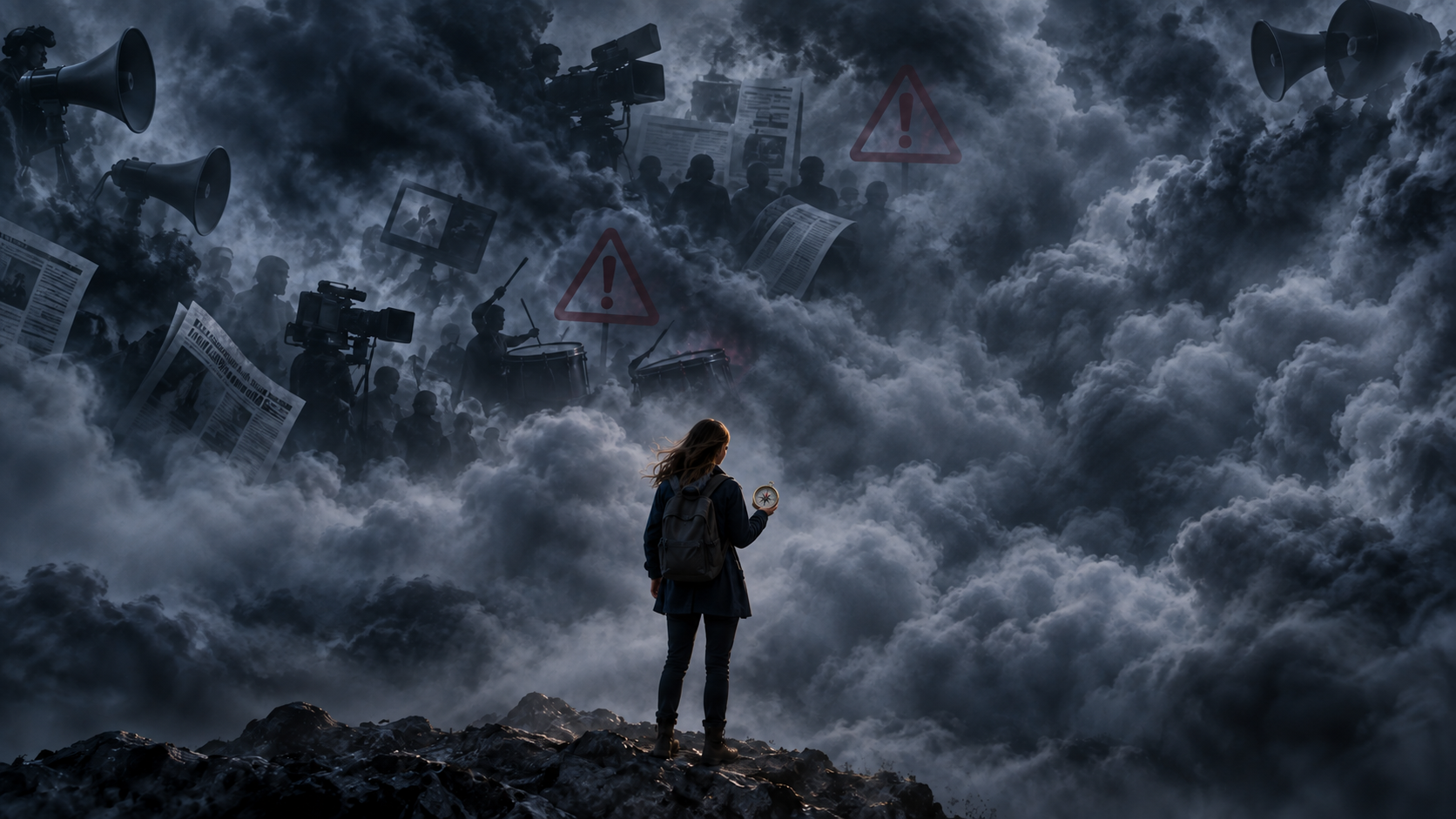
🌫️ The pessimism fog is thick right now
The doomsday drums are beating again, and the Nobel laureate who winged it with total confidence.

Share this story!
Right now the media is filling up with negative claims about AI. At the moment the possible doomsday is at the centre, but there is also growing opposition to data centres (in the US), to the use of water and energy, and to the risk of unemployment.
The drums are beaten so hard that a couple of subscribers have got in touch with me. One of them had clear anxiety about the threat to humanity and was frightened.
It is bizarre.
Not that they feel that way, or that they reached out (on the contrary, I am grateful that they trust me enough to do it), but that they should have to feel that way!
The threat to humanity is groundless nonsense that the media loves to spin round and round, again and again, on an eternal doomsday carousel.
That people should have to walk around afraid, now that we have created a technology that promises so much good.
I had planned to write an article today about the big step forward that has just happened, with OpenAI releasing a new version of ChatGPT. I rarely write about new models, but now something genuinely big has happened, something that has doubled my own productivity. I am not joking. I get twice as much done now. At least.
But unfortunately I am forced, for the umpteenth time, to note that the positive disappears into a pessimism fog as thick as the one at Lützen in 1632. So I will have to come back to that next week and instead try to help you through the fog.
Because I understand the people who got in touch. The doomsday drums are loud and frightening right now. I looked in The News Scale to see how things have developed over the past few weeks.
On 10 August there was balance, with only a slight negative tilt of -2, on a scale from -100 to +100 where 0 is balance.
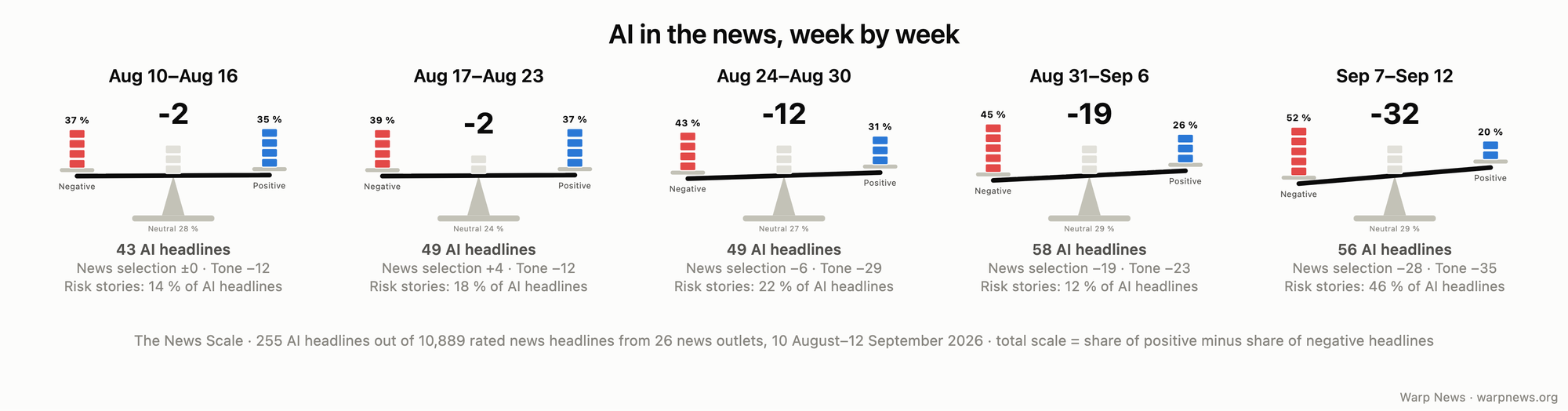
Since then the imbalance has grown, and last week it landed at -32, where the tone of the news was for once worse than the news selection itself, at -35.
The share of AI news that was about risks rose from 14 percent to 48 percent.
Hundreds of millions of people will starve to death
I started out writing an article that answered every claim in circulation, but it was turning into half a book. I will have to split it into several articles, and I think the most useful thing right now is to describe the phenomenon of the pessimism fog.
It rolls in as soon as a new technology arrives.
Pessimists Archive has compiled what people have been against through the ages. The telegraph, because it would mean too much information. The bicycle, which would wipe out local shops. Novels corrupted the young. The elevator caused brain fever. Coffee stirred people to revolt. The telephone made people addicted to pointless chatter. Video games led to violence, pinball to addiction, and the iPod to repetitive strain injuries of the thumb. The list could be made much longer.
In my book I describe one of these earlier fogs: the population explosion.
The year was 1968. Paul and Anne Ehrlich published The Population Bomb, where they wrote:
"In the 1970s hundreds of millions of people will starve to death," and nothing could prevent it any longer.
Two American presidents called population growth humanity's most serious problem. The UN Secretary-General built up the organisation's capacity to handle it. The head of the World Bank ranked it just after nuclear war. India's prime minister pushed through a sterilisation programme.
Many experts, researchers, politicians, journalists, organisations, amateurs and professionals agreed: if the population of the earth keeps growing, the world faces famines unlike anything we have seen before.
They were completely wrong.
Between the 1960s and the 1970s the number of people dying of hunger fell by 90 percent. Then it got even better. From the 1970s until the early 2020s it fell by another 95 percent.
And on it goes. Panic after panic. The millennium bug was going to knock out the computers. Nothing happened. In 2000 more than 200 researchers signed a letter demanding a five-year pause for genetically modified crops. More than 25 years later there are no reported harms. Joe Biden's AI order and the EU's AI regulation set a ceiling for how large models could be before they were considered especially dangerous. The ceiling has been passed. Nothing happened.
That does not mean you should ignore what other people say. It only means you should think for yourself and demand explanations from those who make the claims. And you should do it in the light of the fact that we humans always whip up panic around new technology.
Into the fog
But the fact that people have been wrong before does not mean they are wrong now. This could be a warning of something genuinely dangerous.
The first thing to note is that AI is especially exposed. Its breakthrough came in the wake of a generally negative opinion about the internet and tech. On top of that there is plenty of science fiction to help us visualise the end. And then there are media that gladly amplify the doomsday scenarions, over and over.
But again, that in itself is not proof that it is wrong this time.
So we have to examine those sounding the alarm. There are several of them, but the heavyweight right now is Anthropic's CEO, Dario Amodei. Anthropic makes the popular AI model Claude.
In February 2019 OpenAI announced that it was holding back its largest language model, because they claimed it was "too dangerous" to release. It was so powerful that in the wrong hands it could cause far too much damage.
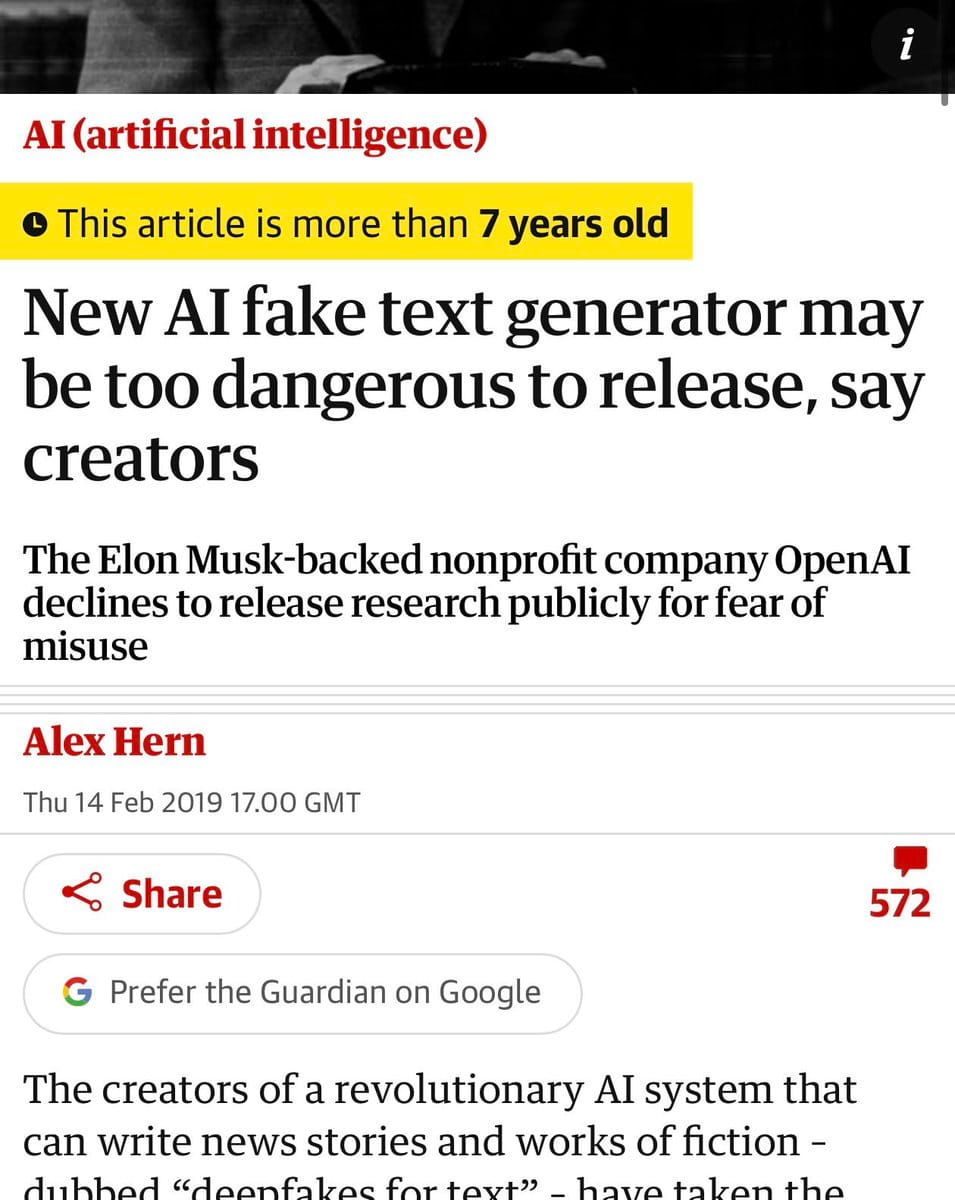
The model was called GPT-2. A predecessor of ChatGPT.
GPT-2 was, in other words, considerably worse and far less powerful than the first version of ChatGPT, which was released three years later.
Even so, GPT-2 was far too dangerous, they claimed.
One of those who claimed it was Dario Amodei.
He worked at OpenAI at the time and took part in the decision to stop the model. Amodei later left OpenAI, partly because he felt they were not taking safety seriously.
When GPT-4 was released in the spring of 2023 it started up again. A number of people (several of them heard in the debate now as well) wanted a pause. This was moving too fast. It was too dangerous.
But nothing bad happened and development continued. ChatGPT-5 was released. The Swedish professor Olle Häggström told a newspaper that he was not sure we would survive ChatGPT-5.
This spring it was Dario Amodei's turn again. Once more there was a model too dangerous to release, this time called Mythos. Just as in 2019 with GPT-2, it got enormous global coverage in the media.
But then Mythos was released to the public under the name Fable this summer, and we are still alive and in good health.
And now here we are again.
Why should we believe these alarms now, when the people making them have been wrong time after time?
At the risk of repeating myself: the fact that they have been wrong before does not mean they are wrong now. But given our recurring human capacity for creating technology panics, and given these particular people's dismal record in predicting what is dangerous, we should demand evidence for their claims. Or at least really good explanations.
There is none.
There are extremely imaginative theories, often completely detached from reality, but no claims that can be tested in any way.
A person stating a number for the probability that everyone dies within five years says absolutely nothing, if that person has nothing beyond their own feeling.
Nobel laureate: soon there will be no radiologists
Nor is it the case that all these opinions are particularly well thought through. Not even from Nobel laureates.
One of them is Geoffrey Hinton, the father of machine learning and a Nobel laureate in 2024. It is hard to be more of an AI expert than that. He scatters predictions around him, among them the end of humanity.
He made one of those predictions a few years ago.
In 2016 he said that within five years radiologists would no longer be reading scans, and he recommended that students not train for it. AI would do it better and take over.
He was completely convinced of this. It was "completely obvious", he said. It might take ten years, he added, but the outcome was self-evident.
Ten years have now passed. He was right that AI does it better, or at least almost as well, but wrong that we would not need radiologists. Instead what happened was that radiologists, with the help of AI, review many more X-rays. The work is also far more complex than just looking at scans.
My point is not that Hinton was wrong, but how he was wrong.
Behind that absolutely certain claim there was no research, no studies, no knowledge of the radiology profession, but something much shallower. Hinton explains himself why he was so wrong.
His picture of radiologists was based on a single former student, who spent all his time reading X-rays.
That was his entire basis. One student! In other words he knew nothing at all about radiologists, but still spoke with such certainty that he wrote off an entire profession.
Demand good explanations!
I am not saying that every claim is as shallow as Hinton's, but it illustrates how even the very biggest experts can spout nonsense. Which is taken completely seriously, because of who they are.
Especially when you are in the middle of a pessimism fog.
Of course we should listen, but it is irresponsible that we keep buying their groundless claims without demanding some sort of evidence or a good explanation.
Obviously AI will not be problem-free. It is a powerful technology that will become more powerful still. It will create problems, and some of them may be serious. But the upside is much larger, much better supported by good explanations, and the claims about our downfall are nothing but bad science fiction.
Mathias Sundin
Angry Optimist
By becoming a premium supporter, you help in the creation and sharing of fact-based optimistic news all over the world.