⛪ Tobias Wahlqvist: Pessimism is a kind of religion
No culture has ever existed without religion. And neither do we. Robin Dunbar shows that religion is not about God, but about belonging. In our secular age, pessimism has become the creed. Complaining is the ritual. And the optimist? A heretic.

Share this story!
Religious behavior in a secular age
You’re sitting with friends at a café. The four people before you have all ordered a bun. When it’s your turn, you say, “An ice cream, please.” No one says anything. Yet something shifts in the air.
It’s a ridiculous situation. No one really cares what you eat. And still, you all feel it. A microscopic tension. An invisible question lingering half a second too long.

Choosing ice cream when everyone else chose a bun is not religion with a god and a church, but it is religion in its most basic form. An invisible crack in the fabric of community, onto which everyone at the table projects their values and opinions, constantly scanning for signs that everyone is moving in the same direction. Or that they are not.
What religion is, how it arose, and why it still exists is something I recently explored through Robin Dunbar’s book How Religion Evolved. It gave me a new perspective on religion and strongly influenced further reflections on how religion remains very much present even though society has become increasingly secular.
Dunbar argues that religion did not primarily evolve to explain the world but to create social cohesion. Through shared rituals, songs, and stories, larger groups could stay united and cooperate. That provided evolutionary advantages. Religious communities became stronger, more enduring, and more successful than groups without these elements.
So far, no culture has been found anywhere that practices no religion at all. Religion thus seems deeply embedded in how we function as humans. Dunbar suggests that religion is as natural a part of human nature as laughter, friendship, and love, and has likely existed ever since language emerged.
Today, many of us live in secular contexts. But if religion is as natural to us as laughter, can we really have abandoned it?
Religion without God
Once I began thinking of religion as something natural, it became obvious that it exists all around me. It has simply taken new forms. These expressions can be divided into two fundamental human drives.
First, we have a deeply rooted need for tribal belonging. Robin Dunbar emphasizes that religion’s primary function was to create social cohesion, and that need has not disappeared. Today we find our congregations in new places. It shows up in extreme brand loyalty, where criticism of a product can be perceived as a personal attack, or in the world of sports. There, religious mechanisms live on through strict rituals and a sharp division between us and them, creating instant community with strangers who wear the same colors.
Second, we carry an insatiable need for order and meaning. As Nassim Taleb shows in his analyses of randomness, humans have a hard time accepting chaos. We see patterns where none exist. We see meaning where there is only chance. We engage in magical thinking, more often than we like to admit. We prefer a bad explanation to no explanation at all. Where traditional religion once offered answers to life’s big questions, we now see conspiracy theories offering a poor explanation that is easier to accept than acknowledging that something is too complex to truly understand. The idea of a hidden plan is simply easier for our brains to handle than the thought that the world is often random and beyond our grasp.
These examples show fragments of religion. The congregation, the rituals, the myth-making. They exist separately, scattered throughout our secular culture. But there is one phenomenon that gathers the whole mechanism in one place: our era’s fascination with dystopia.
The silent rules of group dynamics
In every community, there are unspoken rules about what is right and wrong to think and say. In church, you confess your faith and follow the dogma. In secular groups, we confess by signaling our values. We show belonging by sharing the right opinions, reacting to the right things, calling out those who think wrongly, and being mildly outraged about the right problems.
In many contexts, there is an unspoken agreement that the world is heading in the wrong direction. The climate, democracy, young people’s mental health, trust between people. The details vary between groups, but the underlying story is the same. It was better before, and it is getting worse.
This narrative functions as a creed. You show belonging by sharing it, by collectively lamenting the state of things. There is something almost cozy about shared worry. You “suffer” together. You show care by sharing each other’s concerns. Participating in this ritual confirms that you belong to the group and share its values.
Group dynamics operate through reward and punishment. Those who affirm the group’s worldview receive positive feedback, likes, agreement, validation. Those who challenge the group’s basic assumptions are met with suspicion, questioning, or silence. The reward system is subtle but powerful. We quickly learn which opinions earn social points and which come at a cost.
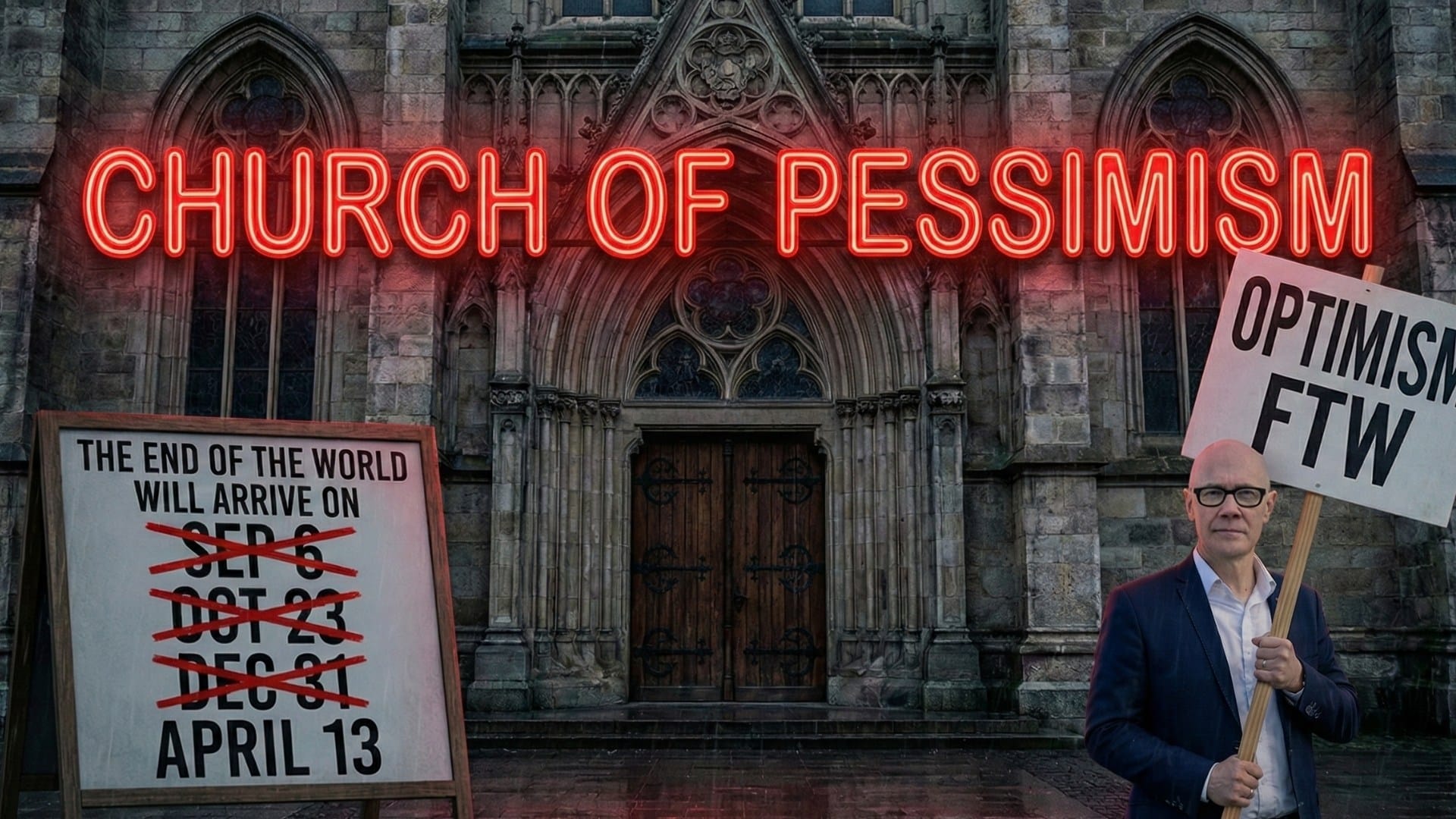
The one who does not fully participate breaks the group’s moral agreement. In a community where it is virtuous to acknowledge how bad everything is, optimism becomes almost a sin. Not because of optimism itself, but because of the disloyalty to the group. You are a heretic.
Gaining status through devotion
Hugo Mercier shows in the book Not Born Yesterday that in subgroups, people are often rewarded extra for being the most devoted and taking more extreme positions. It is not enough simply to agree. The one who shows the greatest commitment, pushes the boundaries, and most clearly marks out deviants gains the highest status.
This drives groups toward ever purer positions, where moderation can be perceived as weakness or disloyalty.
It is a pattern we recognize from religion. The most devout, the one who fasts longest, who sacrifices most, gains the highest esteem. In secular contexts, we see the same dynamic. The one most outraged by injustice, who takes the clearest stance, who compromises the least with “wrong” opinions, earns the most respect within the group.
This creates a competition in orthodoxy that gradually shifts the group’s center. What yesterday was an extreme position becomes today’s standard, and tomorrow something even stronger is required to show true devotion. Moderate voices fade away or fall silent, not because they have changed their minds, but because the cost of speaking becomes too high.
By being the one who most clearly calls out the heretic, you gain social status. And it is in this pursuit of the group’s recognition that the subtle cost of deviation becomes most palpable.
Why pessimism?
Why has pessimism become one of our time’s dominant creeds? Part of the answer is biological. We are biologically predisposed to this behavior. Negativity bias means our brains react more strongly to threats and problems than to positive news. Our very existence is due to our ancestors having this survival mechanism. Messages of doom stick. Good news slides off. That is why a dark worldview can feel more real than actual data.
Pessimists can appear smart and responsible. Optimists are easily dismissed as naïve or simplistic. The most irritating form of optimism is not shallow cheerfulness. That is easy to brush off as ignorance. What truly provokes is well-informed, calm, non-provocative optimism. When it is grounded in facts and data, it can no longer be dismissed as uninformed. What remains is to question motives and cast suspicion.
Saying “it was better before” requires no precision. It feels emotionally true even when it is factually false. When someone, for example me, instead says “no, it was worse before in almost every measurable way,” it makes the sorrow unnecessary. This is not about facts but about belonging. Questioning the group’s consensus is perceived as a threat to the community itself.
Understanding our own nature
None of us is immune to the mechanisms of religion. Since religious behavior is evidently part of our human nature, we are all influenced by the need for belonging, moral frameworks, and rituals. We are all drawn to communities that confirm our worldview. We all feel that warmth when someone agrees with our concerns, and the chill when someone questions them.
Understanding these mechanisms does not free us from them. But it gives us the opportunity to reflect. When we recognize our own religious behavior in secular disguise, we can ask ourselves whether it truly serves us well.
And the next time someone challenges the order of the universe by choosing ice cream when everyone else chose a bun, see it as practice. Even if it grates just a little, it is those who dare to challenge who actually make things happen in the end. That should be encouraged.
Tobias Wahlqvist
(And the person was probably just craving a scoop of raspberry licorice ice cream, not trying to overthrow the social order. Even if your religious instincts tell you otherwise.)
By becoming a premium supporter, you help in the creation and sharing of fact-based optimistic news all over the world.