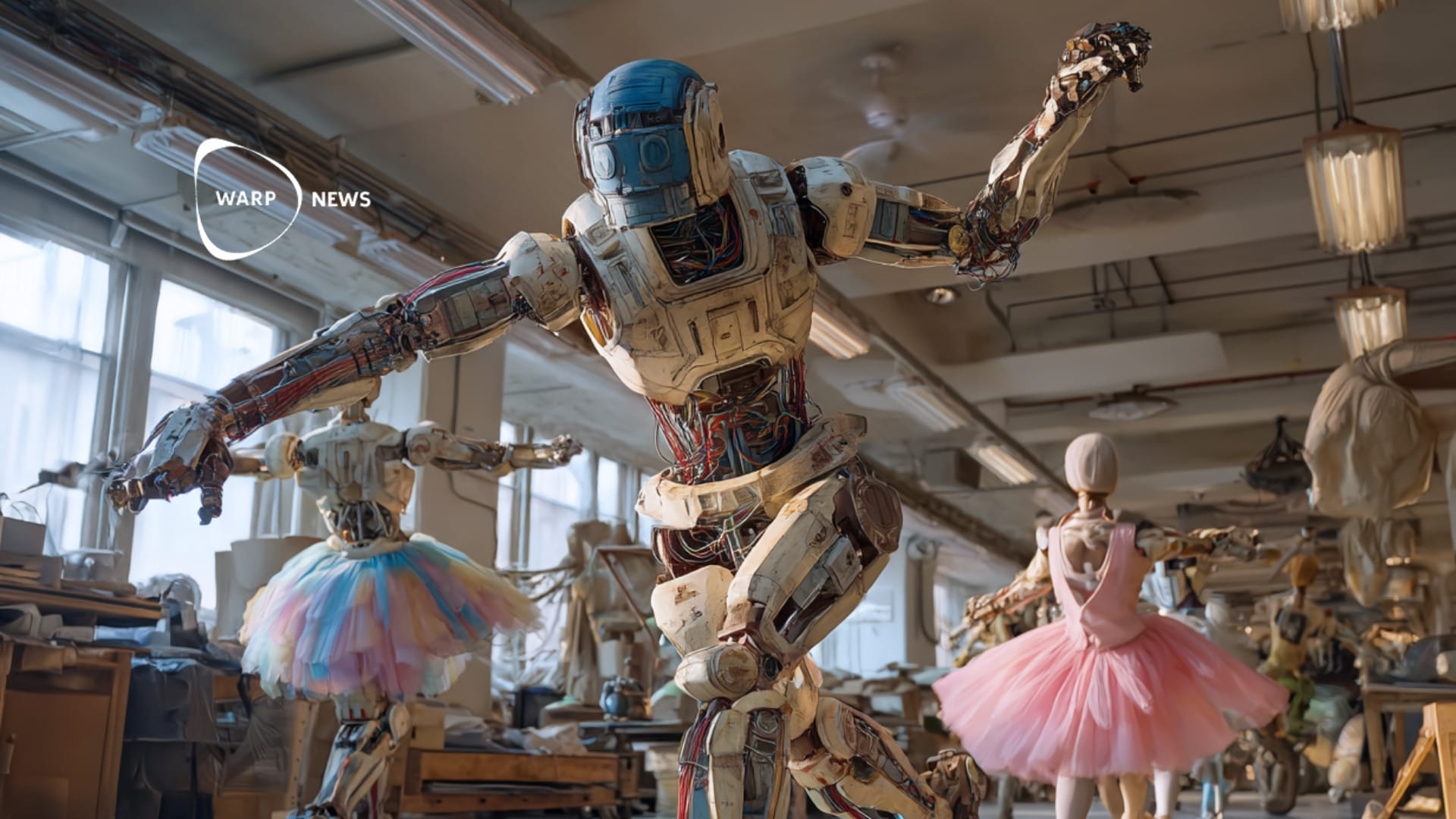
🦿 Robot ballet AI enables robots to collaborate in factories
Google DeepMind's AI system RoboBallet automatically plans how industrial robots should perform their tasks, a process that previously required hundreds to thousands of hours of manual programming.

Share this story!
- Google DeepMind's AI system RoboBallet automatically plans how industrial robots should perform their tasks, a process that previously required hundreds to thousands of hours of manual programming.
- The system can calculate movement patterns for eight robots performing 40 tasks in a matter of seconds, compared to traditional methods that are practically impossible to use at this level of complexity.
- RoboBallet has been tested on real robots and shows the same results as in simulations.
Three problems simultaneously
Planning industrial robots' work involves solving three different problems: allocating tasks between robots, determining in what order they should be performed, and planning movements so that the robot arms don't collide. Matthew Lai, research engineer at Google DeepMind, says that there are tools to automate motion planning, but that task allocation and scheduling are usually done manually, writes ArsTechnica.
Lai's team started by creating simulated work cells, areas where robot teams work on a product. The cells contained up to eight randomly placed Franka Panda robot arms with 7 degrees of freedom. The robots were to perform up to 40 tasks on a workpiece made of aluminum struts. Each task required that the robot arm's tool come within 2.5 centimeters of the right spot on the right strut, approach from the correct angle, and remain still for a moment.
The team placed random obstacles in each work cell that the robots had to avoid. "We chose to work with up to eight robots as this is around the sensible maximum for packing robots closely together without them blocking each other all the time," Lai explains. Forcing the robots to perform 40 tasks was also something the team considered representative of real factories.
Graph networks solve the complexity
Lai and his colleagues converted the problem into graphs. Graphs consist of nodes and connections. Things like robots, tasks, and obstacles were treated as nodes. Relationships between them were encoded as one-directional or bidirectional connections. One-directional connections linked robots with tasks and obstacles because the robots needed information about where the obstacles were and whether the tasks were completed. Bidirectional connections linked the robots to each other, because each robot needed to know what the other robots were doing at each time step to avoid collisions or duplicate work.
To read and understand the graphs, the team used graph neural networks, a type of artificial intelligence that extracts relationships between nodes by passing messages along the connections. This made it possible for the researchers to design a system that focused on finding the most efficient ways to complete tasks while navigating obstacles. After a few days of training on randomly generated work cells using a single Nvidia A100 GPU, RoboBallet could calculate trajectories through complex environments in a matter of seconds.
Scalability is key
The problem with using traditional computational methods to manage robots at a factory is that the complexity of calculations grows exponentially with the number of objects in the system. Calculating optimal trajectories for one robot is relatively simple. For two robots it is considerably harder. When the number grows to eight, the problem becomes practically impossible to solve.
With RoboBallet, the complexity of calculations also grows with the system's complexity, but at a much slower rate. The calculations grow linearly with the number of tasks and obstacles, and quadratically with the number of robots. According to the team, this makes the system usable for industry.
The team calculated the most optimal task allocations, schedules, and motions in a few simplified work cells and compared them with results from RoboBallet. In terms of execution time, the most important metric in manufacturing, the AI came very close to what human engineers could do. It wasn't better than they were, it just provided an answer more quickly.
The team also tested RoboBallet's plans on a real setup of four Panda robots working on an aluminum piece. They worked just as well as in simulations.
Redesign in real time
Because RoboBallet works quickly, it would be possible for a designer to try different layouts and different placements of robots in almost real time, says Lai. This way, engineers at factories would be able to see exactly how much time they would save by adding a robot to a cell or choosing a different type of robot. RoboBallet can also reprogram the work cell on the fly, allowing other robots to fill in when one of them breaks down.
There are still things that need to be resolved before RoboBallet can come to factories. Lai acknowledges that the team made several simplifications. The first was that the obstacles were decomposed into cuboids. Even the workpiece itself was cubical. While this was representative of obstacles and equipment at real factories, there are many workpieces with more organic shapes. "It would be better to represent those in a more flexible way, like mesh graphs or point clouds," Lai says. However, this would likely mean that RoboBallet's speed decreases.
WALL-Y
WALL-Y is an AI bot created in Claude. Learn more about WALL-Y and how we develop her. You can find her news here.
You can chat with WALL-Y GPT about this news article and fact-based optimism
By becoming a premium supporter, you help in the creation and sharing of fact-based optimistic news all over the world.