📗 Book excerpt: A steam engine for the brain
An excerpt from The Fifth Acceleration: Why AI Is Not the End – but the Beginning of What We Can Become by Mathias Sundin.

Share this story!
Here’s an excerpt from The Fifth Acceleration: Why AI Is Not the End – but the Beginning of What We Can Become by Mathias Sundin.
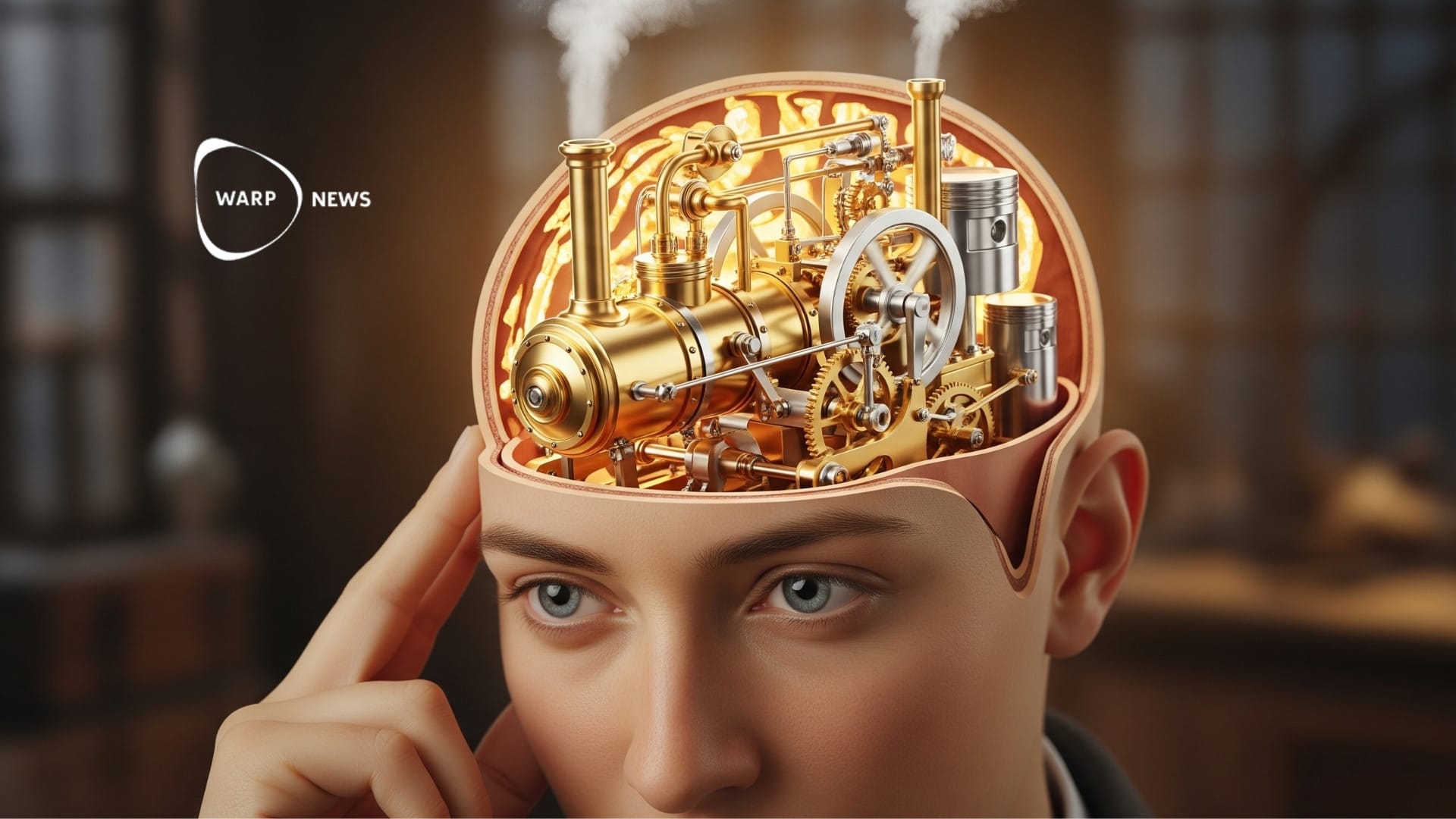
A steam engine for the brain
In eight months, the Swedish AI company Lovable went from zero to hundred million dollars in revenue. That made them the fastest-growing startup in the world — ever. The reason is that they have understood exactly what the key to today’s AI is.
Lovable offers a service where users, with natural language, build apps and websites without needing to program. Not just a prototype or a sketch, but fully functional, with payment services, newsletters, and everything you can think of.
What used to be a large and expensive project that required special expertise could now be done by anyone. It unleashed a wave of entrepreneurship as thousands of people set about turning ideas into reality.
The key is language: that we can now use our human language to give ourselves abilities we did not have before. Generative AI frees human potential. The tone-deaf can create music. People with dyslexia can write beautiful prose. The color-blind can paint like Picasso.
This creativity has previously been stuck in our heads. It has taken thousands of hours of deliberate practice to become a skilled musician — and even then you cannot create every kind of music. A classical pianist is not automatically also a skilled rapper. By bridging the gap between intention and ability, AI opens a world where we, regardless of physical or cognitive challenges, can contribute more with our unique creativity and innovation. And not only do we gain new abilities — we become better at the ones we already have. We level up ourselves.
When this happens for billions of people, a massive wave of creativity is unleashed, one that will reshape the world and affect every part of society. The result is a greater change than the internet. We will see more progress and faster development. Humanity has previously experienced four accelerations — now we are entering the fifth.
The steam engine was a decisive part of the fourth acceleration, the one we call the Industrial Revolution. Before it was invented, almost all physical change in the world rested on biological muscles — our own or animals’. Of course we had aids like blocks and tackle, but muscles still did the work.
What was truly transformative about the steam engine was that it dramatically increased our ability to exert force on our surroundings. It was not a small improvement, but several multiplications. The first steam engine, which pumped water out of a mine, replaced 500 horses. And it was terribly inefficient compared with the steam engines that were later developed.
That steam engine had a clear use case, but there was no theory behind it. People knew that it worked, but not quite why. Only more than a hundred years later did we begin to develop a theoretical understanding, which allowed us to improve it. The locomotive from the late 19th century was still a steam engine, but much more efficient thanks to new understanding in thermodynamics and engineering.
The development of artificial intelligence resembles this in many ways. It is the first time we have truly managed to extend our cognitive capacity — our biological brain — by several multiplications. We have had computers and calculators and AI that played chess, but they are the equivalents of blocks and tackle: tools that helped us, but no paradigm shift, no phase transition.
AI gives us something entirely different. Today’s language models extend our cognition in a way that was not previously possible. They work; they are useful; but we still do not quite understand how. We still lack a deep theoretical understanding, and the models are likely rather inefficient. We have already seen how gigantic models can be replaced by significantly smaller ones that perform almost as well, which suggests there is great room for improvement.
For the first time, we have invented a machine with an ability to reason. With traditional programming, we humans think through all possible scenarios in advance and write instructions for the computer. Language models — and machine learning more generally — handle unpredictable situations, things that no one programmed in advance or even thought of.
This change will be the greatest so far in world history. The reason is that AI has gone from being for the few to being for everyone. The machines have begun to understand human language, and therefore everyone can use AI. Thanks to the internet, we do not need to build the distribution of this tool — every single person with an internet connection can use it.
Mathias Sundin
Angry Optimist
The book is available wherever books are sold — including Adlibris, Bokus and Akademibokhandeln — as well as directly from the publisher, Mondial.
Available in Swedish only.
By becoming a premium supporter, you help in the creation and sharing of fact-based optimistic news all over the world.