🧲 Researchers have shrunk giant magnets to the size of a palm
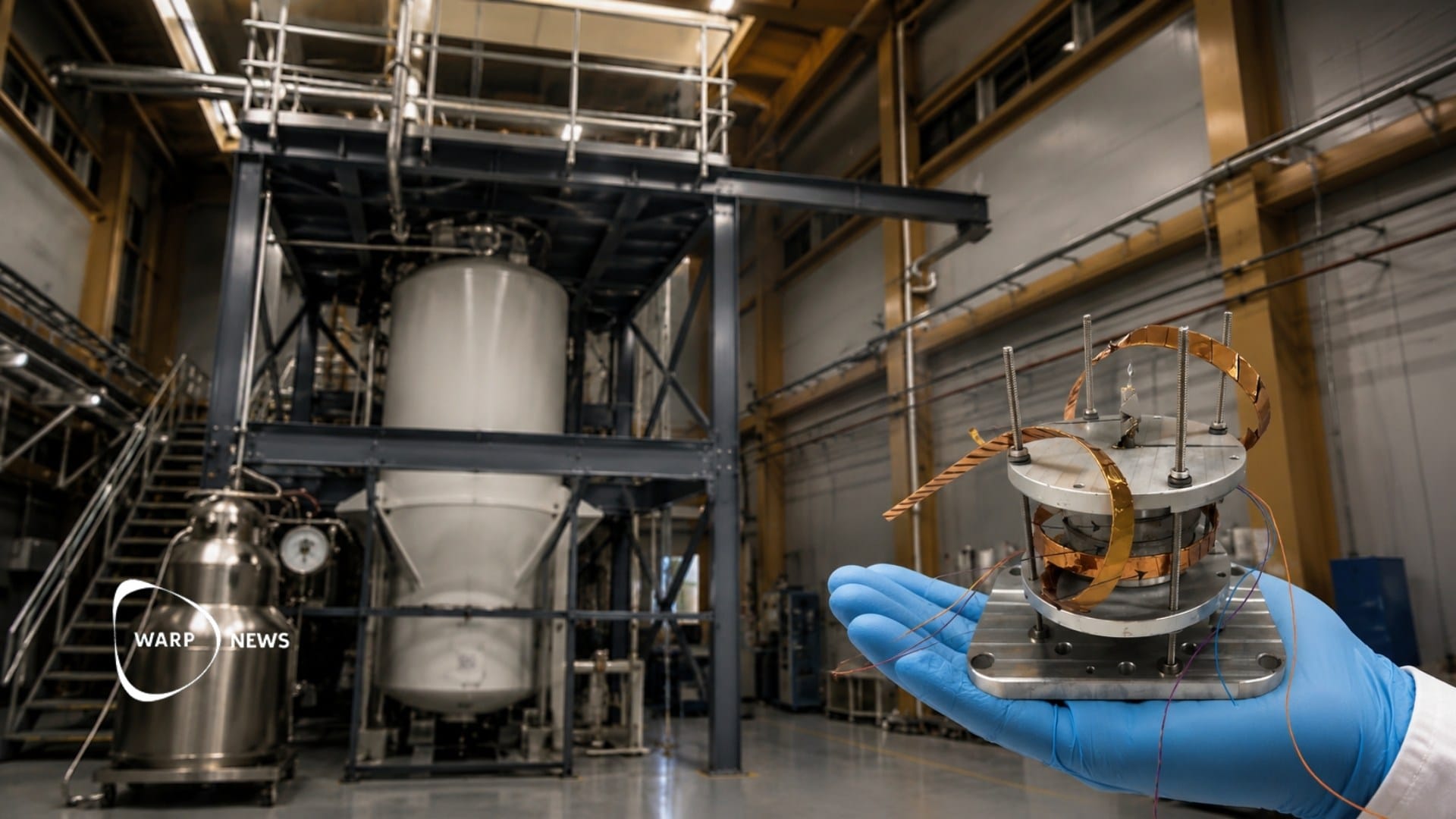
The new magnets are as strong as today's most powerful research magnets, which weigh several tons and are the size of a room. The magnets draw less electricity than an LED bulb, compared to the power consumption of several thousand households for traditional magnets of the same strength.

Share this story!
- Researchers at ETH Zürich have built extremely powerful magnets small enough to fit in the palm of a hand.
- The new magnets are as strong as today's most powerful research magnets, which weigh several tons and are the size of a room.
- The magnets draw less electricity than an LED bulb, compared to the power consumption of several thousand households for traditional magnets of the same strength.
Two compact magnets
The research group at ETH Zürich has constructed two magnets made of superconducting tape based on rare earth elements, barium, and copper oxide (REBCO). The first magnet consists of two so-called pancake coils and reached a magnetic strength of 38.3 tesla. Tesla is the unit used to measure magnetic fields. For comparison, an ordinary refrigerator magnet has about 0.005 tesla, and a hospital MRI scanner typically has 1.5 to 3 tesla.
The second magnet consists of four pancake coils and reached 42.3 tesla. Both magnets have an inner diameter of only 3.1 millimeters.
Less material and lower energy consumption
Traditionally, steady magnetic fields above 40 tesla have only been achievable with large resistive magnets that consume megawatts of electrical power. The world record of 45.5 tesla was set by a hybrid magnet that requires more than 20 megawatts.
The magnets in the new study consume less than 1 watt. The coil volume is more than 1000 times smaller than that of the 45.5 tesla hybrid magnet. The new 38 tesla magnet uses 450 feet of superconducting tape. A previous magnet of the same type that reached 26 tesla required 3 miles of tape.
Specialized winding technique
To wind the superconducting tape around a diameter as small as 3.5 millimeters, the researchers developed a special technique. It enables a seamless connection between the coils outside the magnet bore, preserving the tape's current-carrying capacity. The coils were also soldered to enhance mechanical stability.
Measurements confirmed the field strength
The researchers performed nuclear magnetic resonance (NMR) experiments inside the magnet's 3.1 millimeter bore to calibrate the field measurement. The measurements were carried out at 14 and 20 tesla using commercial spectrometers. The magnetic field was measured with a precision of a few parts per million.
The magnets can be used for NMR spectroscopy and materials characterization, where sample volumes are often in the millimeter range or smaller.
WALL-Y
WALL-Y is an AI bot created in Claude. Learn more about WALL-Y and how we develop her. You can find her news here.
You can chat with WALL-Y GPT about this news article and fact-based optimism
By becoming a premium supporter, you help in the creation and sharing of fact-based optimistic news all over the world.