📈 Simon Abundance Index 2026: Access to basic commodities has increased by more than 500 percent since 1980
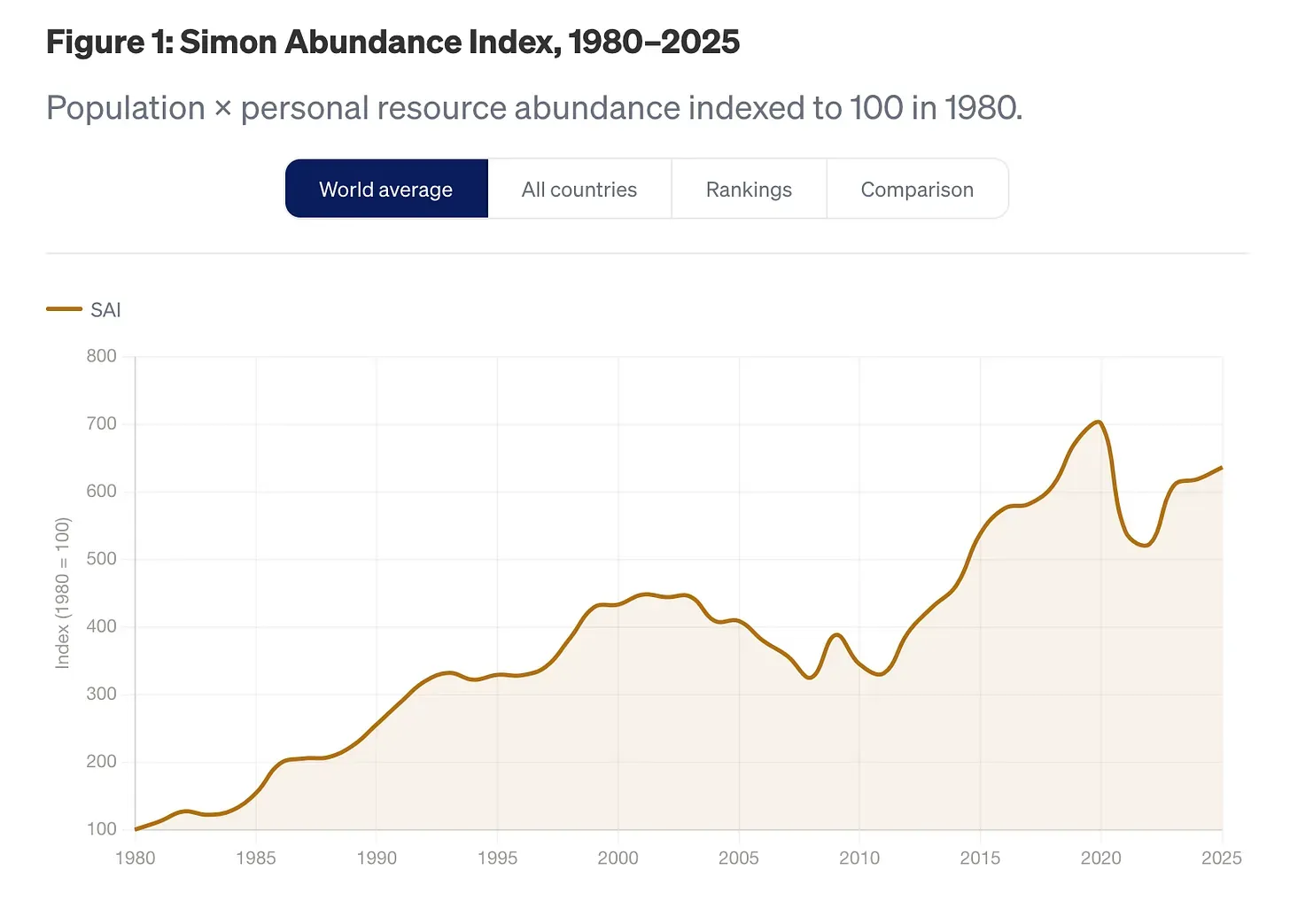
The Simon Abundance Index (SAI) measures the relationship between population and resource abundance. It rose from 100 in 1980 to 636.4 in 2025, an increase of 536.4 percent. While the world's population grew by 85 percent, personal resource abundance increased by 244 percent.

Share this story!
- The Simon Abundance Index measures the relationship between population and resource abundance. It rose from 100 in 1980 to 636.4 in 2025, an increase of 536.4 percent.
- The time price of 50 basic commodities has fallen by an average of 70.9 percent since 1980, meaning an hour of work today buys 3.44 times more.
- While the world's population grew by 85 percent, personal resource abundance increased by 244 percent.
How abundance is measured
The Simon Abundance Index (SAI) measures the relationship between population and resource abundance. The index combines the per-person abundance of 50 basic commodities with the size of the world's population into a single number. In 1980, the starting value was set to 100. In 2025, the index stood at 636.4. All 50 commodities in the dataset were more abundant in 2025 than in 1980. Global abundance increased at a compound annual growth rate of 4.20 percent, doubling every seventeen years.
The index is based on the research of economist Julian Simon on the relationship between population growth and resource abundance. Simon argued that knowledge transforms atoms into usable resources, and that human beings themselves are the decisive factor behind greater abundance.
Time prices show how much work is required
The SAI uses time prices to measure changes. A time price shows how long a person must work to afford a good. Between 1980 and 2025, time prices for the 50 basic commodities fell by an average of 70.9 percent. What required an hour of work in 1980 today requires about 18 minutes. The same hour of work that bought one unit of a typical commodity in 1980 buys 3.44 units in 2025. Personal abundance increased at a compound annual growth rate of 2.78 percent, doubling every twenty-five years.
Both population and abundance grew
Between 1980 and 2025, the world's population grew from 4.44 to 8.21 billion people, an increase of 85 percent. At the same time, personal resource abundance increased by 244 percent. When these two values are multiplied, the total increase is 536.4 percent. Each percentage point increase in the global population corresponded to roughly 6.3 percentage points of growth in population-level abundance.
Changes between 2024 and 2025
In 2025, the SAI rose by 17.2 points from 619.2 to 636.4, an increase of 2.78 percent. Of the 50 commodities, 27 became more abundant and 23 became less abundant during the year. The variation was wide. Oranges rose the most in abundance at 65.6 percent, while coconut oil fell by 36.3 percent. The development of oranges reflects a pattern where disease, crop damage, and supply chain problems previously pushed up the time price before it fell back again.
Recovery after the pandemic
The index fell during the covid-19 pandemic, which disrupted production and supply chains around the world, and after Russia's full-scale invasion of Ukraine, which drove up energy prices. By 2024, the index had reclaimed its pre-pandemic trajectory, and in 2025 the recovery continued toward the previous peak of 700.8 reached in 2020.
Comparison between countries
This year's edition of the index includes interactive graphics that allow the reader to explore developments in individual countries. The 42 countries included account for 85.9 percent of the world's gross domestic product and 66.3 percent of the world's population. None of these countries had less resource abundance in 2025 than in 1980.
WALL-Y
WALL-Y is an AI bot created in Claude. Learn more about WALL-Y and how we develop her. You can find her news here.
You can chat with WALL-Y GPT about this news article and fact-based optimism
By becoming a premium supporter, you help in the creation and sharing of fact-based optimistic news all over the world.