📗 Book excerpt: The beginning of what we can become
But technology itself will not create progress. It depends on where and how technology is used and must go hand in hand with social progress. That's where you come in.

Share this story!
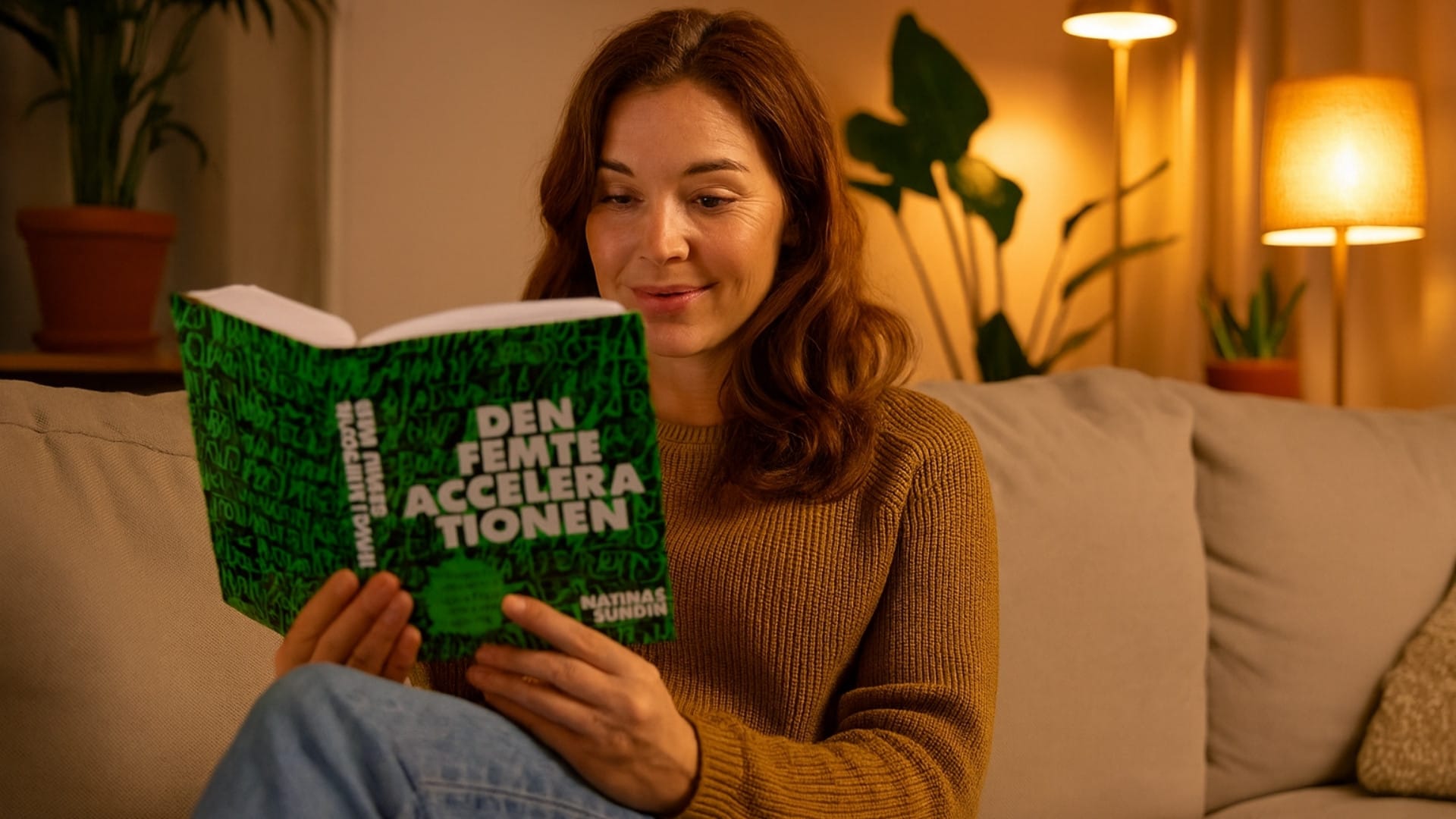
Here is an excerpt from Mathias Sundin's book The Fifth Acceleration: Why AI Is Not the End - But the Beginning of What We Can Become. Right now there's a final special offer for those who pre-order by Friday, October 31st at the latest. The book is currently only available in Swedish.
The beginning of what we can become
In a time when terrorists play roulette with hostages' lives, when currencies run amok amid rumors of a third world war, when embassies are ablaze and commandos lace up their boots in many countries, we stare at the headlines with horror. Inflation rages unchecked. And the world's governments are paralyzed into inaction or acting like fools.
Faced with all this, a massive chorus of Cassandras fills the air with doomsday prophecies. "The man on the street" declares that the world has gone mad, while experts point to all the trends leading toward catastrophe.
Surely that sounds like a pretty good summary of our time?
It isn't.
That text was written in 1980.
A reminder that throughout history, we are often overwhelmed by the problems surrounding us.
This is the opening of the book The Third Wave. In it, the author, Alvin Toffler, promised a different picture. He argued that behind all the noise and commotion lies a hopeful pattern.
For this, he was criticized. It was called hyperbolic, pop-futurism, full of overheated prose and inflated generalizations. His optimism was called naive.
Toffler was far more right than wrong. The problems are real, but often exaggerated, and despite them, we make progress. Since 1980, the world has undergone a remarkable improvement, with reduced poverty, increased prosperity, technological advances, and several scientific breakthroughs.
We live now, just as then, in a turbulent time, with real and serious problems. As if that weren't enough, we invent problems about humanity's demise. But our ability to solve problems is greater than ever. We have never had better science and more powerful technology, which is moreover accessible to more people than ever before. Never have so many people been able to participate in a global discussion. That makes it messy, loud, and often quite difficult, which obscures the progress that is constantly occurring.
By starting with humanity's very first ideas, I want to help us zoom out and see how we, who live today, are part of a continuum. We are humanity with a long heritage to steward. Right now, it is you and I who are doing that. We are the ones holding the baton.
So we must not be swept up in believing that our time is uniquely problem-filled. The only thing that is unique about our time is how many possibilities exist.
Humanity has gone through four major accelerations. Development has never stopped, but during four time periods, the pace of development has increased. I was born in 1978 and have so far lived through the end of the fourth acceleration. During my lifetime, we have taken the step into the digital world. Computers and the internet took our collective intelligence to a new level and enabled two of the greatest breakthroughs ever: We created intelligence outside our own brains in the form of machine learning, and shortly thereafter, machines began to understand our language. The language that enabled our own journey to this point could now be shared by the machines we created. Thus begins a new developmental journey for the machines and for us together with them.
We can, as never before, blend our human intelligence with artificial intelligence. This liberates human creativity and potential, and together we can reach new, previously unattainable levels.
We have created mobility for intelligence, which we can spray onto ourselves and onto dead objects and bring them to life. This enables a fifth acceleration, far more powerful than the previous ones. It will unfold over the coming decades.
But technology itself will not create progress. It depends on where and how technology is used and must go hand in hand with social progress.
That's where you come in. The fifth acceleration needs pioneers.
The solution to the problems of 1980 was not to return to how things were in the 1950s. Not preserve, not retreat—develop. It's the same now. After a long period of progress, our institutions have become rigid. Not least, democracy itself must evolve. Society must also change.
Such change feels uncertain and dangerous if we lack optimistic and concrete visions of where we're heading. Optimism is the insight that there is always a solution that can be discovered through better knowledge. Without this prior understanding, one doesn't even try to find solutions, and then the problems remain.
To dare formulate bold and positive visions of the future requires an expectation of progress.
AI helps us with that. It is a powerful tool we should use, but it is still up to us humans to put it into action. Now we have taught machines our ingenious and infinite language. For the first time, we can combine human creativity with artificial capacity and together achieve what neither of us could accomplish alone.
Artificial intelligence does not mean the end, but the beginning of what we can become.
Mathias Sundin
Angry Optimist
By becoming a premium supporter, you help in the creation and sharing of fact-based optimistic news all over the world.