
🍽️ The naive optimist who turned out to be right – lunch with Ramez Naam
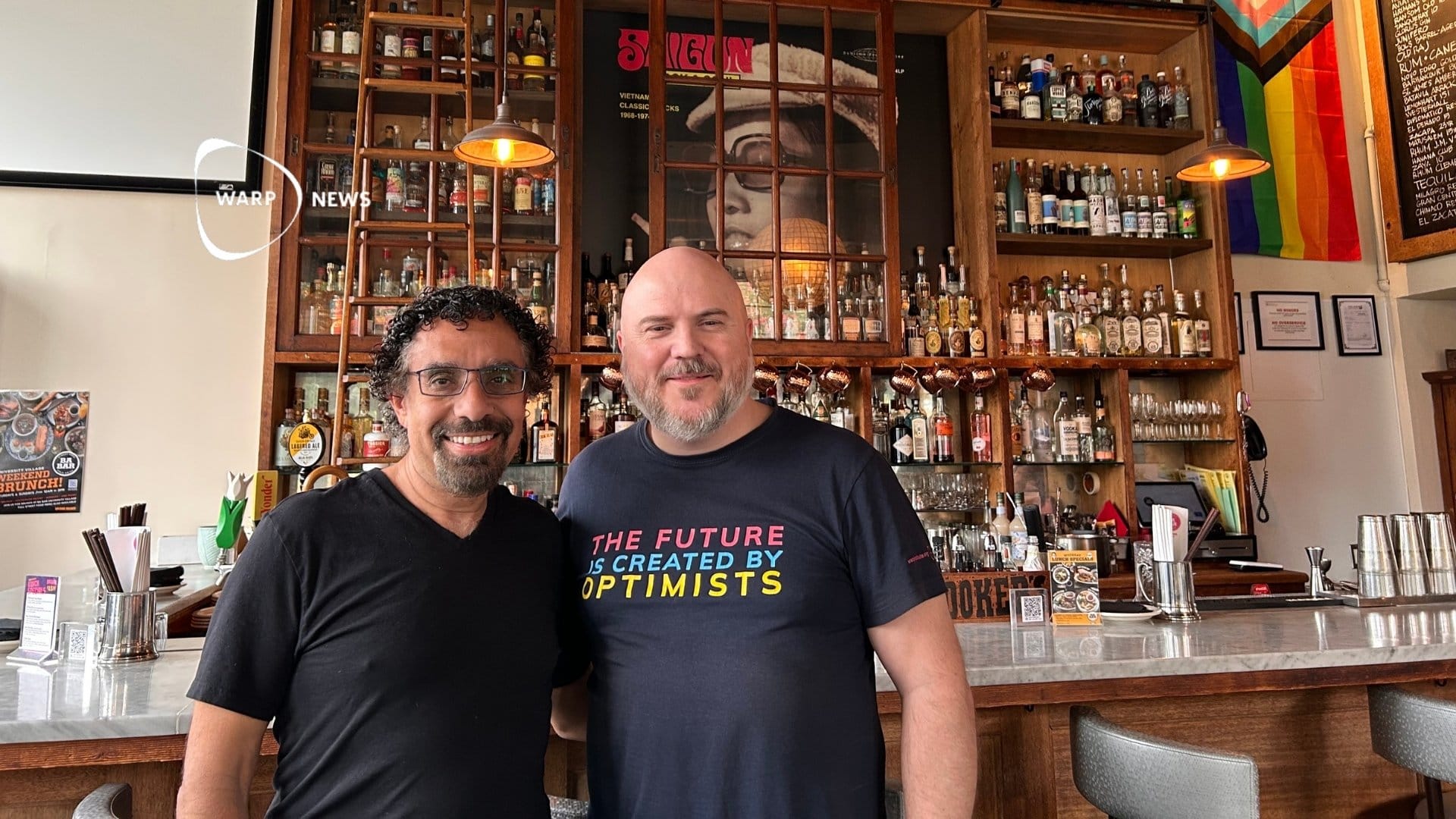
Two failed hugs framed an interesting conversation with the polymath and renewable energy expert Ramez Naam.

Share this story!
We’ve never met before, but he starts by giving me a hug. As a slightly stiff Scandinavian, I’m caught off guard — in the Nordics we shake hands or nod at each other — and the hug is rather awkward. But I immediately feel that I like Mez.
His real name is Ramez Naam, and he lives in Seattle, where he once worked for Microsoft. It wasn’t until after he left that I really took notice of him, when I started digging into the cost of solar energy. His name kept popping up, often described as an extreme optimist.
Apparently that was meant as an insult, and some people were angry with him. Naive optimists are supposed to be kept in check!
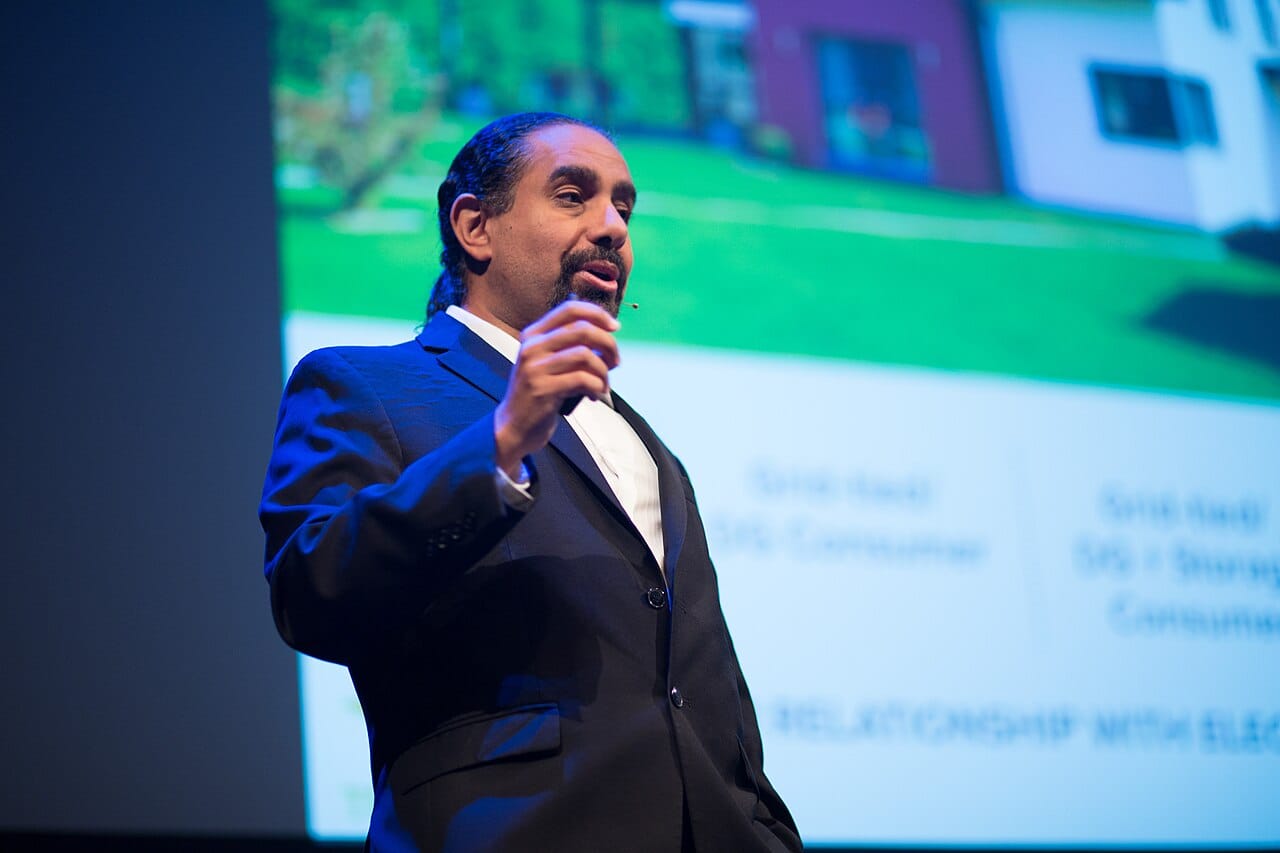
The anger was directed at an article in Scientific American from 2011. In it, he claimed that the world’s leading energy organization, the International Energy Agency (IEA), was wrong. Very wrong. According to Naam’s calculations, the price of solar energy would fall much faster and much further than the IEA predicted.
We have lunch at a pleasant Vietnamese restaurant in Seattle. I’m in town for other reasons and took the opportunity to book a meeting with Mez. Among other things, I want to know how he dared to challenge the consensus the way he did almost 15 years ago.
“I was naive and arrogant,” he replies. At the time, he had just come from Microsoft and a world where Moore’s law is well known. Since the late 1950s, the number of transistors per chip has roughly doubled every other year without an increase in cost, creating an exponential curve. Could Moore’s law also be applied to solar energy?
When Naam looked at historical data, he saw that it could.
“Over the past 30 years, researchers have seen the cost of capturing solar energy fall exponentially,” he wrote.
He therefore assumed that this trend would continue. By 2020, the price of solar energy would more than halve, from about 27 cents per kilowatt-hour (kWh) in 2010 to 13 cents in 2020.
The IEA had made a forecast a year before Naam, also looking toward 2020. They too believed prices would fall, but much less, ending up at roughly double the cost Naam predicted.
That was what irritated people. And they would become even angrier. Because nothing is more annoying than when a naive extreme optimist turns out to be right.

Five years later — after rapid declines in solar prices — the IEA updated its forecast and landed at the same level for 2020 that Naam had predicted. But Naam also updated his forecast, and he too ended up lower. By 2020, the price would be 7–8 cents per kWh.
The advantage of time-bound predictions is that we eventually get an answer. The year 2020 arrived, and it turned out that the price was lower than what even Naam had predicted, around 4–5 cents per kWh. He came far closer than almost anyone else in the world (Tony Seba was exactly right).
In one sense, Mez is right when he says it was naive arrogance that made him believe he could use knowledge from one field to understand another better than that field’s experts. But one could just as well say that the naive arrogance lay with those experts, who failed to incorporate insights from other domains. After all, Mez turned out to be far more correct than they were.
If you mix naivety and arrogance with humility, I often think that knowledge from one field can help you see things differently than what is established in another field.
So what does Naam believe now about the future of solar energy and other renewables?
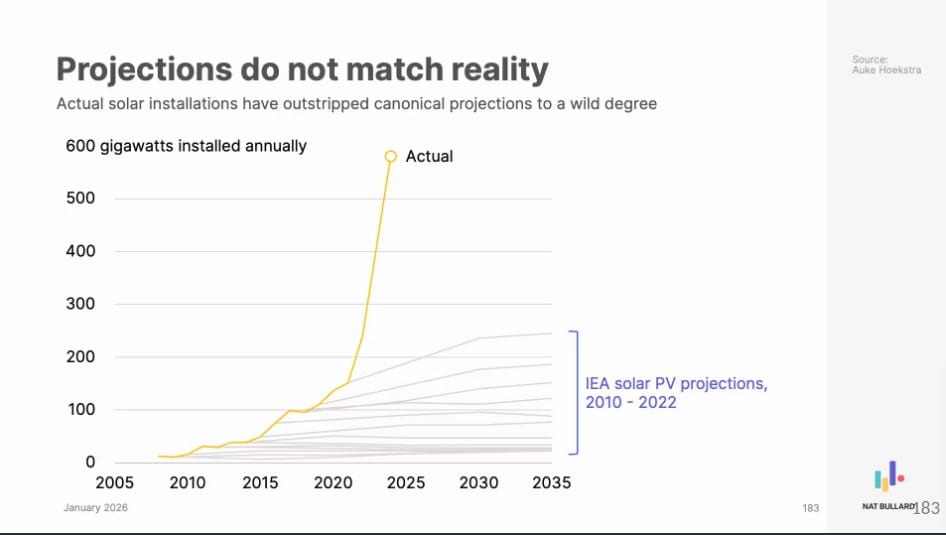
The first thing he points out is that it’s not only solar prices where forecasts have been wrong. When it comes to how much solar power is built, how many batteries are sold, and how many electric vehicles are sold, reality repeatedly outperforms projections. Naam believes the price trend will continue, with both solar and batteries becoming 75–80 percent cheaper over the next 25 years.
Anything other than renewables?
If Naam is right again, solar energy combined with batteries in sunny locations will be the cheapest electricity that can be delivered continuously, around the clock, all year.
But does he see anything else on the energy horizon?
Yes — he is fond of fusion power. That’s when light atomic nuclei are fused together, releasing energy. It’s the process that powers the sun and stars, but it has not yet been commercialized on Earth. This is not the kind of nuclear power we use today (that’s called fission, where atomic nuclei are split).
The advantage of fusion over fission is that it uses fuel that is practically unlimited, since it relies on hydrogen isotopes that can be extracted from ordinary water. Fusion produces far less long-lived radioactive waste and is inherently safer: if something goes wrong, the fusion process stops on its own. It also releases much more energy per kilogram of fuel. The downside is that the technology is extremely difficult to make work reliably and economically, which is why it hasn’t yet been used commercially.
That last part, Naam believes, is now drawing closer to being solved. For fusion power to work, more energy must be produced than consumed, and step by step we have moved closer to that point.
"We’re right on the threshold of crossing that line,” says Naam. He touches on this in a talk I watch afterward. The upper right corner is where we need to get for it to work — and as you can see, we’re very close.
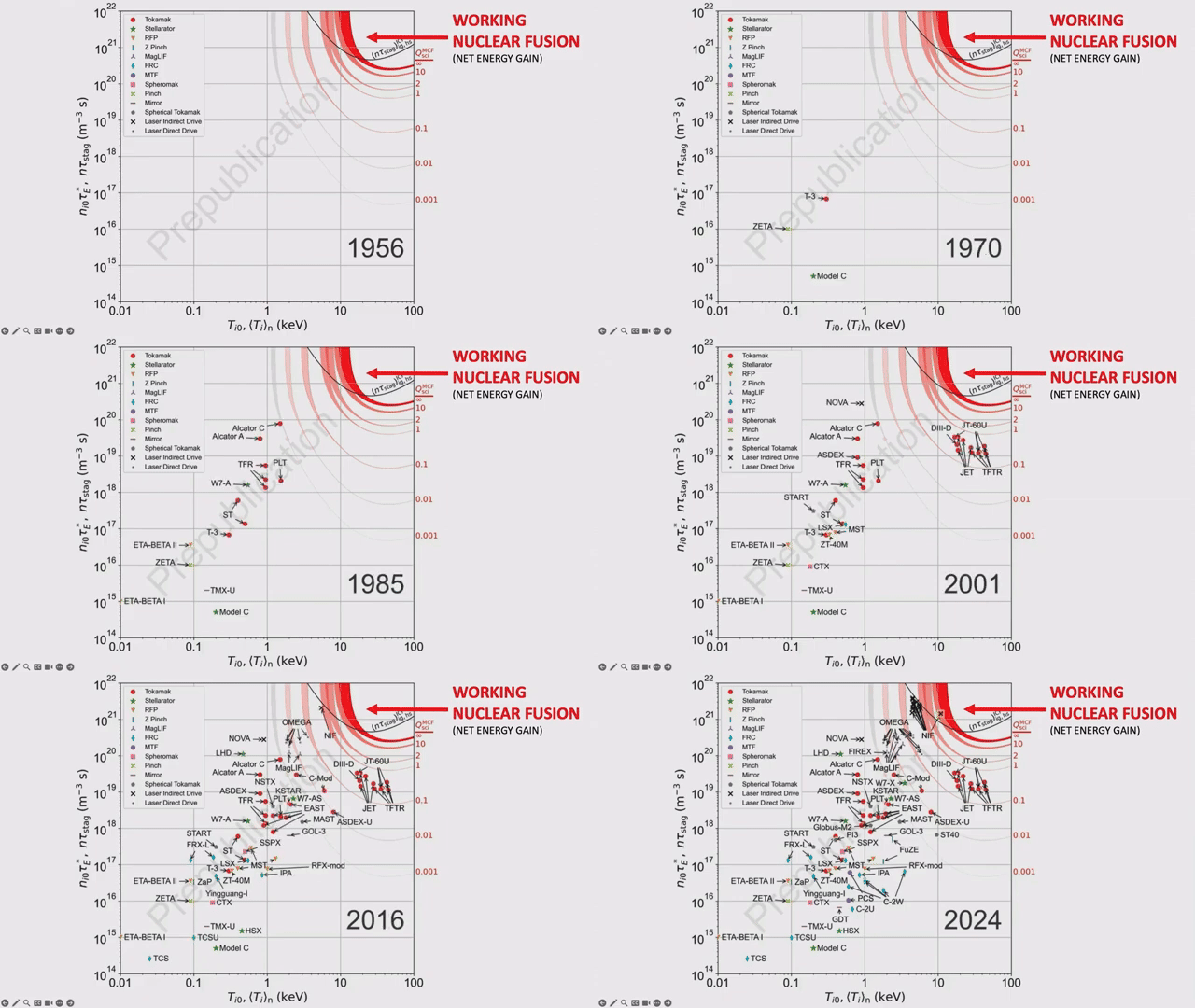
Major questions remain about scaling up and making it commercially viable. But once we succeed, Naam argues, we will have an energy source that is cheaper than solar power.
More books on the way?
Naam is also the author of one of my favorite books, whose title neatly captures its message: The Infinite Resource: The Power of Ideas on a Finite Planet. A message I’ve repeated countless times here at Warp News and in my own books.
It’s a nonfiction book, but he has also written science fiction — the Nexus trilogy — about a not-too-distant future where a nano-drug connects people, mind to mind.
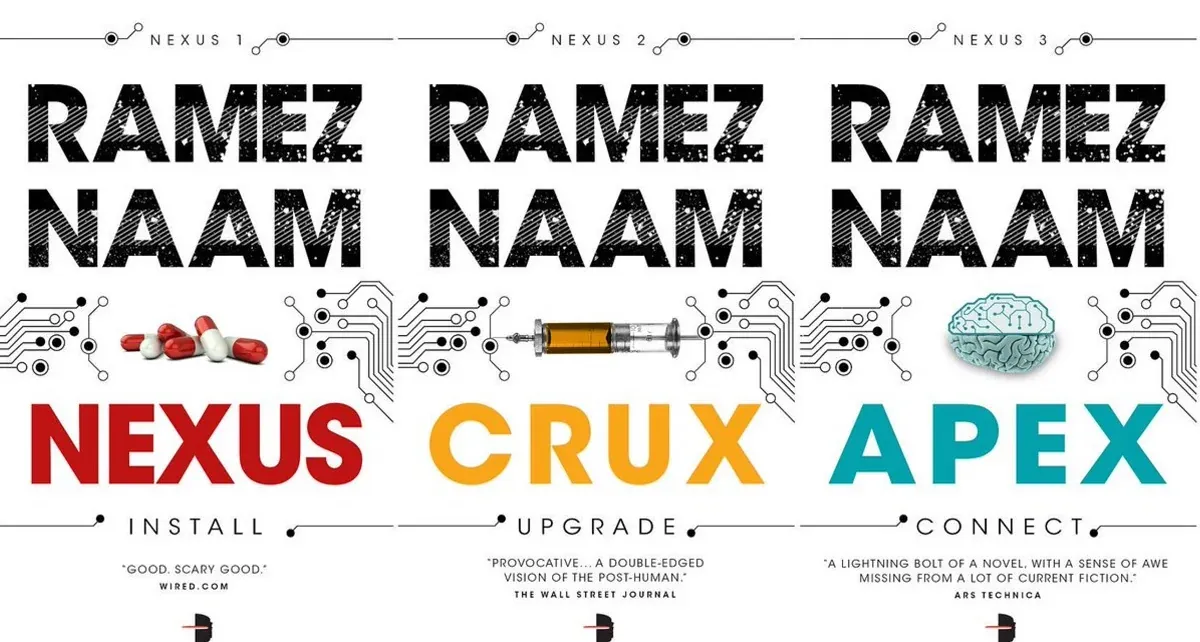
So I’m curious — and hopeful — about whether he’s writing something new. I’m not disappointed.
"I'm working on a short story about AI, alignment, and values versus control,” he says. In addition, he’s the editor of a collection of stories by other authors about the future of AI and the brain. It will be released this year.
A goodbye hug
When we part outside Ba-Bar, he gives me another hug. Embarrassingly, I’m once again unprepared and silently curse my ancient relatives who once thought it was a good idea to settle in Sweden.
I try to compose myself and give him a pat on the back.
Because now I like Mez even more. Both as the person I just talked to — and because I also love naive extreme optimists who dare to challenge consensus, and who turn out to be right.
WALL-Y
WALL-Y is an AI bot created in Claude. Learn more about WALL-Y and how we develop her. You can find her news here.
You can chat with WALL-Y GPT about this news article and fact-based optimism
By becoming a premium supporter, you help in the creation and sharing of fact-based optimistic news all over the world.
.jpg?ref=warpnews.org#/media/File:Ramez_Naam_at_the_SingularityU_The_Netherlands_Summit_2016_(29359738780).jpg)