🤦 The Nobel laureate’s banal critique of humanity
The Nobel laureate László Krasznahorkai claims humanity peaked at the Moon landing and that technology since has made us worse. But his bleak view is neither new nor convincing — it mostly reveals how we humans always complain about the time we live in.

Share this story!
Once is nothing, twice is a tradition. Last year I criticized the literature laureate, Han Kang, for her pessimistic view of humanity. A view she seems to share with this year’s laureate, László Krasznahorkai. So here I am again. Both because I think he’s wrong, and because his view is so banal.
Krasznahorkai opened his Nobel lecture by declaring that he has lost all hope.
“On receiving the 2025 Nobel Prize in Literature, I originally wished to share my thoughts with you on the subject of hope, but as my stores of hope have definitively come to an end, I will now speak about angels..”
The lost hope, he says, comes from the idea that humans have stopped being human.
He praises the humans of the past. It’s beautiful.
“You invented the wheel, you invented fire, you realized that cooperation was your only means of survival…”
And he continues:
“…reinforced your species upon Earth and caused it to grow, you gathered together in hordes, you built up societies, you created civilizations, you also became capable of the miracle of not dying out...”
This hopeful human continues into the 20th century, but somewhere around here it seems to end:
“…finally you flew into space, forsaking the birds, then you flew up to the Moon, and you took your first steps there…”
For now technology begins to destroy the human being, he argues.
“…with complete and utter suddenness, began to believe in nothing at all anymore, and, thanks to the devices that you yourself invented, destroying imagination, you are left with only short-term memory now…”
He doesn’t say that technology itself is evil, but that technology has changed humans in a way that has robbed us of certain earlier abilities. Our own gadgets destroy our imagination. They leave us with only short-term memory. Therefore we let go of knowledge, beauty, and morality.
Many people share this view. But it is in no way unique to our time. We know that Socrates complained 2,400 years ago about what would happen once we started writing things down: bad memory! (We remember that he said this because Plato wrote it down.)
It seems deeply human to complain about the time one lives in and idealize the past. Last year the Washington Post did a fascinating investigation into the question of when “the past” was actually better (which I wrote about here). Because if every generation thought things were better in the past, when exactly was the past at its best? In the 1970s? The 1950s? The 1920s? Or when?
It turned out that people didn’t agree on a particular decade — but on a particular age. When people had grown older, they claimed society had been at its best when they were teenagers.
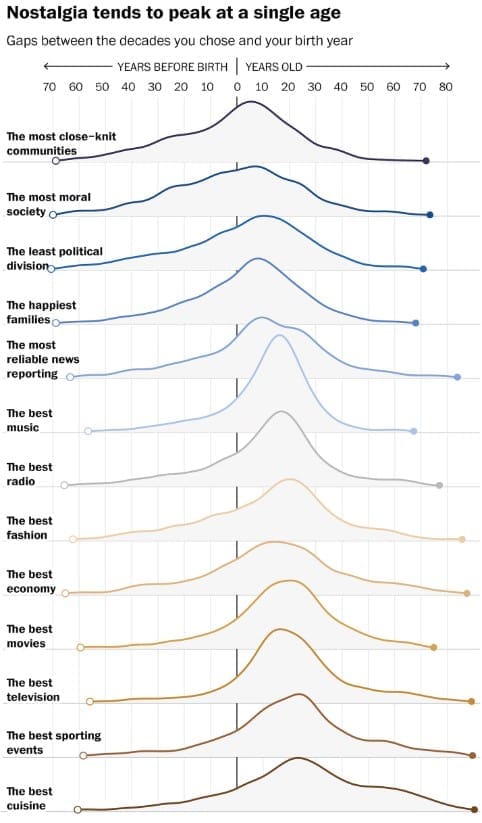
Every generation believes that when they were teenagers, society had the most community spirit, the strongest morals, the least political polarization, the happiest families, the most reliable news, the best music, the best radio shows, the best fashion, the best economy, the best films, the best TV programs, the best sporting events, and the best food culture.
All this makes me think of Douglas Adams’ sharp observation:
“Anything that’s in the world when you’re born is normal and ordinary and is just a natural part of the way the world works.
Anything that’s invented between when you’re fifteen and thirty-five is new and exciting and you can probably get a career in it.
Anything invented after you’re thirty-five is against the natural order of things.”
Adams wrote this in 1999, when people were complaining about the then-new technology called the internet.

László Krasznahorkai believes humanity’s positive development peaked at the Moon landing in 1969. Since then, things have begun to slide downhill — and in recent years deteriorated so much that he has lost all hope.
How old was László Krasznahorkai in 1969, when humanity flew up to the Moon, and took its first steps there?
Fifteen years old.
Mathias Sundin
Angry Optimist
By becoming a premium supporter, you help in the creation and sharing of fact-based optimistic news all over the world.