

💡 Warp News #328
🚰 Polluted drinking water in the US has been cut in half. 📉 Data centers have lowered Americans' electricity bills. 🎗️ No young women died of cervical cancer in England.

Share this story!
Free newsletter with fact-based optimistic news about technology, science, and human progress with the angry optimist, Mathias Sundin. If you are not a subscriber, become one here.
🇪🇺 A major opportunity for Europe
Jonas Birgersson’s EnergyNet is the power grid’s equivalent of the internet. Built on the same architecture, with thousands of small networks instead of one large one.
Once built out, it could give us an abundance of cheap and clean electricity, while also providing a very robust system.
It has, admittedly, been clear for a long time that the EU needs to get its act together, increase growth, strengthen its defense capabilities, and improve its competitiveness. A couple of years ago, the Draghi report forcefully argued that regulation had gone too far.
Since Donald Trump returned to the White House, it has become urgent.
EnergyNet can be built all over the world, but the EU has one advantage: the area has already been deregulated — unlike almost the entire rest of the world.
A few years ago, a ban was removed, making it legal to run electricity cables between properties and thereby share energy.
This gives the EU the opportunity to become the first in the world with EnergyNet. The EU would get the world’s lowest energy costs and the world’s most robust power grid, which can be filled with as much solar, wind, and batteries as we want.
For the third time, I have written a longer update on what is happening in the world-unique Project Energy Society.
In short, things are moving fast. Two connected properties are becoming ten, and in seven other locations in Sweden, plans are underway to build EnergyNet.
I also write about a force that — much like in Star Wars — is there in the background, almost invisible, but increasingly shaping our present and future.
Mathias Sundin
The Angry Optimist
🏆 This week's Premium Supporter article
Open and free for everyone thanks to the support of our paying members.
🔋 Part 3: Towards the energy society – Energy Valley and the power of power electronics
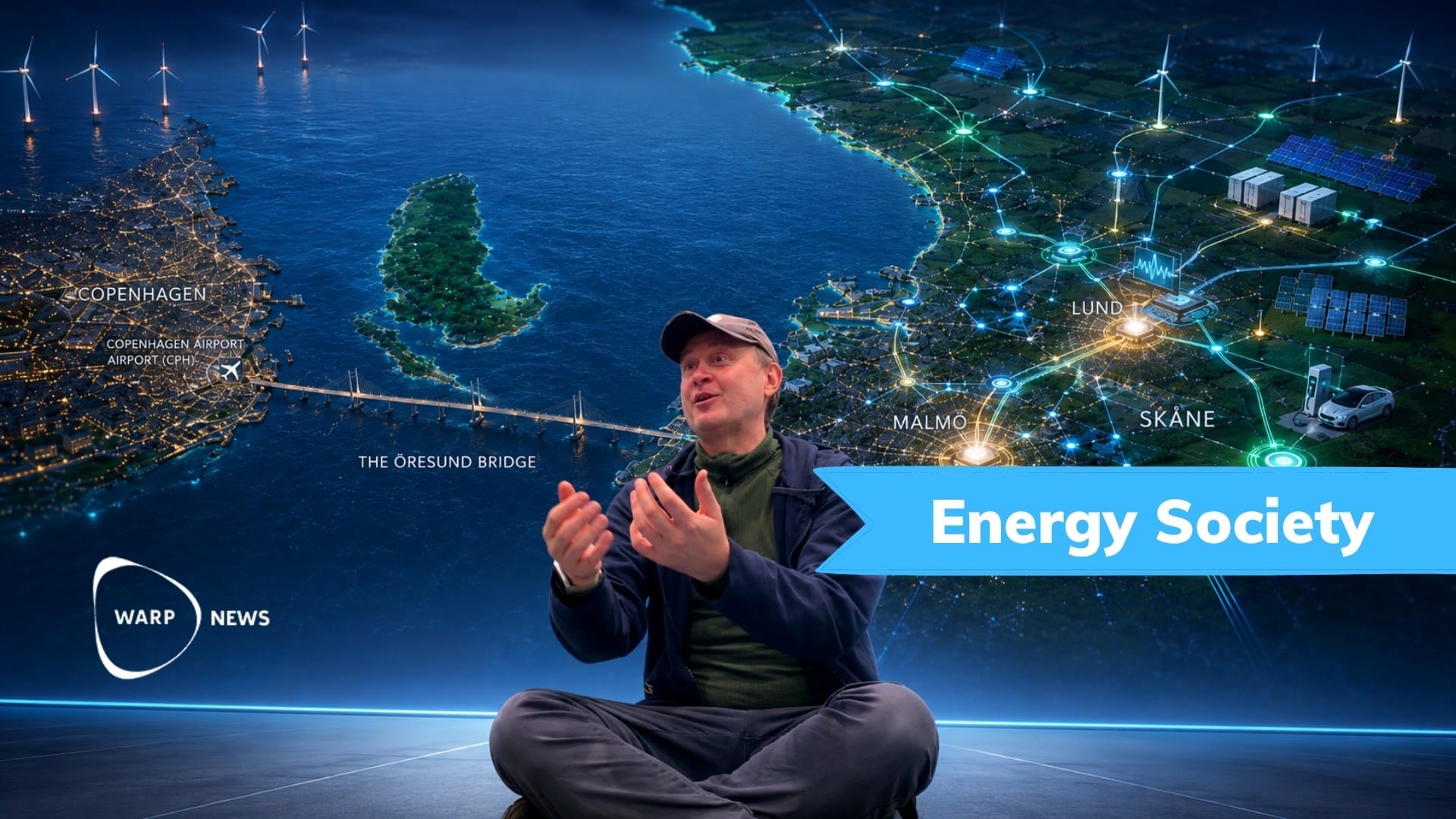
It's an ordinary Thursday in an ordinary conference room. But something unique is taking shape there. With the help of a power few people know about, but one that helps you better understand the future.
💡 Fact-based optimistic news of the week
🚰 The share of polluted drinking water in the US has been cut in half
The share of readings in American drinking water that exceeded health limits fell by half between 2003 and 2019. A new study has mapped 266 million readings of 1,250 different pollutants and shows how investments in water systems lower pollution levels.
🤖 Amazon's new warehouse robot understands plain language
Employees can give the robot instructions the same way they would talk to a colleague. The robot is part of a €10 billion investment to expand Amazon's operations in Europe, a move expected to create 25,000 new jobs.
🔊 Midjourney is building a body scanner that maps the entire body in 60 seconds
A full-body scan with today's MRI takes 60 to 90 minutes. Midjourney's new machine aims to do the same thing in under 60 seconds. The scanner uses a ring of half a million tiny elements that send ultrasound through the body from every direction. The result is a 3D map of the body.
📉 Data centers have lowered Americans' electricity bills
Data centers have lowered Americans' electricity bills. A study shows average prices fell between 2015 and 2024. The reason is that the power system's large fixed costs are spread across more kilowatt-hours when demand rises.
🎗️ No young women died of cervical cancer in England over the past five years
A cross all age groups HPV vaccination is linked to around 200 fewer cervical cancer deaths in England. Among vaccinated women aged 20 to 29, the risk of dying from cervical cancer is estimated to have fallen by at least 81 percent.
🤧 Discovery could lead to drugs against the common cold
Researchers have for the first time determined the structure of the protein 2C as it binds to RNA. The protein is found in rhinovirus, the most common cause of the common cold. The new structure gives researchers more to work from when they design drugs that can inhibit the virus.
✉️ Get a dose of fact-based, free, optimism once a week
Every week, we send out a free newsletter with fact-based, optimistic news about technology, science, and human progress.
If you're not a subscriber yet, you are welcome to become one!
If you like this newsletter, please forward it to a friend and ask them to subscribe. It's free and arrives once a week.
🎤 Talk on AI
Let me help your organization level up on AI.
Read more at mathiassundin.org.
By becoming a premium supporter, you help in the creation and sharing of fact-based optimistic news all over the world.