
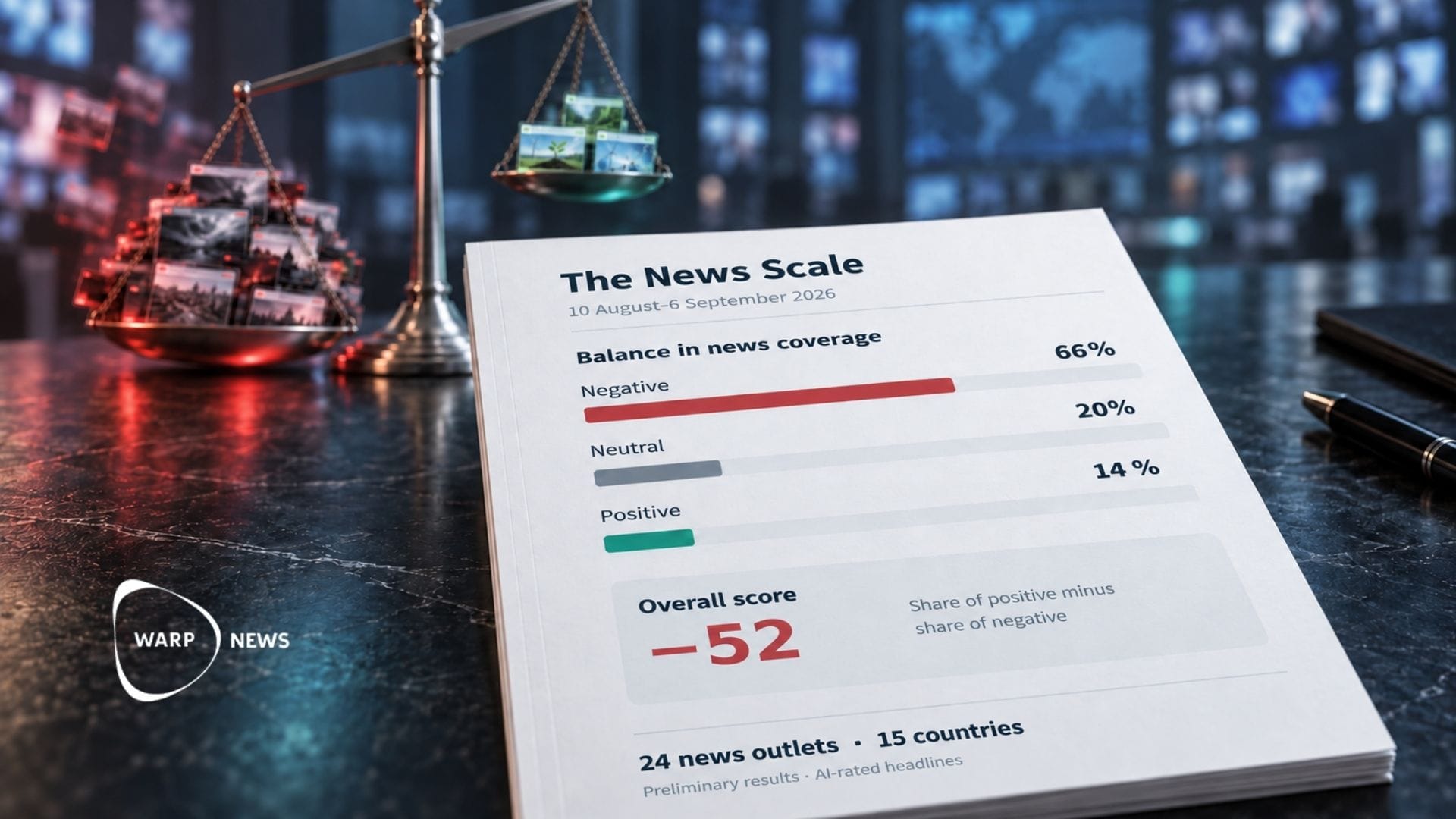
⚖️ This is what the News Scale says about the (im)balance in news media
8,500 headlines and leads from 24 news outlets in 15 countries have been assessed on how positive, negative or neutral they are.

Share this story!
Last week I presented the beta version of The News Scale. The scale that weighs the balance in news media. It has now been running for almost a month and has assessed some 8,500 headlines and leads.
I have made an analysis of what we can see so far, taken together. Note that the News Scale is under development, that the measurement period is barely a month, and that the results should be treated accordingly.
Even so, quite a lot of interesting things emerge.
The overall picture
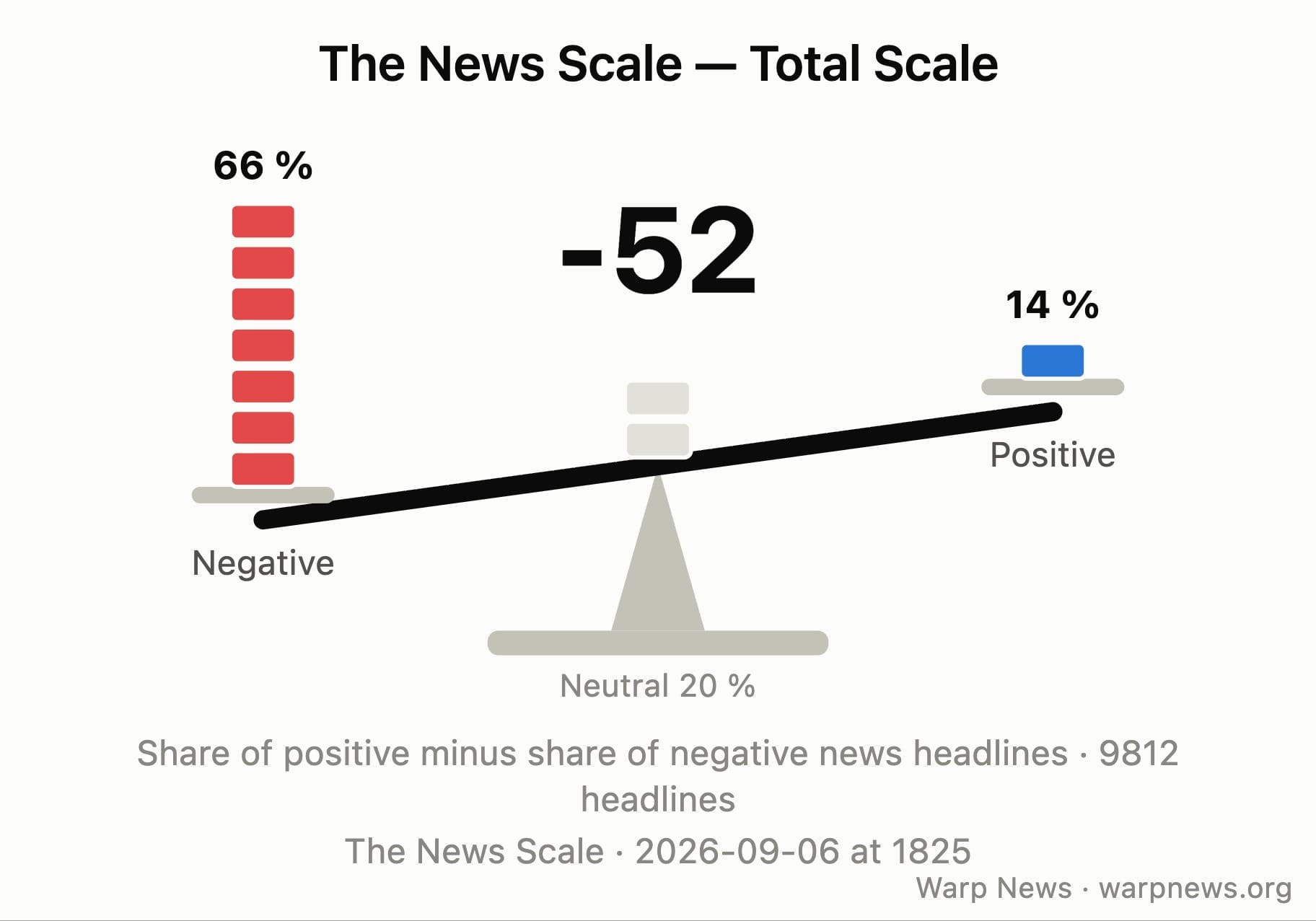
Two out of three news headlines are negative. Of all the headlines the 24 news outlets published over four weeks, 66 percent were assessed as negative, 20 percent as neutral and 14 percent as positive.
The overall reading, the share of positive minus the share of negative, came in at −52 on the scale from −100 to +100.
Very negative is common, very positive is rare. On the five-point scale, 23 percent of the headlines got the lowest rating, very negative, but only 1.7 percent got the highest, very positive.
The negativity is stable, and the weekend brings no relief. Across the 27 days of measurement the overall reading stayed between −38 and −59 every single day. Weekend days averaged −51 and weekdays −51, and the first half of the period barely differed from the second.
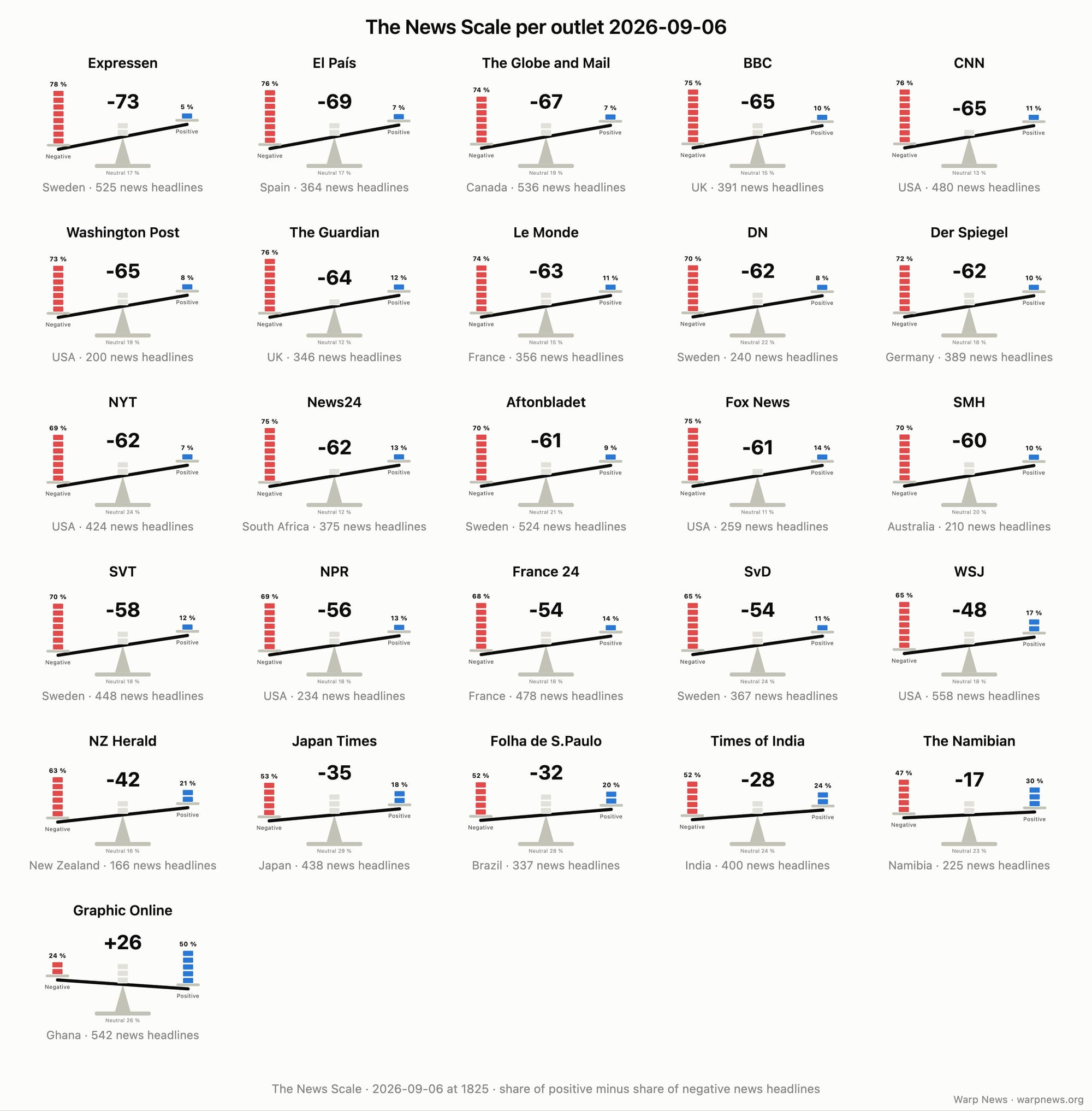
Swedish newspaper Expressen is the most negative news outlet in the measurement, at −73: 78 percent of its headlines are negative and 5 percent positive.
Graphic Online is the only news outlet where positive headlines outnumber negative ones, 50 percent against 24.
The lower the level of development, the less negative the news reading. The four least negative countries in the measurement — Ghana +26, Namibia −17, India −28 and Brazil −32 — are four of the five countries that rank lowest on the UN development index.
News selection and tone
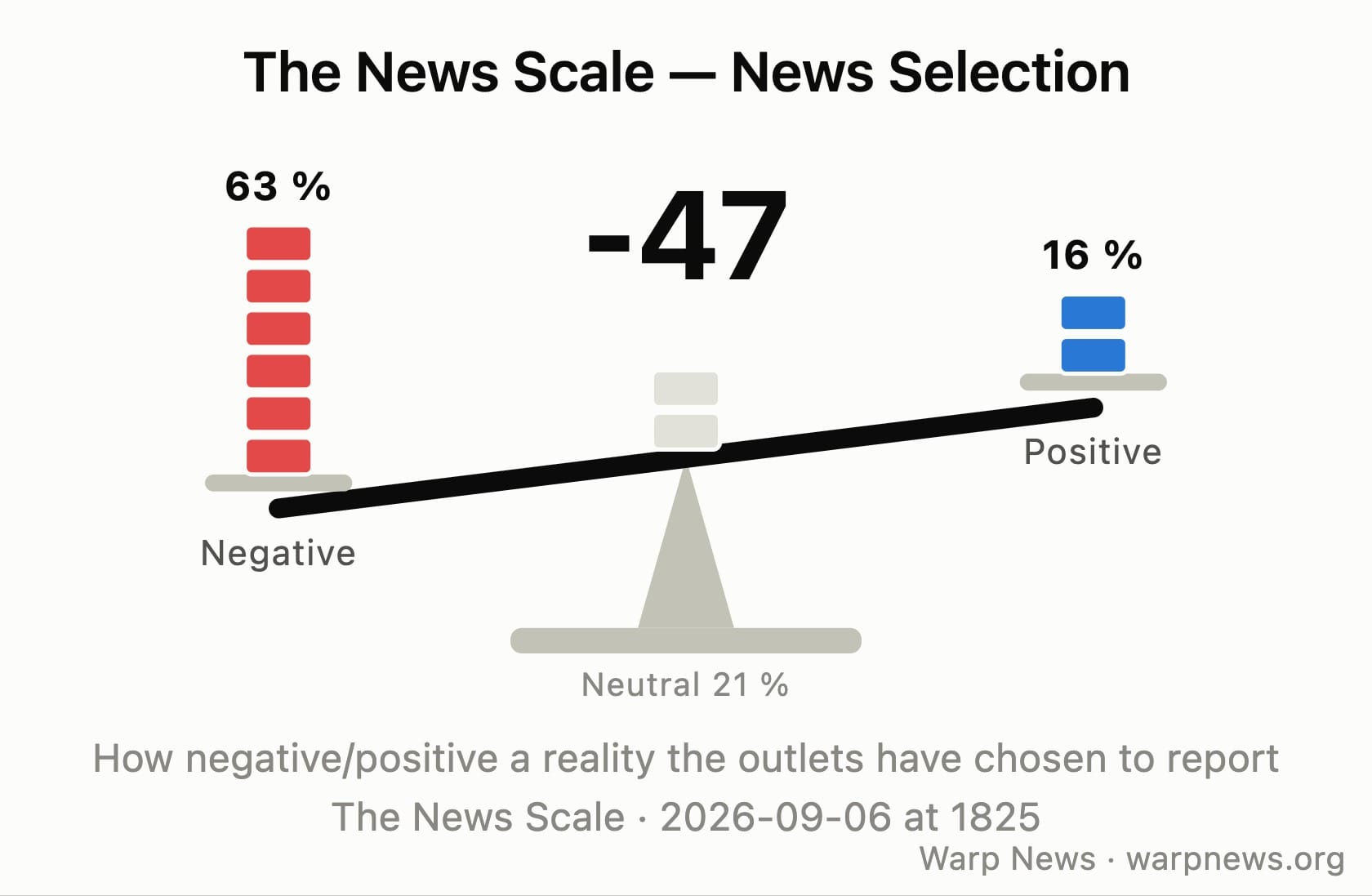
The news is negative above all because news outlets pick negative events, not because they exaggerate them. If you measure only which events the news outlets chose to report, news selection lands at −47.
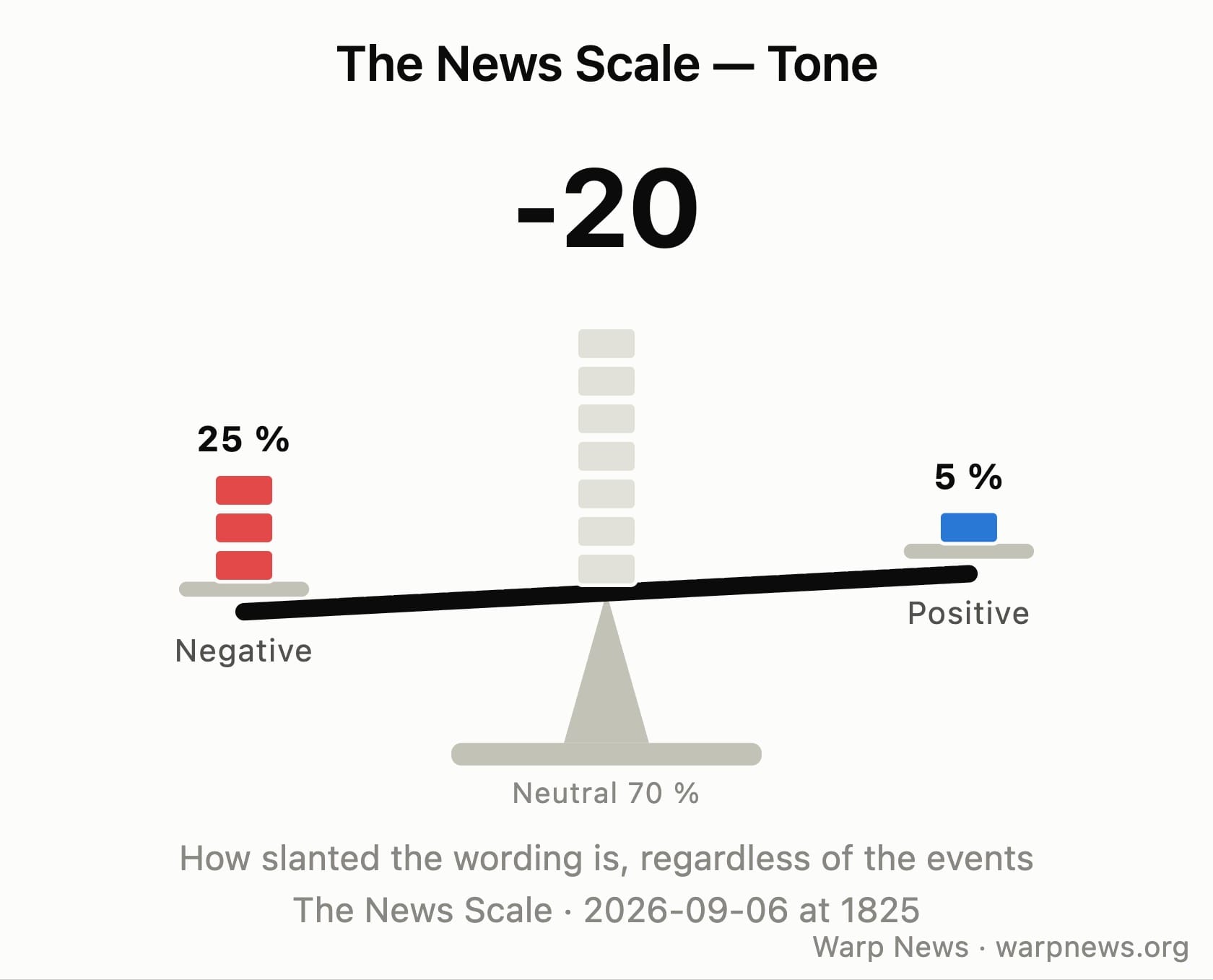
The tone itself has a net balance of −20. Only 6 percent involves neutral or positive events made negative through the wording.
No news outlet has a tone more negative than its news selection — but Fox News comes close. Of the 23 news outlets with a negative news selection, none has a tone more negative than the selection. Closest is Fox News, where the wording almost weighs as heavily as the selection: news selection is at −48 and tone at −42.
Fox News reaches the same negativity as the New York Times and the Washington Post — but through the words. Fox News has the mildest news selection of the American outlets, −48 against −59 for the New York Times and −58 for the Washington Post, but the most negative tone of all 24 news outlets: every other Fox News headline, 51 percent, has a negative tone, and 31 percent of the events that are not negative are still given a negative angle. The New York Times is at 34 and 15 percent respectively, the Washington Post at 21 and 11.
The mirror image of Fox News is The Globe and Mail and Le Monde: darkest selection, most matter-of-fact tone. The Canadian paper has one of the three darkest news selections of all, −63, but a negative tone in only 14 percent of its headlines and a negative angle on only 5 percent of the neutral or positive news. Le Monde follows the same pattern with a news selection of −58, a negative tone in 17 percent and 5 percent angled neutral news. Despite the matter-of-fact tone, both are among the most negative news outlets in the measurement, at −67 and −63 respectively.
Public service picks almost equally dark events, but writes more soberly. The public service outlets' news selection averages −54 and the commercial ones' −58, but the tone is −16 against −27.
Which news is negative, neutral and positive
Politics, crime, accidents and war fill almost two thirds of the news feed. Domestic politics is the biggest topic with 19 percent of the headlines, followed by crime and justice at 18 percent and accidents and disasters at 11 percent. Add war and conflict plus foreign policy and the five topics account for 63 percent of all headlines. Science and technology makes up 4 percent of the feed and infrastructure and development 2 percent.
Science and technology is the only topic where positive headlines clearly outnumber negative ones: 55 percent positive and 20 percent negative, +35 on the scale — but the topic is only 4 percent of the feed. The negative science headlines are strikingly often about AI: about four in ten of them mention AI, such as SvD's "Now AI can create dangerous viruses".
The positive headlines are about the economy, science and society. Among the positive headlines, business and the economy is the biggest topic at 19 percent, followed by science and technology at 15 percent and society and social issues at 13 percent.
Is there any progress in the feed?
One percent of the news feed is progress. Of the 8,451 different news headlines, 85 concerned a documented advance. For example a scientific finding, a medical advance, clean energy, reduced disease or poverty, a conservation success or a measurable improvement in society.
Progress is also a small part of the positive news. Only 14 percent of the headlines are positive, and of those 7 percent are progress: 85 out of 1,200. In other words, 93 percent of the positive news feed is something other than documented progress — economic upturns, campaign promises, political decisions, curiosities.
Progress is found in three small topics — the big topics have almost none. 67 of the 85 progress stories belong to climate, environment and energy; science and technology; and health and medicine, topics that together make up 12 percent of the feed. Domestic politics, crime, accidents, the economy, war and foreign policy account for 72 percent of the feed and contain a single progress story, the New York Times on Baltimore's record low murder rate. Conservation is the most common progress category, such as The Guardian's "The return of the caspian tiger: how a species feared extinct has come back to Kazakhstan". Climate, environment and energy is at the same time one of the most negative topics, with 57 percent negative headlines, and one of the most dramatised, with 30 percent negative tone — but also the topic where progress is densest: 8 percent of the headlines.
Two events accounted for 15 of the 85 headlines. Lebanon abolishing the death penalty produced eight headlines in six news outlets and the launch of the Nancy Grace Roman space telescope produced seven headlines in seven news outlets.
Counted in distinct events, the 24 news outlets together reported around 70 advances in four weeks — on average two or three a day, in the whole world, across 24 news outlets.
Caveats
A single measurement period of four weeks. A longer series is needed to say anything about season or trend.
The assessments are made by AI. The consistency — 84 percent fully identical ratings across three independent rounds for the overall assessment, 82 percent for news selection and tone — measures how consistent the model is, not how well it agrees with humans. That comparison is now being made with the help of readers' own assessments. Tone is the axis where the assessment depends most on interpretation. You can help improve our assessment by rating five headlines. See the link at the top of the page.
Generative AI has been shown in a research study to be better than humans at assessing headlines. Fabrizio Gilardi and colleagues showed in PNAS (2023) that it outperforms hired human raters by an average of 25 percentage points in accuracy, and with higher consistency than both amateurs and trained annotators. Gilardi, Alizadeh & Kubli (2023): "ChatGPT outperforms crowd workers for text-annotation tasks"
Outside Sweden, the United States, the United Kingdom and France, each country is represented by a single news outlet, so country figures are in practice newspaper figures. The correlation with the development index is based on 15 countries and is illustrative, not statistically established.
The RSS feeds do not necessarily reflect a full publication output and are of different sizes: Expressen and Graphic Online deliver around 20 headlines a day, DN 9, The Namibian 9, the Washington Post 8 and the NZ Herald 6. Small feeds give less certain figures.
The definition of progress is strict and the figure of 1 percent is a lower bound.
How the figures were produced
Material: headline and lead collected once every 24 hours via RSS from 24 news outlets in 15 countries. Only news journalism is included — opinion, sport, culture, entertainment and lifestyle are filtered out in advance. 8,774 assessed headlines and 8,451 different headlines; the same headline can appear on several days.
Period: 28 measurements from 10 August to 6 September 2026, 27 calendar days.
Assessment: each headline is assessed blind — with no information about the news outlet — by AI in three independent rounds on a scale from −2 to +2 along three axes: overall impression, the charge of the event, and the charge of the wording in relation to the subject. The rating is the average; negative at −0.5 or lower, positive at +0.5 or higher. The main measure is the net balance, share of positive minus share of negative, on the scale from −100 to +100.
Exclusions: the Wall Street Journal and CNN have been removed because their RSS feeds turned out to be dead and delivered the same roughly 20 old headlines every day. Without them the overall reading is unchanged: −52 both with and without.
Topic classification and progress flags: made by AI, blind and independently of the ratings, with exactly one of twelve topics per headline. 121 headlines were initially flagged as progress; each was then reviewed by three independent AI reviewers tasked with trying to refute the flag, and 36 were struck when at least two of three rejected them. When 240 headlines were reclassified from scratch in a second independent round, the topic was the same in 98 percent of cases.
Development indicators: the UN Human Development Report 2025 and the IMF World Economic Outlook April 2026.
News media: Sweden (DN, SvD, Aftonbladet, Expressen, SVT), the United States (New York Times, Washington Post, Fox News, NPR), Europe (BBC, The Guardian, Le Monde, France 24, Der Spiegel, El País), other democracies (SMH, Japan Times, Times of India, The Globe and Mail, NZ Herald, Folha de S.Paulo) and Africa (News24, Graphic Online, The Namibian).
Mathias Sundin
Angry Optimist
By becoming a premium supporter, you help in the creation and sharing of fact-based optimistic news all over the world.