
💡 Warp News #335
🌳 Amazon deforestation lowest in 13 years. 🌏 Global greenhouse gas emissions have almost stopped growing. 🚗 Electric car sales rise again and set records in 50 countries.

Share this story!
Free newsletter with fact-based optimistic news about technology, science, and human progress with the angry optimist, Mathias Sundin. If you are not a subscriber, become one here.
⚖️ This is how unbalanced the news media is
Last week I presented the beta version of The News Scale, which assesses whether a headline and lead paragraph is positive, neutral or negative.
It has now been running for almost a month and has assessed around 8,500 news items, from 24 news outlets in 15 countries. Even though the results are highly preliminary, there is indeed a lot that is interesting to read from them.
The imbalance is large. 66 percent are negative, 20 percent neutral and 14 percent positive.
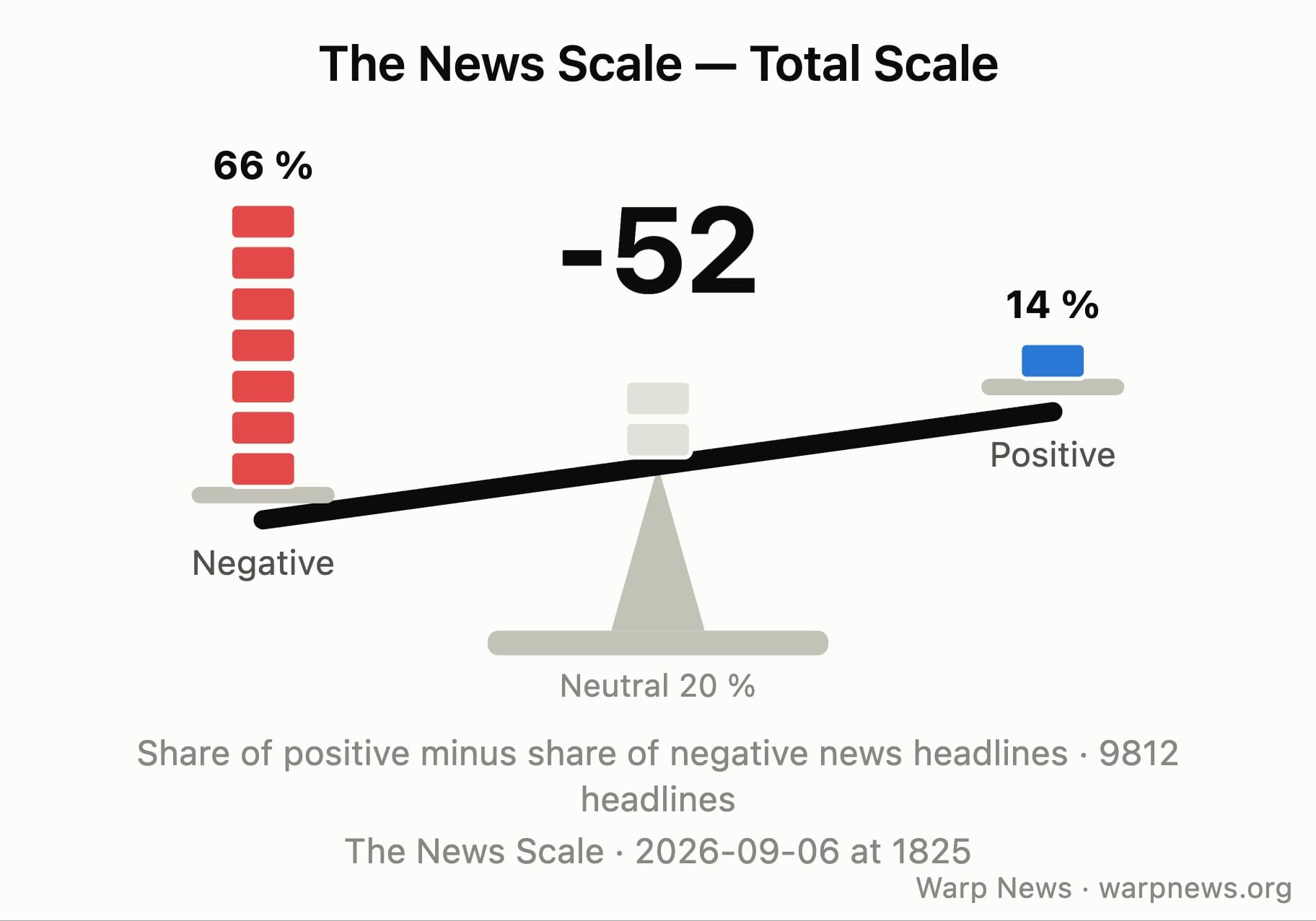
Not particularly surprising, but one observation is that the negative balance is constant. Every single measurement day, weekday or holiday, no matter what happens, there are four to five times as many negative news items as positive ones.
Every headline and lead paragraph is rated on a scale from -2 (very negative) to +2 (very positive). On the five-point scale, 23 percent of the headlines were rated very negative, but only 1.7 percent very positive.
Of the 8,451 different news headlines, only 85 were about progress. For example a scientific advance, reduced poverty or a measurable improvement in society. Progress made up one percent of the news.
There are a lot more interesting results. I have written an article about it: ⚖️ This is what the News Scale says about the (im)balance in news media
There you will see, among other things, which of these 24 news outlets is the most negative and the most positive.
Mathias Sundin
The Angry Optimist
⚖️ This is what the News Scale says about the (im)balance in news media
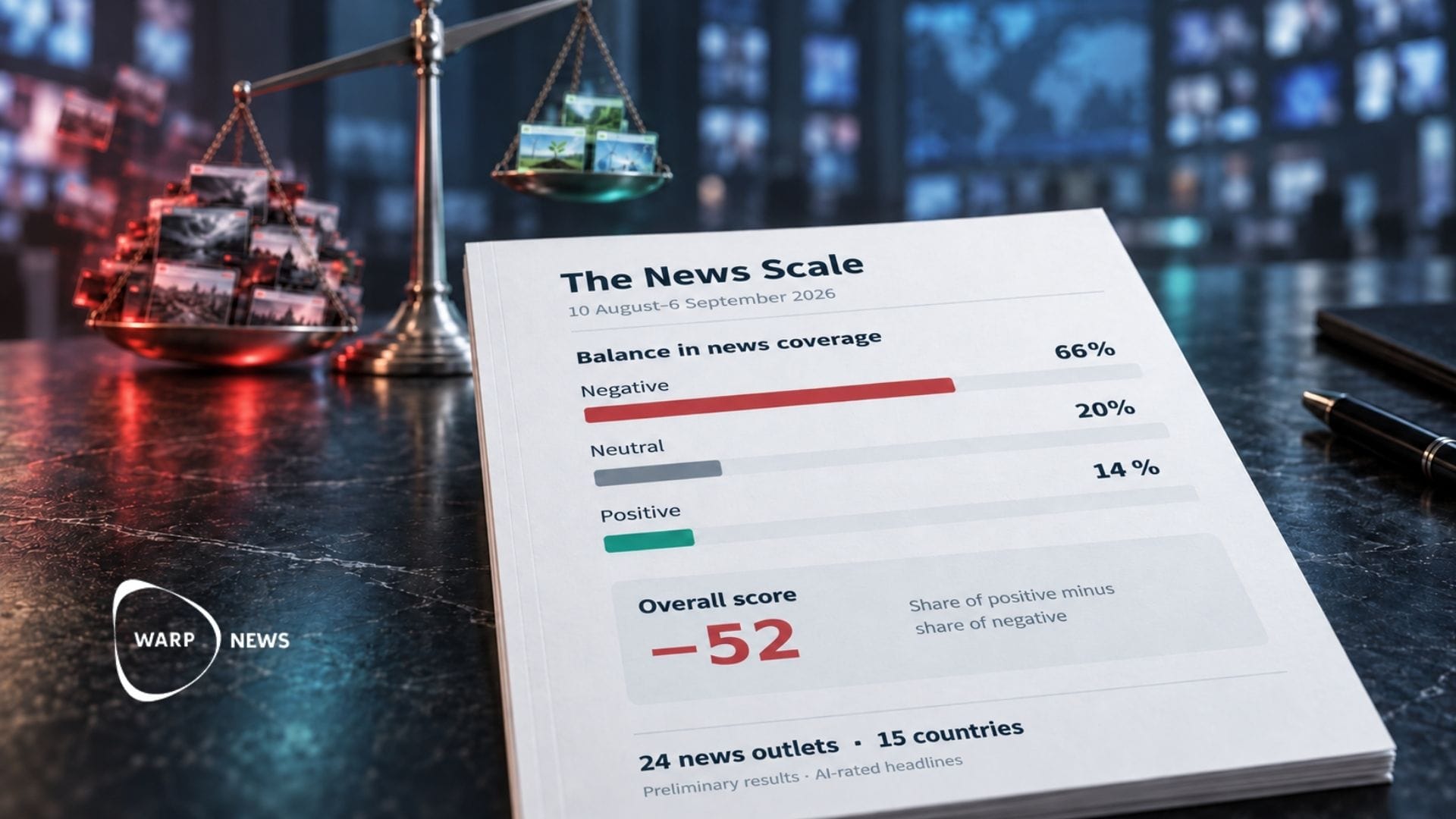
8,500 headlines and leads from 24 news outlets in 15 countries have been assessed on how positive, negative or neutral they are.
💡 Fact-based optimistic news of the week
🌏 Global greenhouse gas emissions have almost stopped growing
Emissions rose 0.2 percent compared with the first half of 2025. Between 2015 and 2023, they grew by an average of 1.1 percent per year. China and the United States, the world's two largest emitters, saw their emissions fall by 0.3 and 0.4 percent respectively.
🚗 Electric car sales rise again and set records in 50 countries
Electric car sales rose 4 percent in the second quarter of 2026 compared with the same quarter last year, while total global car sales fell by around 5 percent in the first half of the year.
🌳 Amazon deforestation lowest in 13 years
Deforestation fell 36 percent from the previous year and was 55.6 percent below the average of the past ten years. That is according to new satellite data from Brazil's National Institute for Space Research, INPE. The decline has continued since 2023.
🥵 Texas handled record electricity demand in the heat thanks to solar and batteries
High temperatures pushed electricity demand in Texas to record levels in late July. The old record was broken two days in a row. Still they did not need to ask residents to conserve electricity. Such calls have otherwise been common during the hottest months in recent years.
💸 Africa's own payment system reaches 28 countries: transfers in seconds instead of days and billions in saved fees
Payments between African countries have previously taken days and gone through US dollars and banks in New York. With PAPSS, the money moves in seconds, in local currencies. The detour via the dollar is estimated to cost around 5 billion dollars a year in avoidable exchange fees.
📉 Emissions from deforestation and land use have fallen 32 percent since the 2000s
Until 1999, emissions held steady at around 6.6 billion tonnes of carbon dioxide per year. Between 2015 and 2024 they averaged 5 billion tonnes, and in 2025 they fell to 4.1 billion tonnes. The main reasons are that permanent deforestation has decreased and that new forest absorbs carbon dioxide.
✉️ Get a dose of fact-based, free, optimism once a week
Every week, we send out a free newsletter with fact-based, optimistic news about technology, science, and human progress.
If you're not a subscriber yet, you are welcome to become one!
If you like this newsletter, please forward it to a friend and ask them to subscribe. It's free and arrives once a week.
🎤 Talk on AI
Let me help your organization level up on AI.
Read more at mathiassundin.org.
By becoming a premium supporter, you help in the creation and sharing of fact-based optimistic news all over the world.