
💡 Warp News #321
🌳 Rainforest wildlife returns to abandoned farmland. 💉 New vaccine reduced Lyme disease cases by 70 percent. 📈 Access to basic commodities has increased by more than 500 percent since 1980.

Share this story!
Free newsletter with fact-based optimistic news about technology, science, and human progress with the angry optimist, Mathias Sundin. If you are not a subscriber, become one here.
🏗️ Less and less productive
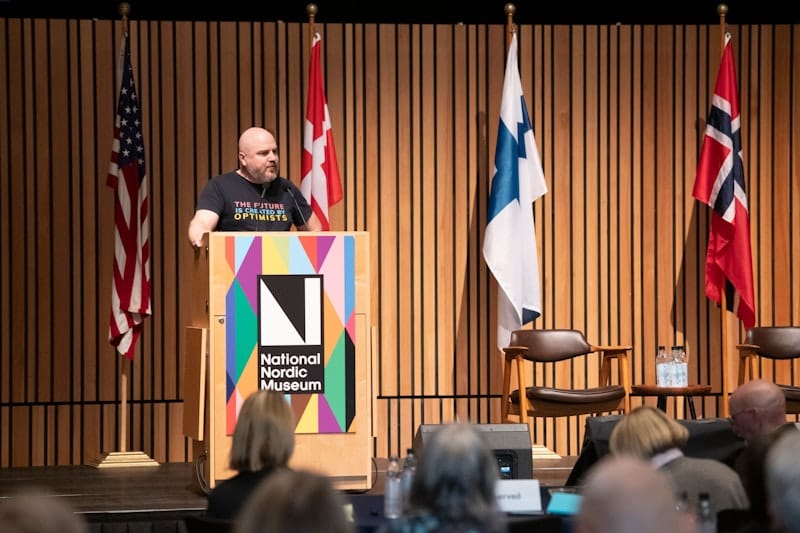
When I was in Seattle last year to give a talk on AI at the Nordic Museum, I met Jonas Jonsson.
He had a very Swedish name, but was clearly most comfortable speaking English. So I assumed his family had emigrated to the US, but when I asked where he lived, he answered Stockholm, Sweden.
I couldn’t quite make sense of it.
Back in Stockholm, he got in touch after reading my book and wanted to talk about AI. We did—but I also became interested in a problem he had set out to tackle.
Jonas works in real estate, and he told me that the construction industry has been becoming less productive for decades. Each year, you get slightly less built for the same amount of money.
Most other industries are moving in the opposite direction, becoming more efficient.
I’ve interviewed Jonas about this and visited one of his construction sites to understand how he plans to crack this problem—so we can get cheaper and better housing in less time.
It turns out he has a background that makes him particularly well suited for exactly that. And I also got to the bottom of the small mystery about his language.

Mathias Sundin
The Angry Optimist
💡 Premium Supporter content
Open and free for everyone, thanks to the support of our paying members, Premium Supporters.
🏗️ The tech builder set to solve the construction industry’s century-old problem

The construction industry has for a long time become less productive each year. We get less housing for the money. That is the problem that Jonas Jonsson and his company ByggVesta are now setting out to solve.
💡 Fact-based optimistic news of the week
💉 New vaccine reduced Lyme disease cases by 70 percent in clinical trial
Pharmaceutical companies Pfizer and Valneva report that their Lyme disease vaccine LB6V reduced the number of disease cases by around 70 percent compared with placebo. It would become the first approved Lyme disease vaccine for humans in nearly three decades.
🚧 The world's first geothermal plant with 10 to 100 times higher output per well is now being built
Project Obsidian will be the world's first geothermal power plant to extract energy from rock at 300 to 500 degrees Celsius. The millimeter wave drilling technique allows drilling to reach depths and temperatures that conventional drills cannot handle.
🗳️ Democracy strengthened or did not deteriorate in three quarters of the world's countries during 2025
Nearly three quarters of the world's countries received higher or unchanged scores in the 2025 democracy index. Latin America and the Caribbean broke a nine-year decline and improved their results. The global index rose by 0.02 points, one of the largest increases since 2012.
🌳 Rainforest wildlife returns to abandoned farmland within 30 years
A study from Ecuador shows that biodiversity in tropical rainforest recovers to more than 90 percent of its original level within three decades. Three-quarters of the animal and plant species typical of untouched primary forest return to abandoned agricultural land during the same period.
📈 Simon Abundance Index 2026: Access to basic commodities has increased by more than 500 percent since 1980
The Simon Abundance Index (SAI) measures the relationship between population and resource abundance. It rose from 100 in 1980 to 636.4 in 2025, an increase of 536.4 percent. While the world's population grew by 85 percent, personal resource abundance increased by 244 percent.
🧫 Bacteria swim using a tiny electric motor that spins several hundred times per second
Researchers have now mapped every part of the flagellar motor that bacteria use to swim, after more than 50 years of research. The motor spins several hundred revolutions per second and is powered by protons streaming into the cell at more than 2,000 per second.
✉️ Get a dose of fact-based, free, optimism once a week
Every week, we send out a free newsletter with fact-based, optimistic news about technology, science, and human progress.
If you're not a subscriber yet, you are welcome to become one!
If you like this newsletter, please forward it to a friend and ask them to subscribe. It's free and arrives once a week.
🎤 Talk on AI
Let me help your organization level up on AI.
Read more at mathiassundin.org.
By becoming a premium supporter, you help in the creation and sharing of fact-based optimistic news all over the world.